Tiny oxygen generators boost effectiveness of anticancer treatment
August 31, 2011 in Cancer
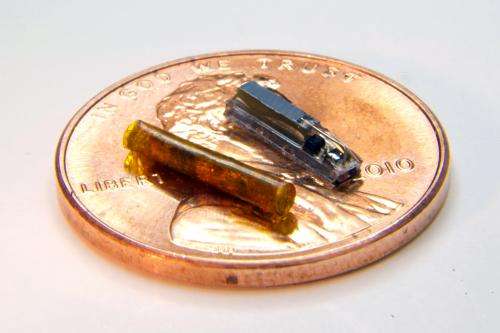
Researchers have created and tested a miniature device, seen here, that can be implanted in tumors to generate oxygen, boosting the killing power of radiation and chemotherapy. The technology is designed to treat solid tumors that are hypoxic at the center, meaning the core contains low oxygen levels. The device (right) fits inside a tube (left) that can then be inserted into a tumor with a biopsy needle. (Birck Nanotechnology Center, Purdue University)
(Medical Xpress) -- Researchers have created and tested miniature devices that are implanted in tumors to generate oxygen, boosting the killing power of radiation and chemotherapy.
The technology is designed to treat solid tumors that are hypoxic at the center, meaning the core contains low oxygen levels.
"This is not good because radiation therapy needs oxygen to be effective," said Babak Ziaie, a Purdue University professor of electrical and computer engineering and biomedical engineering. "So the hypoxic areas are hard to kill. Pancreatic and cervical cancers are notoriously hypoxic. If you generate oxygen you can increase the effectiveness of radiation therapy and also chemotherapy."
The new "implantable micro oxygen generator" is an electronic device that receives ultrasound signals and uses the energy to generate a small voltage to separate oxygen and hydrogen from water a chemical operation called water electrolysis.
"We are putting these devices inside tumors and then exposing the tumors to ultrasound," Ziaie said. "The ultrasound energy powers the device, generating oxygen.
The devices were created at the Birck Nanotechnology Center in the university's Discovery Park. Purdue researchers are working with Song-Chu (Arthur) Ko, an assistant professor of clinical radiation oncology at the Indiana University School of Medicine.
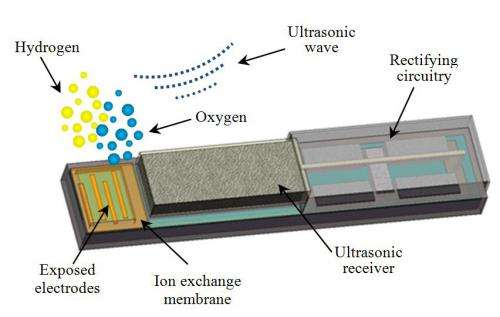
This diagram shows the design of a miniature device that can be implanted in tumors to generate oxygen, boosting the killing power of radiation and chemotherapy. (Birck Nanotechnology Center, Purdue University)
Researchers have tested the devices in pancreatic tumors implanted in mice, showing they generated oxygen and shrunk tumors faster than tumors without the devices. The devices are slightly less than one centimeter long and are inserted into tumors with a hypodermic biopsy needle."Most of us have been touched by cancer in one way or another," Ziaie said. "My father is a cancer survivor, and he went through many rounds of very painful chemotherapy. This is a new technology that has the potential to improve the effectiveness of such therapy."
Findings are detailed in a research paper appearing online this month in Transactions on Biomedical Engineering. The paper was written by research assistant professor Teimour Maleki, doctoral students Ning Cao and Seung Hyun Song, Ko and Ziaie.
"The implantable mini oxygen generator project is one of 11 projects the Alfred Mann Institute for Biomedical Development at Purdue University (AMIPurdue) has sponsored," Ziaie said. "AMIPurdue has been instrumental in providing the development funding of roughly $500,000 on this project. And beyond funding, the AMIPurdue team has also helped us with market research, physician feedback, industry input, as well as intellectual property and regulatory strategy. We have been able to accomplish a great deal in a short time due to the collaborative effort with AMIPurdue."
A patent application has been filed for the design.
Future work may focus on redesigning the device to make it more practical for manufacturing and clinical trials.
More information: An Ultrasonically-Powered Implantable Micro Oxygen Generator (IMOG), T. Maleki, N. Cao, S.H. Song, C. Kao, S.C. Ko, B. Ziaie
ABSTRACT
In this paper we present an ultrasonically-powered implantable micro oxygen generator (IMOG) that is capable of in situ tumor oxygenation through water electrolysis. Such active mode of oxygen generation is not affected by increased interstitial pressure or abnormal blood vessels that typically limit the systemic delivery of oxygen to hypoxic regions of solid tumors. Wireless ultrasonic powering (2.15 MHz) was employed to increase the penetration depth and eliminate the directional sensitivity associated with magnetic methods. In addition, ultrasonic powering allowed for further reduction in the total size of the implant by eliminating the need for a large area inductor. IMOG has an overall dimension of 1.2x1.3x8 mm^3, small enough to be implanted using a hypodermic needle or a trocar. In vitro and ex vivo experiments showed the IMOG is capable of generating more than 150 mA which in turn can create 0.525 ml/min of oxygen through electrolytic dissociation. In vivo experiments in a well-known hypoxic pancreatic tumor model (1 cm^3 in size) also verified adequate in situ tumor oxygenation in less than 10 minutes.
Provided by
Purdue University
-
Wireless cancer treatment device developed
Apr 18, 2006 |
not rated yet |
0
-
New stretchable electrodes created to study stresses on cardiac cells
Jan 22, 2009 |
not rated yet |
0
-
Lactic acid found to fuel tumors
Nov 20, 2008 |
not rated yet |
0
-
Light Reveals Breast Tumor Oxygen Status
Apr 01, 2009 |
not rated yet |
0
-
Why some prostate cancer returns
May 27, 2009 |
not rated yet |
0
-
Of mice and mental models: Neuroscientific implications of risk-optimized behavior in the mouse
17 hours ago |
not rated yet |
0
-
Limits to growth: Scientists identify key metastasis-enabling enzyme
May 22, 2012 |
5 / 5 (4) |
0
-
Seeing is as seeing does: Spatially-structured retinal input in early development of cortical maps
Apr 26, 2012 |
5 / 5 (4) |
1
-
Dreamless nights: Brain activity during nonrapid eye movement sleep
Apr 09, 2012 |
4.4 / 5 (12) |
0
-
Take your time: Neurobiology sheds light on the superiority of spaced vs. massed learning
Mar 28, 2012 |
4.5 / 5 (21) |
3
-
A question about drug tolerance
May 23, 2012
-
Poor nutrition leading to overeating?
May 23, 2012
-
Math and dyslexia?
May 21, 2012
-
portable metabolism meter?
May 21, 2012
-
Rare medical conditions on 20/20 tonight
May 18, 2012
-
"Good" Cholesterol in Doubt
May 17, 2012
- More from Physics Forums - Medical Sciences
More news stories
Skp2 activates cancer-promoting, glucose-processing Akt
HER2 and its epidermal growth factor receptor cousins mobilize a specialized protein to activate a major player in cancer development and sugar metabolism, scientists report in the May 25 issue of Cell.
Cancer
11 hours ago |
not rated yet |
0
|
Pancreatectomy OK without downstaging from therapy
(HealthDay) -- Pancreatectomy improves median survival in pancreatic cancer patients even when presurgical neoadjuvant therapy does not lead to radiographic downstaging of tumors, according to a study published ...
Cancer
12 hours ago |
not rated yet |
0
Common therapies for basal cell carcinoma offer similar survival
(HealthDay) -- For patients with superficial basal cell carcinoma (sBCC), treatment with imiquimod or photodynamic therapy (PDT) results in similar long-term tumor-free survival, according to a review published ...
Cancer
12 hours ago |
not rated yet |
0
Cancer may require simpler genetic mutations than previously thought
Chromosomal deletions in DNA often involve just one of two gene copies inherited from either parent. But scientists haven't known how a deletion in one gene from one parent, called a "hemizygous" deletion, can contribute ...
Cancer
14 hours ago |
not rated yet |
0
|
New prostate cancer screening guidelines face a tough sell, study suggests
(Medical Xpress) -- Recent recommendations from the U.S. Preventive Services Task Force (USPSTF) advising elimination of routine prostate-specific antigen (PSA) screening for prostate cancer in healthy men are likely to encounter ...
Cancer
17 hours ago |
not rated yet |
1
Of mice and mental models: Neuroscientific implications of risk-optimized behavior in the mouse
(Medical Xpress) -- Regardless of an organism’s biological complexity, every encephalized animal continuously makes under-informed behavioral choices that can have serious consequences. Despite its ubiquity, ...
Tongue analysis software uses ancient Chinese medicine to warn of disease
For 5,000 years, the Chinese have used a system of medicine based on the flow and balance of positive and negative energies in the body. In this system, the appearance of the tongue is one of the measures used to classify ...
Inherited DNA change explains overactive leukemia gene
A small inherited change in DNA is largely responsible for overactivating a gene linked to poor treatment response in people with acute leukemia.
Early physical therapist treatment associated with reduced risk of healthcare utilization and reduced overall healthcare
A new study published in Spine shows that early treatment by a physical therapist for low back pain (LBP), as compared to delayed treatment, was associated with reduced risk of subsequent healthcare utilization and lower ...
New device allows pacemaker patients to safely undergo MRIs
For many, it's a medical conundrum: The very pacemaker keeping their heart in rhythm prevents them from undergoing an MRI to diagnose other ailments, because interaction between the two devices could prove deadly.
First study to suggest that the immune system may protect against Alzheimer's changes in humans
Recent work in mice suggested that the immune system is involved in removing beta-amyloid, the main Alzheimer's-causing substance in the brain. Researchers have now shown for the first time that this may apply in humans.

Aug 31, 2011
Rank: not rated yet
Aug 31, 2011
Rank: not rated yet