Serotonin levels affect the brain's response to anger
September 15, 2011 in Psychology & Psychiatry

Serotonin levels affect the brain's response to anger

Enlarge

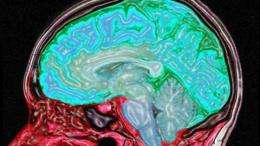
Research provides new insight into why some individuals may be more aggressive than others.

Fluctuations of serotonin levels in the , which often occur when someone hasn’t eaten or is stressed, affects that enable people to regulate anger, new research from the University of Cambridge has shown.

Although reduced serotonin levels have previously been implicated in aggression, this is the first study which has shown how this chemical helps regulate behaviour in the brain as well as why some individuals may be more prone to aggression.  The research findings were published today, 15 September, in the journal Biological Psychiatry.

For the study, healthy volunteers’ serotonin levels were altered by manipulating their diet.  On the serotonin depletion day, they were given a mixture of amino acids that lacked tryptophan, the building block for serotonin. On the placebo day, they were given the same mixture but with a normal amount of tryptophan.

The researchers then scanned the volunteers’ brains using functional magnetic resonance imaging (fMRI) as they viewed faces with angry, sad, and neutral expressions. Using the fMRI, they were able to measure how different brain regions reacted and communicated with one another when the volunteers viewed angry faces, as opposed to sad or neutral faces.

The research revealed that low brain serotonin made communications between specific brain regions of the emotional limbic system of the brain (a structure called the amygdala) and the frontal lobes weaker compared to those present under normal levels of serotonin. The findings suggest that when are low, it may be more difficult for the prefrontal cortex to control emotional responses to anger that are generated within the amygdala.

Using a personality questionnaire, they also determined which individuals have a natural tendency to behave aggressively. In these individuals, the communications between the amygdala and the prefrontal cortex was even weaker following serotonin depletion.  ‘Weak’ communications means that it is more difficult for the prefrontal cortex to control the feelings of anger that are generated within the amygdala when the levels of serotonin are low.  As a result, those individuals who might be predisposed to aggression were the most sensitive to changes in serotonin depletion.

Dr Molly Crockett, co-first author who worked on the research while a PhD student at Cambridge’s Behavioural and Clinical Neuroscience Institute (and currently based at the University of Zurich) said: “We’ve known for decades that serotonin plays a key role in aggression, but it’s only very recently that we’ve had the technology to look into the brain and examine just how serotonin helps us regulate our emotional impulses. By combining a long tradition in behavioral research with new technology, we were finally able to uncover a mechanism for how might influence aggression.”

Dr Luca Passamonti, co-first author who worked on the research while a visiting scientist at the Medical Research Council Cognition and Brain Sciences Unit in Cambridge (and currently based at the Consiglio Nazionale delle Ricerche (CNR), Unità di Ricerca Neuroimmagini, Catanzaro), said: “Although these results came from healthy volunteers, they are also relevant for a broad range of psychiatric disorders in which violence is a common problem. For example, these results may help to explain the brain mechanisms of a psychiatric disorder known as intermittent explosive disorder (IED). Individuals with IED typically show intense, extreme and uncontrollable outbursts of violence which may be triggered by cues of provocation such as a facial expression of anger.

“We are hopeful that our research will lead to improved diagnostics as well as better treatments for this and other conditions.”

Provided by University of Cambridge search and more info website

5 /5 (4 votes)  

Filter


Move the slider to adjust rank threshold, so that you can hide some of the comments.


Display comments: newest first

hush1
Sep 15, 2011

Rank: not rated yet
Rare indeed is a person's ability to question one's self emotional state - before implementing that state.

We are indoctrinated with beliefs that emotions and feelings are honest.

The inadequate tools to examine at least non subliminal cognitive processes or associations are no defense against a sheer endless list of manipulative provocations.

The art of provocation exceeds cognitive association.
No amount of perfectly balanced chemistry, or even manipulative chemistry can prevent me from connecting you to an association where an emotion is set free. Free to reign.

Are you sure you want chemically controlled associative cognition? Making any target/subject easier prey?
Rank 5 /5 (4 votes)
Relevant PhysicsForums posts

More news stories

Storm chasers: born to be wild?

(HealthDay)—We've all seen them: the surfers who race to the beach when a hurricane hits, the guy who decides to ride out the storm in his overmatched boat, the tornado chasers who fearlessly steer their ...

Psychology & Psychiatry created 19 hours ago | popularity not rated yet | comments 0

Hormone levels may provide key to understanding psychological disorders in women

Women at a particular stage in their monthly menstrual cycle may be more vulnerable to some of the psychological side-effects associated with stressful experiences, according to a study from UCL.

Psychology & Psychiatry created 19 hours ago | popularity 3.7 / 5 (3) | comments 1 | with audio podcast

Are there atheists in foxholes? Study says they're the minority

Ernie Pyle – an iconic war correspondent in World War II – reportedly said "There are no atheists in foxholes." A new joint study between two brothers at Cornell and Virginia Wesleyan found that only ...

Psychology & Psychiatry created 22 hours ago | popularity 2.5 / 5 (4) | comments 2

Breathing exercises help veterans find peace after war, scholar says

(Medical Xpress)—Research by Stanford scholar Emma Seppala at the Center for Compassion and Altruism Research and Education found that post-traumatic stress disorder decreased in veterans who participated ...

Psychology & Psychiatry created 22 hours ago | popularity 5 / 5 (1) | comments 1

Depression raises diabetics' risk of severe low blood sugar episodes

(Medical Xpress)—Patients with diabetes who are depressed are much more likely to develop episodes of dangerously low blood sugars, or hypoglycemia, than are those who are not depressed, a new study has ...

Psychology & Psychiatry created 23 hours ago | popularity not rated yet | comments 0 | with audio podcast


Heart failure accelerates male 'menopause'

Heart failure accelerates the aging process and brings on early andropausal syndrome (AS), according to research presented today at the Heart Failure Congress 2013. AS, also referred to as male 'menopause', was four times ...

First drug to improve heart failure mortality in over a decade

Coenzyme Q10 decreases all cause mortality by half, according to the results of a multicentre randomised double blind trial presented today at Heart Failure 2013 congress. It is the first drug to improve heart failure mortality ...

Feds fight morning-after pill age ruling in NY

(AP)—Department of Justice lawyers have again asked a federal appeals court in New York to delay lifting age restrictions and prescription requirements on an emergency contraceptive popularly known as the morning-after ...

Death highest in heart failure patients admitted in January, on Friday, and overnight

Mortality and length of stay are highest in heart failure patients admitted in January, on Friday, and overnight, according to research presented today at the Heart Failure Congress 2013. The analysis of nearly 1 million ...

Engineered cytomegalovirus protects monkeys from HIV equivalent

(Medical Xpress)—A new study by researchers in the US has shown that an ancient virus can be modified to help in the fight against the simian immunodeficiency virus SIV, which is the equivalent in monkeys ...

Researchers identify first drug targets in childhood genetic tumor disorder

Two mutations central to the development of infantile myofibromatosis (IM)—a disorder characterized by multiple tumors involving the skin, bone, and soft tissue—may provide new therapeutic targets, according to researchers ...