Putting the body back into the mind of schizophrenia
October 31, 2011 in Psychology & Psychiatry
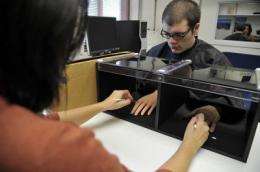
Research analyst Lindsey McIntosh demonstrates the procedure that elicits the rubber hand illusion on senior Michael Geoghegan. Credit: John Russell / Vanderbilt University
A study using a procedure called the rubber hand illusion has found striking new evidence that people experiencing schizophrenia have a weakened sense of body ownership and has produced the first case of a spontaneous, out-of-body experience in the laboratory.
These findings suggest that movement therapy, which trains people to be focused and centered on their own bodies, including some forms of yoga and dance, could be helpful for many of the 2.2 million people in the United States who suffer from this mental disorder.
The study, which appears in the Oct. 31 issue of the scientific journal PLoS One, measured the strength of body ownership of 24 schizophrenia patients and 21 matched control subjects by testing their susceptibility to the "rubber hand illusion" or RHI. This tactile illusion, which was discovered in 1998, is induced by simultaneously stroking a visible rubber hand and the subject's hidden hand.
"After a while, patients with schizophrenia begin to 'feel' the rubber hand and disown their own hand. They also experience their real hand as closer to the rubber hand." said Sohee Park, the Gertrude Conaway Vanderbilt Chair of Psychology and Psychiatry, who conducted the study with doctoral candidate Katharine Thakkar and research analysts Heathman Nichols and Lindsey McIntosh.
"Healthy people get this illusion too, but weakly," Park continued. "Some don't get it at all, and there is a wide range of individual differences in how people experience this illusion that is related to a personality trait called schizotypy, associated with psychosis‑proneness."
Body ownership is one of two aspects of a person's sense of self awareness. (The other aspect is self-agency, the sense that a person is initiating his or her own actions.) According to the researchers, the finding that schizophrenia patients are more susceptible to the rubber hand illusion suggests that they have a more flexible body representation and weakened sense of self compared to healthy people.
"What's so interesting about Professor Park's study is that they have found that the sense of bodily ownership does not diminish among patients with schizophrenia, but it can be extended to other objects more easily," observed David Gray, Mellon assistant professor of philosophy at Vanderbilt, who is an expert on the philosophy of the mind. He did not participate in the study but is familiar with it. "Much of the literature concerning agency and ownership in schizophrenia focuses on the sense of lost agency over one's own movements: But, in these cases, the sense of ownership is neither diminished nor extended."
Before they began the procedure, the researchers gave participants a questionnaire to rate their degree of schizotypy: the extent to which they experience perceptual effects related to the illusion. The researchers found that the individuals who rated higher on the scale were more susceptible to the illusion.
The researchers gauged the relative strength of the RHI by asking participants to estimate the position of the index finger of their hidden hand on rulers placed on top of the box that conceals it before and after stimulation. The stronger the effect, the more the subjects' estimate of the position of their hidden hand shifted in the direction of the rubber hand. Even the estimates of those who did not experience the effect subjectively shifted slightly.
The rubber hand illusion also has a physiological signature. Scientists don't know why, but the temperature of the hidden hand drops by a few tenths of a degree when a person experiences the illusion. "It's almost as if the hand is disowned and rejected, no longer part of the self," Park commented.
The researchers were surprised when one of the patients undergoing the procedure experienced a full out-of-body experience. He reported that he was floating above his own body for about 15 minutes. According to Park, it is extremely rare to observe spontaneous out-of-body experiences in the laboratory. When they invited the patient back for a second session, he once again had an out-of-body experience during the rubber hand procedure, proving that the experience is repeatable.
"Anomalous experiences of the self were considered to be core features of schizophrenia decades ago but in recent years much of the emphasis has been on cognitive functions such as working memory," said Park.
According to the psychologist, out-of-body experiences and body ownership are associated with a particular area in the brain called the temporoparietal junction. Lesions in this area and stimulation by strong magnetic fields can elicit out-of-body experiences. The new study suggests that disorders in this part of the brain may also contribute to the symptoms of schizophrenia.
The relationship between schizophrenia and body ownership may help explain the results of a German study published in 2008 that found a 12-week exercise program reduced the symptoms and improved the behavior of a small group of patients with chronic schizophrenia when compared to a control group that did not exercise. The study also found that the exercise increased size of the patients' hippocampus slightly a smaller-than-normal hippocampus is a well established symptom of schizophrenia.
"Exercise is inexpensive and obviously has a broad range of beneficial effects, so if it can also reduce the severity of schizophrenia it is all to the good," said Park. These findings suggest that focused physical exercise which involves precise body control, such as yoga and dancing, could be a beneficial form of treatment for this disorder.
Provided by
Vanderbilt University
-
Amputees can experience prosthetic hand as their own
Dec 11, 2008 |
not rated yet |
0
-
Perceiving touch and your self outside of your body
Aug 05, 2009 |
not rated yet |
0
-
Scientists create illusion of having 3 arms
Feb 23, 2011 |
not rated yet |
0
-
Virtually feeling fat
Feb 01, 2011 |
not rated yet |
0
-
How we come to know our bodies as our own
Jun 16, 2011 |
not rated yet |
0
-
Motion perception revisited: High Phi effect challenges established motion perception assumptions
Apr 23, 2013 |
3 / 5 (2) |
2
-
Anything you can do I can do better: Neuromolecular foundations of the superiority illusion (Update)
Apr 02, 2013 |
4.5 / 5 (11) |
5
-
The visual system as economist: Neural resource allocation in visual adaptation
Mar 30, 2013 |
5 / 5 (2) |
9
-
Separate lives: Neuronal and organismal lifespans decoupled
Mar 27, 2013 |
4.9 / 5 (8) |
0
-
Sizing things up: The evolutionary neurobiology of scale invariance
Feb 28, 2013 |
4.8 / 5 (10) |
14
-
Pressure-volume curve: Elastic Recoil Pressure don't make sense
May 18, 2013
-
If you became brain-dead, would you want them to pull the plug?
May 17, 2013
-
MRI bill question
May 15, 2013
-
Ratio of Hydrogen of Oxygen in Dessicated Animal Protein
May 13, 2013
-
Alcohol and acetaminophen
May 13, 2013
-
Marie Curie's leukemia
May 13, 2013
- More from Physics Forums - Medical Sciences
More news stories
Ketamine shows significant therapeutic benefit in people with treatment-resistant depression
Patients with treatment-resistant major depression saw dramatic improvement in their illness after treatment with ketamine, an anesthetic, according to the largest ketamine clinical trial to-date led by researchers from the ...
Psychology & Psychiatry
12 hours ago |
4.7 / 5 (3) |
0
|
US psychiatry gets makeover in new manual
The latest makeover to a massive psychiatric tome honored by some, reviled by others and even called the "Bible" of mental disorders is being released Saturday with a host of new changes.
Psychology & Psychiatry
May 18, 2013 |
not rated yet |
1
Study reviews readmissions in inpatient psychiatric facilities
(HealthDay)—Most Medicare beneficiaries treated in inpatient psychiatric facilities (IPFs) exhibit characteristics associated with hospital readmission, according to a report prepared for the National Association ...
Psychology & Psychiatry
May 17, 2013 |
not rated yet |
0
Skydiving is never plane sailing
Skydivers show the same level of physical stress before every jump whether a first-timer or experienced jumper, say Northumbria researchers.
Psychology & Psychiatry
May 17, 2013 |
not rated yet |
0
|
Kids, especially boys, perceive sadness of depressed parents
Children of depressed parents pick up on their parents' sadness—whether mom or dad realizes their mood or not.
Psychology & Psychiatry
May 17, 2013 |
4.5 / 5 (2) |
1
|
Computational tool translates complex data into simplified 2-dimensional images
In their quest to learn more about the variability of cells between and within tissues, biomedical scientists have devised tools capable of simultaneously measuring dozens of characteristics of individual ...
New theory on genesis of osteoarthritis comes with successful therapy in mice
Scientists at Johns Hopkins have turned their view of osteoarthritis (OA) inside out. Literally. Instead of seeing the painful degenerative disease as a problem primarily of the cartilage that cushions joints, ...
Study finds that sleep apnea and Alzheimer's are linked
A new study looking at sleep-disordered breathing (SDB) and markers for Alzheimer's disease (AD) risk in cerebrospinal fluid (CSF) and neuroimaging adds to the growing body of research linking the two.
'Gap' for HIV vaccine efforts after latest setback
The hunt for an HIV vaccine has gobbled up $8 billion in the past decade, and the failure of the most recent efficacy trial has delivered yet another setback to 26 years of efforts.
Alzheimer's leaves bilingual victims stranded in Canada
The devastating effect of Alzheimer's disease on bilingual people has been thrown into focus in Canada, where the sudden loss of a second language can leave sufferers feeling like strangers in their own country.
Consuming coffee linked to lower risk of detrimental liver disease, study finds
Regular consumption of coffee is associated with a reduced risk of primary sclerosing cholangitis (PSC), an autoimmune liver disease, Mayo Clinic research shows. The findings were being presented at the Digestive Disease ...
Oct 31, 2011
Rank: not rated yet
It seems like
1: History of person in question is allways omitted.
2: Persons susceptibillity to allways answer yes to authorities are allways taken for granted.
3: Missing perspective regarding the phenomenom in this artickle relates to forgetting or perhaps not seeing the clues out in the larger community. This relates to similarities. Discarded?
For one.
It was perfect to include RHI. Relativistic Heavy Ion collider
If you look at, for instance, the community of musicians. Tunnel vision is a nice clue. Happens under favourable circumstances. Free flow in musical expression. Exceptional moments. Ask about this.
I've tried this.
I've allso tried precursors to Pschychotic state as well as fullblown Psychosis. Measures I've tried based on paralels drawn to physics->chem(chains of molucules)
Muscular tension. El-Statics counters El-fluids.
Oct 31, 2011
Rank: 5 / 5 (1)
http://www.ploson....0027089
Thakkar KN, Nichols HS, McIntosh LG, Park S (2011) Disturbances in Body Ownership in Schizophrenia: Evidence from the Rubber Hand Illusion and Case Study of a Spontaneous Out-of-Body Experience.
PLoS ONE 6(10): e27089. doi:10.1371/journal.pone.0027089
Nov 01, 2011
Rank: 2.3 / 5 (3)
"...measured the strength of body ownership..."
All you did was reroute associations. The transference and merging of associations to invoke the illusion. That's it. No theories, no magic, no hand wringing or waving of clever reasoning from exotic branches of science.
You have subjects that hear sound upon touch.
You have subjects that hear sound viewing motion.
The measure of body ownership is directly proportional to the number of associations attached/associated/rerouted to the associations supporting the illusions and/or associations established during the subject's existence to acquire such reasoning to convince the subject that the that which takes place is of physical nature. At one time in time, the origins of all those associations were physical.
Sohee Park, David Gray, Katharine Thakkar, Heathman Nichols, and Lindsey McIntosh.
It is time. Time for you all to go to a real schools, with real schooling and real degrees. Start over.
Nov 01, 2011
Rank: 2.3 / 5 (3)
Nov 01, 2011
Rank: 2.3 / 5 (3)