Study: A rich club in the human brain
November 1, 2011 in Neuroscience
Study: A rich club in the human brain

Enlarge

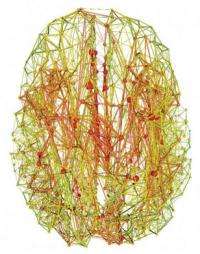
This image shows the group connectome, with the nodes and connections colored according to their rich-club participation. Green represents few connections. Red represents the most. Credit: Reprinted with permission: Van den Heuvel, et al. The Journal of Neuroscience 2011

Just as the Occupy Wall Street movement has brought more attention to financial disparities between the haves and have-nots in American society, researchers from Indiana University and the University Medical Center Utrecht in The Netherlands are highlighting the disproportionate influence of so called "Rich Clubs" within the human brain.

Not all regions of the , they say, are created equal.

"We've known for a while that the brain has some regions that are 'rich' in the sense of being highly connected to many other ," said Olaf Sporns, professor in the Department of Psychological and in IU's College of Arts and Sciences. "It now turns out that these regions are not only individually rich, they are forming a 'rich club.' They are strongly linked to each other, exchanging information and collaborating."

The study, "Rich-Club Organization of the Human Connectome," is published in the Nov. 2 issue of the . The research is part of an ongoing intensive effort to map the intricate networks of the , casting the brain as an integrated dynamic system rather than a set of individual regions.

Using diffusion imaging, which is a form of MRI, Martijn van den Heuvel, a professor at the Rudolf Magnus Institute of Neuroscience at University Medical Center Utrecht, and Sporns examined the brains of 21 healthy men and women and mapped their large-scale network connectivity. They found a group of 12 strongly interconnected bihemispheric hub regions, comprising the precuneus, superior frontal and superior , as well as the subcortical hippocampus, putamen and thalamus. Together, these regions form the brain's "rich club".

Most of these areas are engaged in a wide range of complex behavioral and , rather than more specialized processing such as vision and motor control. If the brain network involving the rich club is disrupted or damaged, said Sporns, the negative impact would likely be disproportionate because of its central position in the network and the number of connections it contains. By contrast, damage to regions outside of the rich club would likely cause specific impairments but would likely have little influence on the global flow of information throughout the brain.

Sporns said the cohesive nature of the rich club's interconnections was surprising and unexpected. It would not have been implausible to have highly connected nodes that did not interact or influence each other to the same degree.

"You sort of wonder what they're talking about when they're communicating with each other," he said. "All these regions are getting all kinds of highly processed information, from virtually all parts of the brain."

The rich club, said van den Heuvel, might be the "G8 summit of our brain."

"It's a group of highly influential regions that keep each other informed and likely collaborate on issues that concern whole brain functioning," he said. "Figuring out what is discussed at this summit might be an important step in understanding how our brain works."

Sporns said he and van den Heuvel hope the findings and subsequent research could shed light on the network basis of brain disorders affecting mental health. Van den Heuvel's prior research has already shown characteristic disturbances of brain networks in schizophrenia. Whether these disturbances specifically affect the brain's rich club is an open question.

Interest in creating a comprehensive map of the human brain's neural connections, the connectome, has accelerated in the last few years. In the U.S., the National Institutes of Health are currently funding a project involving a consortium of more than 70 scientists, including Sporns, who are working together to create a first map of the human connectome. Similar projects are planned or already under way in Europe and Asia.

"People are coming around to the idea that mapping the connectome is not only technically feasible but also very important to do," Sporns said. "It's a fundamental step towards understanding the brain as a networked system. Networks are everywhere these days, found in technology, social media and economics, ecology and systems biology -- They're becoming more and more central in many areas of science. The human brain is perhaps the most challenging example to date."

Provided by Indiana University search and more info website

4.1 /5 (10 votes)  

Filter


Move the slider to adjust rank threshold, so that you can hide some of the comments.


Display comments: newest first

hush1
Nov 01, 2011

Rank: 1 / 5 (1)
OMG!!!!!!<---(subject showing shock)
They are strongly linked to each other, exchanging information and collaborating."

Another conspiracy!!!<--(subject displays disbelief, mistrust)
All these regions are getting all kinds of highly processed information, from virtually all parts of the brain."

No!No!No!<-------(subject is exhibiting classical denial)

"It's a group of highly influential regions that keep each other informed and likely collaborate on issues that concern whole brain functioning

Refuge! No where to hide!!!<---(Subject exhibits withdrawal)
"G8 summit of our brain."

The is no hope. No refuge. No escape.<--- subject becomes suicidal)
Ramael
Nov 01, 2011

Rank: 3.4 / 5 (5)
OMG!!!!!!<---(subject showing shock)
They are strongly linked to each other, exchanging information and collaborating."

Another conspiracy!!!<--(subject displays disbelief, mistrust)
All these regions are getting all kinds of highly processed information, from virtually all parts of the brain."

No!No!No!<-------(subject is exhibiting classical denial)

"It's a group of highly influential regions that keep each other informed and likely collaborate on issues that concern whole brain functioning

Refuge! No where to hide!!!<---(Subject exhibits withdrawal)
"G8 summit of our brain."

The is no hope. No refuge. No escape.<--- subject becomes suicidal)


WTF?!
Cynical1
Nov 02, 2011

Rank: 5 / 5 (1)
I believe it's defined as "sappy" sarcasm... (as opposed to the dripping kind)
hush1
Nov 02, 2011

Rank: not rated yet
lol Cynical1
You have monopole.
Your knowledge of sarcasm works.

I wanted to 'poke fun'.
I love what is in our brains and minds.
Some many people I have yet to meet there.

hush1
Nov 02, 2011

Rank: not rated yet
Some=So
typo correction
kevinrtrs
Nov 02, 2011

Rank: 1 / 5 (6)
Still convinced that we somehow miraculously "evolved from a single ancestor"?
Just how did the complex networks throughout the body develop in step-wise random fashion when it's all SYSTEMs that need highly complex feedback loops and REPAIR mechanisms?
Cynical1
Nov 02, 2011

Rank: not rated yet
Kev - I am even more convinced.
Look at the nature of computer networks. Now, just about everything electronic is connected. And it's gonna get even more so. You think that all happened in a linear fashion?
It's a dang near perfect analogy.
PinkElephant
Nov 02, 2011

Rank: not rated yet
@kevinrtrs ,
Still convinced that we somehow miraculously "evolved from a single ancestor"?
There's no evidence here to the contrary.

Question for you: still convinced there's such a thing as the "soul"?
cyberCMDR
Nov 05, 2011

Rank: not rated yet
This might explain why some people (like Gabrielle Giffords) can get shot in the head and still function. If few if any "rich clubs" get hit, perhaps the cognitive damage would be less severe.
knikiy
Nov 05, 2011

Rank: 5 / 5 (1)
sounds like the brain has characteristics of a scale-free network :

http://en.wikiped..._network
Cynical1
Nov 05, 2011

Rank: not rated yet
It appears that the connectivity paradigm is analogous to the gravitational interactivity of a galaxy..
Rank 4.1 /5 (10 votes)
Related Stories
Relevant PhysicsForums posts
  • Potential Breakthrough in Seizure Control
    created13 hours ago
  • Popping/Cracked sternum.
    created17 hours ago
  • Which Mental Illness Encompasses This Problem?
    created18 hours ago
  • A question about drug tolerance
    createdMay 23, 2012
  • Poor nutrition leading to overeating?
    createdMay 23, 2012
  • Math and dyslexia?
    createdMay 21, 2012
  • More from Physics Forums - Medical Sciences

More news stories

Of mice and mental models: Neuroscientific implications of risk-optimized behavior in the mouse

(Medical Xpress) -- Regardless of an organism’s biological complexity, every encephalized animal continuously makes under-informed behavioral choices that can have serious consequences. Despite its ubiquity, ...

Neuroscience created May 25, 2012 | popularity not rated yet | comments 0 | with audio podcast feature

Persistent sensory experience is good for aging brain

Despite a long-held scientific belief that much of the wiring of the brain is fixed by the time of adolescence, a new study shows that changes in sensory experience can cause massive rewiring of the brain, even as one ages. ...

Neuroscience created May 24, 2012 | popularity not rated yet | comments 0

Boundary stops molecule right where it needs to be

A molecule responsible for the proper formation of a key portion of the nervous system finds its way to the proper place not because it is actively recruited, but instead because it can't go anywhere else.

Neuroscience created May 24, 2012 | popularity not rated yet | comments 0 | with audio podcast

Locating ground zero: How the brain's emergency workers find the disaster area

Like emergency workers rushing to a disaster scene, cells called microglia speed to places where the brain has been injured, to contain the damage by 'eating up' any cellular debris and dead or dying neurons. ...

Neuroscience created May 24, 2012 | popularity 5 / 5 (2) | comments 0 | with audio podcast

Genetic 'reset switch' enables signaling pathway to induce multiple developmental outcomes for olfactory neurons

Within the nervous system, a handful of signaling pathways modulate development of a cornucopia of different neuronal subtypes. “Even small alterations in neuron differentiation pathways can disrupt subsequent ...

Neuroscience created May 24, 2012 | popularity not rated yet | comments 0


Travel to high altitudes tied to Crohn's, colitis flare-ups

(HealthDay) -- People with inflammatory bowel disease, which includes Crohn's disease and colitis, may be at increased risk for flare-ups when they fly or travel to high altitudes for skiing or mountain climbing, ...

Family history of Alzheimer's affects functional connectivity

(HealthDay) -- Cognitively normal individuals with a family history of late-onset Alzheimer's disease (AD) may display lower resting state functional connectivity in the default mode network (DMN) of the brain, ...

Transvaginal mesh op restores pelvic organ prolapse at price

(HealthDay) -- Transvaginal mesh (TVM) procedures are effective for anatomical restoration of pelvic organ prolapse (POP), but patients report a worsening of sexual function following surgery, according to ...

Tongue analysis software uses ancient Chinese medicine to warn of disease

For 5,000 years, the Chinese have used a system of medicine based on the flow and balance of positive and negative energies in the body. In this system, the appearance of the tongue is one of the measures used to classify ...

Weight struggles? Blame new neurons in your hypothalamus

New nerve cells formed in a select part of the brain could hold considerable sway over how much you eat and consequently weigh, new animal research by Johns Hopkins scientists suggests in a study published in the May issue ...

Thioridazine kills cancer stem cells in human while avoiding toxic side-effects of conventional cancer treatments

A team of scientists at McMaster University has discovered a drug, thioridazine, successfully kills cancer stem cells in the human while avoiding the toxic side-effects of conventional cancer treatments.