New insights into how the brain reconstructs the third dimension
December 7, 2011 in Neuroscience

New insights into how the brain reconstructs the third dimension

Enlarge

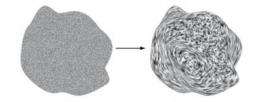
This is a new illusion in which random noise (left) is made to look like a 3-D shape (right). Credit: MPI for Biological Cybernetics

A new visual illusion has shed light on a long-standing mystery about how the brain works out the 3-D shapes of objects.

As dizzying as it may sound, the impression that we are living in a 3D world is actually a continuous fabrication of our brains. When we look at things, the world gets projected onto the and information about the is lost — a bit like when a 3D object casts a shadow onto a flat, 2D wall. Somehow the is able to reconstruct the third dimension from the image, allowing us to experience a convincing 3D world. A team of scientists from Giessen University, Yale and the Max Planck Institute for Biological Cybernetics in Tübingen has recently discovered how in visual cortex might help solve this mystery. They created special 2D patterns designed to stimulate specific nerve cells when we look at them. They find that the result is a vivid illusion of 3D shape, which suggests these cells play an important role in reconstructing 3D shape.

"We created the images by taking random noise and smearing it out across the image in specific patterns. It's a bit like finger painting, except it's done by computer", explains Roland Fleming, Professor of Psychology at the University of Giessen. "The way the texture gets smeared out is not the way texture behaves in the real 3D world. But it allows us to selectively stimulate so-called 'complex cells' in visual cortex, which measure the local 2D orientation of patterns in the retinal image".

These cells — whose discovery led to a Nobel Prize for David Hubel and Torsten Wiesel – are often described as 'edge detectors' because they respond to boundaries or edges in the image. What was not known was that these cells could play a key role in estimating 3D shape.

"We asked people to adjust small probes to report what they saw. The settings allow us to reconstruct exactly which 3D shapes they perceived," says Heinrich Bülthoff, director of the department of Human Perception, Cognition and Action at the Max Planck Institute for Biological Cybernetics. "What's striking is how close the results are to predictions of a model based on cell responses".

The authors suggest the strongest evidence implicating the cells comes from an experiment in which participants stared at patterns for 30 seconds at a time, to change the way the cells respond. The resulting 'adaptation' causes random noise—which normally looks completely flat—to appear like a specific 3D shape.

"It's a kind of aftereffect, a bit like when you stare at a waterfall for a while, adaptation makes things that are stationary look like they are moving in the opposite direction. Except here, the aftereffect makes the noise look 3D," says Daniel Holtmann-Rice, who is currently doing his PhD at Yale University. "We didn't think it was going to work. It was so exciting to get the first data where we could clearly see the predicted shapes emerging in the participants' settings."

The authors are currently working on generalizing the findings to other kinds of information about 3D shape, such as shading and highlights.

More information: Fleming, RW, Holtmann-Rice D & HH Bülthoff Estimation of 3D shape from image orientations. PNAS, published ahead of print December 6, 2011, doi:10.1073/pnas.1114619109

Journal reference: Proceedings of the National Academy of Sciences search and more info website

Provided by Max-Planck-Gesellschaft search and more info website

5 /5 (6 votes)  

Rank 5 /5 (6 votes)
Relevant PhysicsForums posts

More news stories

Waiting for a sign? Researchers find potential brain 'switch' for new behavior

You're standing near an airport luggage carousel and your bag emerges on the conveyor belt, prompting you to spring into action. How does your brain make the shift from passively waiting to taking action when ...

Neuroscience created 14 minutes ago | popularity not rated yet | comments 0 | with audio podcast

If you can remember it, you can remember it wrong

(Medical Xpress)—Native peoples in regions where cameras are uncommon sometimes react with caution when their picture is taken. The fear that something must have been stolen from them to create the photo ...

Neuroscience created 1 hour ago | popularity 2 / 5 (1) | comments 0 | with audio podcast report

Study shows where scene context happens in our brain

In a remote fishing community in Venezuela, a lone fisherman sits on a cliff overlooking the southern Caribbean Sea. This man –– the lookout –– is responsible for directing his comrades on the water, ...

Neuroscience created 3 hours ago | popularity 4 / 5 (1) | comments 0 | with audio podcast

Clouds in the head

Many brain researchers cannot see the forest for the trees. When they use electrodes to record the activity patterns of individual neurons, the patterns often appear chaotic and difficult to interpret.

Neuroscience created 5 hours ago | popularity not rated yet | comments 0

New theory offers clues to vital 'repair and maintenance' role of sleep

(Medical Xpress)—We spend about a third of our life asleep, but why we need to do so remains a mystery. In a recent publication, researchers at University of Surrey and University College London suggest a new hypothesis, ...

Neuroscience created 6 hours ago | popularity not rated yet | comments 0


Estimates reveal low population immunity to new bird flu virus H7N9 in humans

The level of immunity to the recently circulating H7N9 influenza virus in an urban and rural population in Vietnam is very low, according to the first population level study to examine human immunity to the virus, which was ...

Finding a family for a pair of orphan receptors in the brain

Researchers at Emory University have identified a protein that stimulates a pair of "orphan receptors" found in the brain, solving a long-standing biological puzzle and possibly leading to future treatments for neurological ...

Common food supplement fights degenerative brain disorders

Widely available in pharmacies and health stores, phosphatidylserine is a natural food supplement produced from beef, oysters, and soy. Proven to improve cognition and slow memory loss, it's a popular treatment for older ...

Glaucoma drug can cause droopy eyelids

Prostaglandin analogues (PGAs), drugs which lower intraocular pressure, are often the first line of treatment for people with glaucoma, but their use is not without risks. PGAs have long been associated with blurred vision, ...

Teens exposed to schoolmate's death by suicide much more likely to consider or attempt suicide

Youth who had a schoolmate die by suicide are significantly more likely to consider or attempt suicide, according to a study in published in CMAJ (Canadian Medical Association Journal). This effect can last 2 years or mo ...

Most elite athletes believe doping substances are effective in improving performance

Most elite athletes consider doping substances "are effective" in improving performance, while recognising that they constitute cheating, can endanger health and entail the obvious risk of sanction. At the same time, the ...