In third-degree burn treatment, hydrogel helps grow new, scar-free skin
December 13, 2011 in Medical research
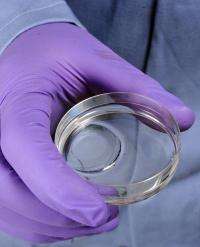
In early testing, this hydrogel, developed by Johns Hopkins researchers, helped improve healing in third-degree burns. Credit: Will Kirk/JHU
Johns Hopkins researchers have developed a jelly-like material and wound treatment method that, in early experiments on skin damaged by severe burns, appeared to regenerate healthy, scar-free tissue.
In the Dec. 12-16 online Early Edition of Proceedings of the National Academy of Sciences, the researchers reported their promising results from mouse tissue tests. The new treatment has not yet been tested on human patients. But the researchers say the procedure, which promotes the formation of new blood vessels and skin, including hair follicles, could lead to greatly improved healing for injured soldiers, home fire victims and other people with third-degree burns.
The treatment involved a simple wound dressing that included a specially designed hydrogel -- a water-based, three-dimensional framework of polymers. This material was developed by researchers at Johns Hopkins' Whiting School of Engineering, working with clinicians at the Johns Hopkins Bayview Medical Center Burn Center and the Department of Pathology at the university's School of Medicine.
Third-degree burns typically destroy the top layers of skin down to the muscle. They require complex medical care and leave behind ugly scarring. But in the journal article, the Johns Hopkins team reported that their hydrogel method yielded better results. "This treatment promoted the development of new blood vessels and the regeneration of complex layers of skin, including hair follicles and the glands that produce skin oil," said Sharon Gerecht, an assistant professor of chemical and biomolecular engineering who was principal investigator on the study.
Gerecht said the hydrogel could form the basis of an inexpensive burn wound treatment that works better than currently available clinical therapies, adding that it would be easy to manufacture on a large scale. Gerecht suggested that because the hydrogel contains no drugs or biological components to make it work, the Food and Drug Administration would most likely to classify it as a device. Further animal testing is planned before trials on human patients begin. But Gerecht said, "It could be approved for clinical use after just a few years of testing."
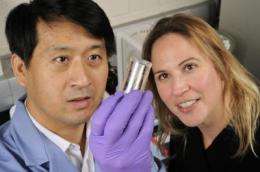
Guoming Sun, left, a postdoctoral fellow, and Sharon Gerecht, an assistant professor of chemical and biomolecular engineering, helped develop a hydrogel that improved burn healing in early experiments. Credit: Will Kirk/JHU
John Harmon, a professor of surgery at the Johns Hopkins School of Medicine and director of surgical research at Bayview, described the mouse study results as "absolutely remarkable. We got complete skin regeneration, which never happens in typical burn wound treatment."
If the treatment succeeds in human patients, it could address a serious form of injury. Harmon, a coauthor of the PNAS journal article, pointed out that 100,000 third-degree burns are treated every year in U. S. burn centers like Bayview's. A burn wound dressing using the new hydrogel could have enormous potential for use in applications beyond common burns, including treatment of diabetic patients with foot ulcers, Harmon said.
Guoming Sun, a Maryland Stem Cell Research Postdoctoral Fellow in Gerecht's lab and lead author on the paper, has been working with these hydrogels for the past three years, developing ways to improve the growth of blood vessels, a process called angiogenesis. "Our goal was to induce the growth of functional new blood vessels within the hydrogel to treat wounds and ischemic disease, which reduces blood flow to organs like the heart," Sun said. "These tests on burn injuries just proved its potential."
Gerecht says the hydrogel is constructed in such a way that it allows tissue regeneration and blood vessel formation to occur very quickly. "Inflammatory cells are able to easily penetrate and degrade the hydrogel, enabling blood vessels to fill in and support wound healing and the growth of new tissue," she said. For burns, the faster this process occurs, Gerecht added, the less there is a chance for scarring.
Originally, her team intended to load the gel with stem cells and infuse it with growth factors to trigger and direct the tissue development. Instead, they tested the gel alone. "We were surprised to see such complete regeneration in the absence of any added biological signals," Gerecht said.
Sun added, "Complete skin regeneration is desired for various wound injuries. With further fine-tuning of these kinds of biomaterial frameworks, we may restore normal skin structures for other injuries such as skin ulcers."
Gerecht and Harmon say they don't fully understand how the hydrogel dressing is working. After it is applied, the tissue progresses through the various stages of wound repair, Gerecht said. After 21 days, the gel has been harmlessly absorbed, and the tissue continues to return to the appearance of normal skin.
The hydrogel is mainly made of water with dissolved dextran, a polysaccharide (sugar molecule chains). "It also could be that the physical structure of the hydrogel guides the repair," Gerecht said. Harmon speculates that the hydrogel may recruit circulating bone marrow stem cells in the bloodstream. Stem cells are special cells that can grow into practically any sort of tissue if provided with the right chemical cue. "It's possible the gel is somehow signaling the stem cells to become new skin and blood vessels," Harmon said.
More information: Sharon Gerecht's Lab: http://www.jhu.edu … mbe/gerecht/
Journal reference:
Proceedings of the National Academy of Sciences
Provided by
Johns Hopkins University
-
Study uses bone marrow stem cells to regenerate skin
Jan 14, 2009 |
not rated yet |
0
-
Researcher seeks to turn stem cells into blood vessels
Feb 18, 2009 |
not rated yet |
0
-
Skin care: new research into scar-free healing
Jan 21, 2008 |
not rated yet |
0
-
Stem Cells from Fat May Help Heal Bone in Wounded Soldiers
Jun 17, 2010 |
not rated yet |
0
-
Bone marrow cells that transform into skin cells could revolutionise approach to wound treatment
Apr 04, 2011 |
not rated yet |
0
-
Of mice and mental models: Neuroscientific implications of risk-optimized behavior in the mouse
May 25, 2012 |
not rated yet |
0
-
Limits to growth: Scientists identify key metastasis-enabling enzyme
May 22, 2012 |
5 / 5 (4) |
0
-
Seeing is as seeing does: Spatially-structured retinal input in early development of cortical maps
Apr 26, 2012 |
5 / 5 (4) |
1
-
Dreamless nights: Brain activity during nonrapid eye movement sleep
Apr 09, 2012 |
4.4 / 5 (12) |
0
-
Take your time: Neurobiology sheds light on the superiority of spaced vs. massed learning
Mar 28, 2012 |
4.5 / 5 (21) |
3
-
Potential Breakthrough in Seizure Control
16 hours ago
-
Popping/Cracked sternum.
21 hours ago
-
Which Mental Illness Encompasses This Problem?
21 hours ago
-
A question about drug tolerance
May 23, 2012
-
Poor nutrition leading to overeating?
May 23, 2012
-
Math and dyslexia?
May 21, 2012
- More from Physics Forums - Medical Sciences
More news stories
Implantable pain disk may help those with cancer
An estimated 3.5 million cancer patients around the globe are in severe pain from their disease, but many get no relief.
Medical research
May 25, 2012 |
5 / 5 (1) |
0
|
Energy levels link sleep control mechanisms
Sleep, or lack of it, can determine level of cognitive performance which is linked with accidents as well as increased risk of serious health problems. Links between cell energy levels, gene transcription ...
Medical research
May 25, 2012 |
not rated yet |
0
Researchers identify key brain cell in antidepressant action
(Medical Xpress) -- Antidepressant medications such as Prozac have helped improve mood and lessen anxiety in millions of people with major depression. But scientists know surprisingly little about how these drugs work.
Medical research
May 25, 2012 |
4.7 / 5 (3) |
0
|
Rockefeller scientists pioneer new method to determine mechanisms of drug action
(Medical Xpress) -- Knowing that a drug works is great. Knowing how it works is a luxury. And until now, determining a drugs mechanism of action has been a tedious and difficult process for scientists.
Medical research
May 25, 2012 |
not rated yet |
0
|
Like curry? New biological role identified for compound used in ancient medicine
Scientists have just identified a new reason why some curry dishes, made with spices humans have used for thousands of years, might be good for you.
Medical research
May 25, 2012 |
4.5 / 5 (12) |
2
|
Keep food safety in mind this memorial day weekend
(HealthDay) -- Picnics, parades and cookouts are as much a part of Memorial Day weekend as tributes to the United States' war veterans.
Travel to high altitudes tied to Crohn's, colitis flare-ups
(HealthDay) -- People with inflammatory bowel disease, which includes Crohn's disease and colitis, may be at increased risk for flare-ups when they fly or travel to high altitudes for skiing or mountain climbing, ...
Family history of Alzheimer's affects functional connectivity
(HealthDay) -- Cognitively normal individuals with a family history of late-onset Alzheimer's disease (AD) may display lower resting state functional connectivity in the default mode network (DMN) of the brain, ...
Transvaginal mesh op restores pelvic organ prolapse at price
(HealthDay) -- Transvaginal mesh (TVM) procedures are effective for anatomical restoration of pelvic organ prolapse (POP), but patients report a worsening of sexual function following surgery, according to ...
Of mice and mental models: Neuroscientific implications of risk-optimized behavior in the mouse
(Medical Xpress) -- Regardless of an organism’s biological complexity, every encephalized animal continuously makes under-informed behavioral choices that can have serious consequences. Despite its ubiquity, ...
Weight struggles? Blame new neurons in your hypothalamus
New nerve cells formed in a select part of the brain could hold considerable sway over how much you eat and consequently weigh, new animal research by Johns Hopkins scientists suggests in a study published in the May issue ...

Dec 13, 2011
Rank: not rated yet
So, the potential implications and possibilities go far beyond burn victims, albeit in a somewhat greusome way.
Consider a bald guy going in to get surgically scalped, and then having a full mop of hair growing back.
Or, more realistically, think about the old ladies in hollywood getting ultra deep face peels, and then this gel helps regenerate new skin. They'll have the sking of a teenager.
I think that the real procedures may probably be less extreme than my imagination, but consider the possibilities.
Dec 13, 2011
Rank: 1 / 5 (6)
Also, what is the freshness date for the dextran? Will it attract bacteria that might grow on it?
"The hydrogel is mainly made of water with dissolved dextran, a polysaccharide (sugar molecule chains). "It also could be that the physical structure of the hydrogel guides the repair," Gerecht said." Then they say later on that they're not sure how it works.
I hope it does help to grow new skin on human burn victims, but the jury is out.
Dec 13, 2011
Rank: not rated yet
Dec 13, 2011
Rank: not rated yet
Dec 13, 2011
Rank: not rated yet
The body will naturally use, break down, or otherwise process a sugar chain.
It is not a completely inert substance.
Also, it gel that consists of elements that replace skin will have different properties from skin. I'm sure that they can account for that.
@Rett - Another scenario is that it is possible that in lab conditions, the skin reverts to a more primitive type of state (like a stem cell). It is certainly possible that in the real world with hormones and stress - a whole body and so on that you may not get desired results.
Dec 13, 2011
Rank: 5 / 5 (1)
Dec 13, 2011
Rank: 2.1 / 5 (7)
Yes, I had read somewhere awhile back about sugar being poured on a wound when a hospital emergency room was not available and the wound healed well. I had forgotten that sugar, as well as salt are natural preservatives. . .but nobody puts salt on a wound, so that's out. :)
Dec 13, 2011
Rank: 1.7 / 5 (6)
What's wrong with the one you have? Only one to a customer. :)
I read your opinions on the V shapes. Very interesting.
Dec 13, 2011
Rank: 5 / 5 (1)
Dec 13, 2011
Rank: 3.7 / 5 (3)
I had heard from a nurse that they used to use Sugar and Iodine on people in nursing homes for the bed sores or other ulcerations that people got.
Maybe this is the beginning of true nano-tech medicine...
Dec 13, 2011
Rank: 1 / 5 (4)
Almost time to go outdoors to see the Geminids meteor shower.
Dec 13, 2011
Rank: 5 / 5 (1)
I'm not sure that that would be the case. My take is that the gel uses your own body's infrastructure to regenerate what is damaged, so if you were suffering from male pattern baldness, then it's likely that the same state would be restored. But I'm sure though that they'll give it a go anyway (as it would mean big bucks).
Dec 13, 2011
Rank: 1 / 5 (5)
Dec 14, 2011
Rank: 5 / 5 (2)
Dec 14, 2011
Rank: 5 / 5 (2)
Dec 14, 2011
Rank: 5 / 5 (1)
Dec 14, 2011
Rank: 1 / 5 (5)
Yes. . .burn victims would get a new psychological lease on life.
@Nano. . . .I'm giving you a FIVE score. . .you know who is still giving me ONES in every thread. LOL
Dec 14, 2011
Rank: 1 / 5 (5)
@Isaacsname. . . .what polymer would that be?
Dec 14, 2011
Rank: 1 / 5 (4)
Googling the chemistry of polymers in disposable diapers, I find this: "Superabsorbent polymers are prepared from acrylic acid and a crosslinker by solution or suspension polymerization. The type and quantity of crosslinker control both the swelling capacity and gel modulus.2 The synthesis and use of crosslinked polyacrylate superabsorbents have been a popular topic in the polymer literature. However, very little information about manufacturing processes has been given due to its proprietary content."
The crosslinker component(s) is not explained.
By "variation", I assume you mean that one is made from sugar and water, while the other is made from a polyacrylic acid. One polymer being organic, while the other is made from OIL = plastic. Unfortunately, I skipped most of my Applied Chemistry classes in high school. Not a big loss.
Dec 14, 2011
Rank: 1 / 5 (1)
Dec 14, 2011
Rank: 1 / 5 (5)
Dec 14, 2011
Rank: 1 / 5 (5)
Here's the link if you would care to see what a jerk Ghost, a hemorrhoid in the ass of FH, is.
http://www.physor...lem.html
Dec 14, 2011
Rank: 1.7 / 5 (6)
Dec 15, 2011
Rank: 2.3 / 5 (3)
I know - you can't avoid posting inanity because your brain contains little else. This is evident in your many empty posts and your posturing manner. But feedback from myself and others should only help to make you aware of this, and hopefully you will consider thinking through your opinions and RESEARCHING them before you expose them to critics like myself. Who after all enjoy making fun of such carelessness. Consider it constructive ridicule.
Dec 16, 2011
Rank: 4.3 / 5 (3)
I am teaching myself about these things in my spare time, nothing more, nothing less.
The major difference between the polymers, that I can understand, is that this one will break down quite easily, the primary problem with cross-linked polymers is that they are incredibly stable,iow, it takes years for them to be broken down in the environment.
Dec 17, 2011
Rank: 1.7 / 5 (6)
Dec 17, 2011
Rank: 2.2 / 5 (13)
Both polymers and plastics are such broad categories that to claim one might be dangerous as a result of fitting into one or both categories shows quite a bit of ignorance. It's like saying "Nah doc, I don't want the laughing gas. I heard they used poison gasses in the World Wars. Not for me."
If only he knew how many polymers his skin encounters on regular basis...
But he's always right about everything and if you disagree you're a socialist/communist bent on destroying America.
Dec 18, 2011
Rank: 1.6 / 5 (7)
Dec 18, 2011
Rank: 1.7 / 5 (6)
@Isaacs. . . .that's just my point. . .plastics degrade very slowly. . .not at all like something organic.
Dec 18, 2011
Rank: 1.6 / 5 (9)
This is just my point. You understand very little of the terminology you use. There are organic compounds that survive millennia and plastics that degrade in weeks. There are also plastics composed of organic compounds.
Dec 18, 2011
Rank: 3.4 / 5 (5)
"Organic (Chemistry) of, relating to, or belonging to the class of chemical compounds that are formed from carbon"
-This includes most plastics you dimwit.
"The vast majority of plastics are composed of polymers of carbon and hydrogen alone or with oxygen, nitrogen, chlorine or sulfur in the backbone."
-This makes them organic you dimwit.
Isnt there a place on perez hiltons website where people like you can feel at home posting whatever occurs to you?
Dec 18, 2011
Rank: 1.7 / 5 (6)
Oh yes, I forgot that you and FrankH are sucking each other's dicks and where one goes to verbally assault someone, the other gets his licks in also. I don't care what you know or don't know. You and your boyfriend FrankH have no right trying to prevent other members from adding to the discussion. . . .whether correct or incorrect. Who died and left YOU the boss of Physorg, by the way?
Dec 18, 2011
Rank: 2.6 / 5 (5)
Dec 19, 2011
Rank: 1.4 / 5 (9)
Moderators, please remove the above post. It clearly falls under the "OFFENSIVE" category. Feel free to remove mine for being off topic :)
Dec 19, 2011
Rank: 2.3 / 5 (3)
www.physorg.com/n...ina.html
Dec 19, 2011
Rank: 3.7 / 5 (3)
Frank and myself are not the only ones who show you how you simply lack the basic knowledge to participate here. Many people have shown you this.
The only reason you persist must be because you enjoy being humiliated. Thats pretty sad.
Why dont you try somewhere else where you might feel more comfortable? Does sesame street have a blog? Maybe a nice organic gardening website?
Dec 20, 2011
Rank: 1.8 / 5 (5)
It appears that TheGhostofOtto1923 and FrankHerbert have taken it upon themselves to be the sergeants-at-arms or the schoolyard bullies of Physorg where they base their vicious attack dog decisions on who goes and who gets to stay by a member's performance.
Dec 20, 2011
Rank: 1.8 / 5 (5)
I shudder to think how University students, on becoming Physorg members, would be treated by these 2 bullies due to the young students' lack of the right terminology and exact scientific knowledge that would be required before they are accepted to ask questions and posit their own theories. There is something very insane about these two whose sole purpose seems to be the "guardians at the gates" or in the role of "bouncers" to prevent anyone remaining at the dance hall who fall short of their expectations. As with Oliver, they cannot live and let live, or even ignore what is said by others. Their attempt at ridicule is sad.
Dec 20, 2011
Rank: 1.4 / 5 (10)
Dec 20, 2011
Rank: 3 / 5 (4)
*this would mean banning FrankHerbert.
Dec 22, 2011
Rank: 2 / 5 (4)
Dec 22, 2011
Rank: 1 / 5 (4)
Dec 22, 2011
Rank: 1 / 5 (10)
So the Vietnam vet wants to talk about mental scars. Can you sleep without a fan on? How about a gun under the bed?
How long were you addicted to smack? Do you still relapse?
Do you have nightmares with Jane Fonda in them?
:P
Dec 22, 2011
Rank: 3.7 / 5 (3)
There is a photo of Frank at the top right of this web page.
Dec 22, 2011
Rank: 5 / 5 (2)
In Circle 1, label it polymers. Some polymers are organic, some are not. Most polymers are plastic, a few are not. Polymers are any kind of compound that can easily be linked into repeating chains and achieve very high molecular weight.
In circle 2, label it plastics. Some plastics are polymers, some are not. Some are organic, others are not. Plastics can be toxic or nontoxic. Plastics are substances that shaped or formed, and then hardened - The definition of plastic is actually ambiguous, because it can include substances not considered to be plastic. It is a somewhat relative definition, and mostly colloqually used to refer to organic plastics.
Organic just means it contains carbon. Since carbon is so awesome at bonding in many ways, it is convenient to use.
Continued...
Dec 22, 2011
Rank: 5 / 5 (2)
These various terms are such wide nets, that to use them to describe more than the one discrete property defined by the definition is pointless and stupid.
We use polymer plastics for implants in the body. We use non-plastic polymers in space travel. We use non polymer plastics as well.
This is the absolute dumbest semantic conversation I have ever run across.
Dec 22, 2011
Rank: 5 / 5 (2)
Correction, "just because it's made from cellulose or oil doesn't change that. But it can be made from silicon or other substances as well."
Dec 23, 2011
Rank: 2.3 / 5 (4)
Dec 25, 2011
Rank: 5 / 5 (2)