Evolved, mutated gene module linked to Joubert syndrome
January 26, 2012 in Autism spectrum disorders

Scientists link evolved, mutated gene module to syndromic autism

Enlarge

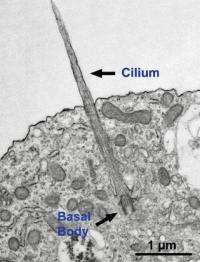
This image using an electron microscope shows a cilium growing from a neuron. Credit: Gleeson lab, UC San Diego

A team led by researchers at the University of California, San Diego School of Medicine reports that newly discovered mutations in an evolved assembly of genes cause Joubert syndrome, a form of syndromic autism.

The findings are published in the January 26 online issue of .

Joubert syndrome is a rare, recessive brain condition characterized by malformation or underdevelopment of the and brainstem. The disease is due specifically to alterations in cellular primary cilia – antenna-like structures found on most cells. The consequence is a range of distinct physical and cognitive disabilities, including poor muscle control, and mental retardation. Up to 40 percent of Joubert syndrome patients meet clinical criteria for , as well as other neurocognitive disorders, so it is considered a syndromic form of autism.

The cause or causes of Joubert syndrome are not well-understood. Researchers looked at in the TMEM216 gene, which had previously been linked to the syndrome. However, only half of the expected Joubert syndrome patients exhibit TMEM216 gene mutations; the other half did not. Using genomic sequencing, the research team, led by Joseph G. Gleeson, MD, professor of neurosciences and pediatrics at UC San Diego, broadened their inquiry and discovered a second culprit: mutations in a neighboring gene called TMEM138.

"It is extraordinarily rare for two adjacent to cause the same human disease," said Gleeson. "The mystery that emerged from this was whether these two adjacent, non-duplicated genes causing indistinguishable disease have functional connections at the gene or protein level."

Through evolutionary analysis, the scientists concluded that the two TMEM genes became joined end-to-end approximately 260 million years ago, about the time some amphibians began transitioning into land-based reptiles. The connected genes evolved in tandem, becoming regulated by the same transcription factors.

"Prior to this transition, the two genes had wildly different expression levels," said Jeong Ho Lee, MD, PhD, and first author of the study. "Following this transition, they became tightly co-regulated. Moreover, we found that the two encoded proteins coordinate delivery of factors key for cilia assembly."

Gleeson said the findings suggest the human genome has evolved to take advantage of fortuitous ancestral events like gene translocations to better coordinate gene expression by assembling into specific modules. When these modules are disrupted, however, neurodevelopmental diseases may result.

Provided by University of California - San Diego search and more info website

5 /5 (3 votes)  

Rank 5 /5 (3 votes)
Related Stories
Relevant PhysicsForums posts

More news stories

Researcher helps give children with autism the chance to communicate

Research by Victoria University PhD education graduand Larah van der Meer highlights the importance of understanding the communication preferences of children with developmental disabilities such as autism.

Autism spectrum disorders created May 14, 2013 | popularity 3.3 / 5 (3) | comments 1

Developers dive in to create a wealth of autism apps

At times, Andy Shih still finds himself overwhelmed by the groundswell of interest in autism applications he's seen in the three years since Apple Inc. released the first iPad.

Autism spectrum disorders created May 09, 2013 | popularity 2 / 5 (1) | comments 0

Enhanced motion perception in autism may point to an underlying cause of the disorder

Children with autism see simple movement twice as quickly as other children their age, and this hypersensitivity to motion may provide clues to a fundamental cause of the developmental disorder, according ...

Autism spectrum disorders created May 08, 2013 | popularity not rated yet | comments 0 | with audio podcast

Autism scientists seek more brains to aid research

(AP)—Autism scientists are seeking more brain samples for research.

Autism spectrum disorders created May 02, 2013 | popularity 5 / 5 (1) | comments 0

Drug shows some benefit for kids with autism

(HealthDay)—An experimental drug for autism did not improve levels of lethargy and social withdrawal in children who took it, but it did show some other benefits, a new study finds.

Autism spectrum disorders created May 02, 2013 | popularity 4 / 5 (1) | comments 0


New research identifies risks, interventions for children's GI health

An increasing number of U.S. children are experiencing gastrointestinal issues that require interventions to resolve, according to research presented at Digestive Disease Week (DDW).

New colonoscope provides ground-breaking view of colon

A ground-breaking advance in colonoscopy technology signals the future of colorectal care, according to research presented today at Digestive Disease Week(DDW). Additional research focuses on optimizing the minimal withdrawal ...

AIDS science at 30: 'Cure' now part of lexicon

Big names in medicine are set to give an upbeat assessment of the war on AIDS on Tuesday, 30 years after French researchers identified the virus that causes the disease.

For combat veterans suffering from post-traumatic stress disorder, 'fear circuitry' in the brain never rests

Chronic trauma can inflict lasting damage to brain regions associated with fear and anxiety. Previous imaging studies of people with post-traumatic stress disorder, or PTSD, have shown that these brain regions can over-or ...

Melon focus headband turns to Kickstarter for rollout plans

(Medical Xpress)—What if the quality of your work depends more on your focus on the piano keys or canvas or laptop than your musical or painting or computing skills? If target users can be convinced, they ...

Temporal processing in the olfactory system

The neural machinery underlying our olfactory sense continues to be an enigma for neuroscience. A recent review in Neuron seeks to expand traditional ideas about how neurons in the olfactory bulb might encode information about ...