Late-stage sepsis suppresses immune system
January 11, 2012 By Jim Dryden in Immunology
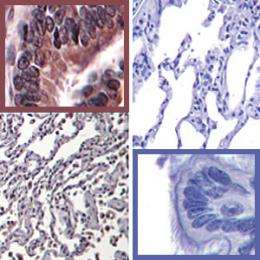
In a sepsis patient's lung cells (left), brown indicates a protein with the potential to "turn off" T-cells. Lung cells from a patient without sepsis remain blue (right), indicating the protein is not present. Credit: 2011 AMERICAN MEDICAL ASSOCIATION
(Medical Xpress) -- Patients who die from sepsis are likely to have had suppressed immune systems that left them unable to fight infections, researchers at Washington University School of Medicine in St. Louis have shown.
The findings suggest that therapies to rev up the immune response may help save the lives of some patients with the disorder. Sepsis is a severe illness in which bacteria overwhelm the bloodstream.
The researchers compared tissue samples taken from the lungs and spleens of 40 patients who had died of sepsis to those of patients who died from other causes. They reported their findings in the Journal of the American Medical Association.
More than 225,000 people die each year from sepsis, and developing more effective therapies has been challenging, says senior investigator Richard S. Hotchkiss, MD, professor of anesthesiology. This project was focused on trying to understand the mechanisms that underlie how the immune system responds to sepsis.
Thats been an important question because the onset of sepsis usually includes what doctors call a cytokine storm, when the bodys immune system produces a massive inflammatory response. Some patients die during this initial phase. But others survive, including a significant number of patients whose sepsis evolves into a longer, chronic phase.
These patients often get new infections, says co-investigator Jonathan M. Green, MD, professor of medicine and of pathology and immunology. They come into the ICU very sick, and we try to get them over that hump, but then they get stuck and dont get better. They typically develop new infections, either a bloodstream infection or pneumonia.
This video is not supported by your browser at this time.
Green, a pulmonary and critical care specialist, and Hotchkiss, an anesthesiologist, have worked together for years treating patients in the ICU at Barnes-Jewish Hospital. But the new research launched over a cup of coffee brought them together for the first time in the laboratory.
Hotchkiss had been collecting tissue samples from patients who died from sepsis, and Green brought expertise in lung function and immunology to the project. By analyzing the tissue samples, they determined that sepsis patients immune systems were, indeed, suppressed.
First author Jonathan S. Boomer, PhD, analyzed the tissue to determine whether key immune system cells, called T-cells, were activated to respond to secondary infections like pneumonia or whether those cells were defective.
We found that these T-cells were not able to function in the ways required to fight an infection, says Boomer, a research instructor in medicine. T-cells were present in both the lung and the spleen, but they failed to mount an effective immune response.
Further study revealed that the T-cells sent to the lung to fight infection were stripped of their ability to mount an immune response, possibly by the lung cells themselves.
Its as if theres a switch on the T-cell, Green says. But somethings got to flip that switch, and the finger is actually on lung cells. It may be that these T-cells are unable to function properly because cells in the lung arent allowing it.
Hotchkiss laboratory found a similar mechanism at work in the spleen. He says taken together, the findings suggest a new direction for sepsis therapy.
A real benefit of this study is that it points to how the paradigm for treating sepsis should change, Hotchkiss says. Its pretty clear from this study that in some patients, we need to find ways to activate T-cells to fight sepsis.
He says potential treatment strategies include blocking a cell-death pathway to rev up the T-cells. Another option may involve treatment with a substance called interleukin-7 (IL-7), which is known to activate T-cells.
A major caveat is that its not clear which sepsis patients would benefit from treatments that boost the immune response. The researchers plan to continue their collaboration as they work to answer that question.
More information: Boomer JS, et al. Immunosuppression in patients who die of sepsis and multiple organ failure. JAMA, vol. 306 (23), pp. 2594-2605, Dec. 21, 2011.
Ward, PA, Immunosuppression in sepsis (editorial), JAMA
Provided by
Washington University School of Medicine in St. Louis
-
Researchers find chemical signals that initiate the body's immune response
Sep 09, 2011 |
not rated yet |
0
-
Findings suggest that severe sepsis can lead to impairment of immune system
Dec 20, 2011 |
not rated yet |
0
-
In the laboratory, green tea proves a powerful medicine against severe sepsis
Nov 08, 2007 |
not rated yet |
0
-
Marijuana use suppresses immune functions, study shows
Dec 03, 2010 |
not rated yet |
0
-
'Blueprint' for blocking MMP may unlock new treatments for deadly blood infection
May 18, 2011 |
not rated yet |
0
-
Of mice and mental models: Neuroscientific implications of risk-optimized behavior in the mouse
May 25, 2012 |
not rated yet |
0
-
Limits to growth: Scientists identify key metastasis-enabling enzyme
May 22, 2012 |
5 / 5 (4) |
0
-
Seeing is as seeing does: Spatially-structured retinal input in early development of cortical maps
Apr 26, 2012 |
5 / 5 (4) |
1
-
Dreamless nights: Brain activity during nonrapid eye movement sleep
Apr 09, 2012 |
4.4 / 5 (12) |
0
-
Take your time: Neurobiology sheds light on the superiority of spaced vs. massed learning
Mar 28, 2012 |
4.5 / 5 (21) |
3
-
magnetic field from stream of protons
3 hours ago
-
Force on a particle constrained to move on the surface of a sphere
4 hours ago
-
Force in a magnetic coupling
14 hours ago
-
Sign of scalar product in electric potential integral?
21 hours ago
-
Heat engines: how can we yield work?
21 hours ago
-
Work done by us on the spring
May 25, 2012
- More from Physics Forums - Classical Physics
More news stories
Gene therapy can correct forms of severe combined immunodeficiency
Severe combined immunodeficiency is defect in the immune system that results in a loss of the adaptive immune cells known as B cells and T cells. Mutations in several different genes can lead to the development of severe ...
Immunology
May 24, 2012 |
not rated yet |
0
Research team uncovers mechanism behind drugs that cause altered immunity
(Medical Xpress) -- An Australian research team has opened the door to understanding why certain drugs cause a so called altered immunity response when offered as treatment for certain specific ailments. In their paper published ...
Immunology
May 24, 2012 |
not rated yet |
0
|
Long-distance training teaches proper technique for asthma test
(Medical Xpress) -- Virtual, long-distance training can teach primary-care professionals the proper technique for performing a lung-function test, a University of Washington-led study has shown. The breathing ...
Immunology
May 23, 2012 |
not rated yet |
0
Asthma medication linked with arrhythmias in children, young adults
Use of inhaled anticholinergics (IACs) has been associated with an increased risk of potentially dangerous heart arrhythmias among young asthma patients, according to a study conducted by researchers at the University of ...
Immunology
May 22, 2012 |
not rated yet |
0
Bee pollen supplements can cause anaphylactic reactions
Although many people take bee pollen as a health supplement, it can cause severe anaphylactic reactions. However, most people are unaware of the risks, states an article published in CMAJ (Canadian Medical Association Journal). ...
Immunology
May 22, 2012 |
not rated yet |
1
Keep food safety in mind this memorial day weekend
(HealthDay) -- Picnics, parades and cookouts are as much a part of Memorial Day weekend as tributes to the United States' war veterans.
Travel to high altitudes tied to Crohn's, colitis flare-ups
(HealthDay) -- People with inflammatory bowel disease, which includes Crohn's disease and colitis, may be at increased risk for flare-ups when they fly or travel to high altitudes for skiing or mountain climbing, ...
Family history of Alzheimer's affects functional connectivity
(HealthDay) -- Cognitively normal individuals with a family history of late-onset Alzheimer's disease (AD) may display lower resting state functional connectivity in the default mode network (DMN) of the brain, ...
Transvaginal mesh op restores pelvic organ prolapse at price
(HealthDay) -- Transvaginal mesh (TVM) procedures are effective for anatomical restoration of pelvic organ prolapse (POP), but patients report a worsening of sexual function following surgery, according to ...
Of mice and mental models: Neuroscientific implications of risk-optimized behavior in the mouse
(Medical Xpress) -- Regardless of an organism’s biological complexity, every encephalized animal continuously makes under-informed behavioral choices that can have serious consequences. Despite its ubiquity, ...
Weight struggles? Blame new neurons in your hypothalamus
New nerve cells formed in a select part of the brain could hold considerable sway over how much you eat and consequently weigh, new animal research by Johns Hopkins scientists suggests in a study published in the May issue ...