'Pulverized' chromosomes linked to cancer?
They are the Robinson Crusoes of the intracellular world -- lone chromosomes, whole and hardy, stranded outside the nucleus where their fellow chromosomes reside. Such castaways, each confined to its own "micronucleus," are often found in cancer cells, but scientists haven't known what role, if any, they play in the cancer process.
In a paper published online on Jan. 18 by the journal Nature, Dana-Farber Cancer Institute researchers have mapped out a mechanism by which micronuclei could potentially disrupt the chromosomes within them and produce cancer-causing gene mutations. The findings may point to a vulnerability in cancer cells that could be attacked by new therapies.
"The most common genetic change in cancer is the presence of an incorrect number of intact chromosomes within cancer cells -- a condition known as aneuploidy," says Dana-Farber's David Pellman, MD, the study's senior author. "The significance of aneuploidy has been hard to pin down, however, because little is known about how it might trigger tumors. In contrast, the mechanism by which DNA damage and broken chromosomes cause cancer is well established -- by altering cancer genes in a way that spurs runaway cell division.
"The new study demonstrates one possible chain of events by which aneuploidy and specifically 'exiled' chromosomes could lead to cancer-causing mutations, with potential implications for cancer prevention and treatment," says Pellman, who is a Howard Hughes Medical Institute investigator and the Margaret M. Dyson Professor of Pediatric Oncology at Dana-Farber, Children's Hospital Boston and Harvard Medical School.
Whole chromosomes can end up outside the nucleus as a result of a glitch in cell division. In normal division, a cell duplicates its chromosomes and dispatches them to the newly forming daughter cells: the original set to one daughter, the twin set to the other. For a variety of reasons, the chromosomes sometimes aren't allocated evenly -- one daughter receives an extra one, the other is short one. Unlike the rest of the chromosomes, these stragglers sometimes don't make it to the nucleus. Instead, they're marooned elsewhere within the cell and become wrapped in their own membrane, forming a micronucleus.
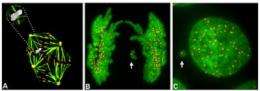
"In some respects, micronuclei are similar to primary nuclei," Pellman remarks, "but much about their function and composition is unknown. Previous studies differ on whether micronuclei replicate or repair their chromosomes as normal nuclei do. The ultimate fate of these chromosomes is unclear as well: Are they passed on to daughter cells during cell division or are they somehow eliminated as division proceeds?"
One clue that odd-man-out chromosomes themselves may be subject to damage -- and therefore be involved in cancer -- emerged from Pellman's previous research into aneuploidy. "We found that cancer cells generated from cells with micronuclei also have a great deal of chromosome breakage," Pellman explains. But researchers didn't know if this was a sign of connection or of coincidence.
Another clue came from a recently discovered phenomenon called "chromothripsis," in which one chromosome of a cancer cell shows massive amounts of breakage and rearrangement, while the remainder of the genome is largely intact. "That finding leapt off the page of these studies -- that such extensive damage could be limited to a single chromosome or single arm of a chromosome," Pellman says. "We wondered if the physical isolation of chromosomes in micronuclei could explain this kind of highly localized chromosome damage."
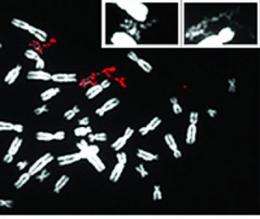
To find out, Karen Crasta, PhD, of Pellman's lab and the study's lead author, used a confocal microscope to observe dividing cells with micronuclei. She found that while micronuclei do form duplicate copies of their chromosomes, the process is bungled in two respects. First, it is inefficient: part of the chromosome is replicated and part isn't, leading to chromosome damage. Second, it is out of sync: the micronucleus keeps trying to replicate its chromosomes long after replication of the other chromosomes was completed. For cell division to be successful, every step of the process must occur in the proper order, at the proper time. In fact, when study co-author Regina Dagher directly analyzed the structure of the late-replicating chromosomes, she found them to be smashed to bits -- exactly what was predicted as the first step in chromothripsis.
The final piece of the puzzle came when Pellman's colleague Neil Ganem, PhD, examined what happens to these pulverized fragments, using an imaging trick that marked the chromosome in the micronucleus with its own color.
"It has been theorized that micronuclei are garbage disposals for chromosomes that the cell doesn't need anymore," Pellman comments. "If that were true, the smashed pieces would be discarded or digested, but we found that, a third of the time, they're donated to one of the daughter cells and therefore cold be incorporated into that cell's genome.
Pellman says that the findings suggest that, unexpectedly, whole chromosome aneuploidy might promote cancer in a very similar way to other kinds of genomic alterations. The key event may be mutations in oncogenes and tumor suppressors. This mechanism may also explain how cancer cells acquire more than one such mutation at a time.
"Although chromothripsis occurs in only a few percent of human cancers, our findings suggest that it might be an extreme instance of a kind of chromosome damage that could be much more common," says Pellman, who adds that accelerating this process in cancer cells, thus generating so many mutations that the cells die, may represent a possible strategy for new therapies against certain tumors.


