Diabetes may start in the intestines, research suggests
February 15, 2012 in Diabetes

Diabetes may start in the intestines, research suggests

Enlarge

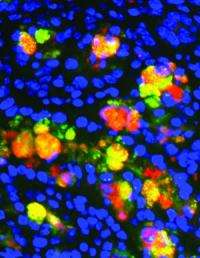
In mice without the key enzyme, fatty acid synthase, bad bacteria invade the colon and the small intestine, which creates the inflammation underlying insulin resistance and diabetes. In the mouse colon above, a protein (shown in red) that makes up the protective membrane in the gut is not functioning properly. Credit: Washington University School of Medicine

Scientists at Washington University School of Medicine in St. Louis have made a surprising discovery about the origin of diabetes. Their research suggests that problems controlling blood sugar — the hallmark of diabetes — may begin in the intestines.

The new study, in mice, may upend long-held theories about the causes of the disease. Because insulin is produced in the pancreas and sugar is stored in the liver, many scientists have looked to those organs for the underlying causes of .

The findings are reported Feb. 16 in the journal Cell Host & Microbe.

In the new research, scientists studied mice that are unable to make fatty acid synthase (FAS) in the intestine. FAS, an enzyme crucial for the production of lipids, is regulated by insulin, and people with diabetes have defects in FAS. Mice without the enzyme in the intestines develop chronic inflammation in the gut, a powerful predictor of diabetes.

"Diabetes may indeed start in your gut," says principal investigator Clay F. Semenkovich, MD. "When people become resistant to insulin, as happens when they gain weight, FAS doesn't work properly, which causes inflammation that, in turn, can lead to diabetes."

This video is not supported by your browser at this time.

Mice with defects in their ability to make the enzyme fatty acid synthase in their intestines develop inflammation, and diabetes. In a new study, Washington University researchers made the surprising discovery that diabetes may get its start in the intestines, rather than in the pancreas or the liver. The culprit is that inflammation related to not having fatty acid synthase in gut tissues. Jim Dryden has more… Credit: Washington University BioMed Radio

First author Xiaochao Wei, PhD, and Semenkovich, the Herbert S. Gasser Professor of Medicine, professor of cell biology and physiology and director of the Division of Endocrinology, Metabolism and Lipid Research, collaborated with specialists in gastroenterology and genome sciences to determine what happens in mice that can't make FAS in their intestines.

"The first striking thing we saw was that the mice began losing weight," says Wei, a research instructor in medicine. "They had diarrhea and other gastrointestinal symptoms, and when we looked closely at the tissue in the gut, we found a lot of inflammation."

Initially, the researchers thought that the mice became sick because of changes to the mix of microbes that naturally live in the gut, where they help digest food and synthesize vitamins.

In collaboration with Jeffrey I. Gordon, MD, director of the Center for Genome Sciences and Systems Biology at the School of , they looked more closely at gut microbes in the mice.

"The mice had substantial changes in their gut microbiome," Semenkovich says. "But it wasn't the composition of microbes in the gut that caused the problems."

Instead, Wei says, the mice got sick because of a defect in fatty acid synthase. The mice without fatty acid synthase had lost the protective lining of mucus in the intestines that separates the microbes from direct exposure to cells. This allowed bacteria to penetrate otherwise healthy cells in the gut, making the mice sick.

In a further collaboration with Nicholas O. Davidson, MD, director of the Division of Gastroenterology, the researchers found gastrointestinal effects resembling some features of inflammatory bowel disease. Other investigators studying humans with ulcerative colitis had previously made the unexplained observation that colon biopsies from these patients have low amounts of fatty acid synthase.

"Fatty acid synthase is required to keep that mucosal layer intact," Wei says. "Without it, bad bacteria invade cells in the colon and the small intestine, creating inflammation, and that, in turn, contributes to insulin resistance and diabetes."

Inflammation and insulin resistance reinforce each other. Inflammatory substances can cause insulin resistance and inhibit the production of insulin, both of which interfere with the regulation of . In turn, is known to promote inflammation.

Further study showed that the ability to build the thin, but important, layer of mucosal cells was hindered by faulty FAS.

That the is so important to the development of diabetes makes sense because many people with the condition not only have faulty FAS, but they also frequently develop gastrointestinal difficulties, Semenkovich says.

"Abdominal pain and diarrhea are some of the most common problems we see in people with diabetes," he says. "We could only connect these 'dots' because other experts at the university could help us link what we observed in these mice to what occurs in patients with diabetes and inflammatory bowel disease," Semenkovich says.

Semenkovich and Wei say much more study is needed, but they say that FAS and a key component of the intestinal mucosa called Muc2 may be potential targets for diabetes therapy. They now plan to study people with diabetes to see whether FAS is altered in a similar way, producing damage to the mucosal layer in the intestines.

More information: Wei X, Yang Z, Rey FE, Ridaura VK, Davidson, NO, Gordon JI, Semenkovich CS, Fatty acid synthase modulates intestinal barrier function through palmitoylation of mucin2. Cell Host & Microbe, Feb. 16, 2012.

Journal reference: Cell Host & Microbe search and more info website

Provided by Washington University School of Medicine search and more info website

4.1 /5 (16 votes)  

Filter


Move the slider to adjust rank threshold, so that you can hide some of the comments.


Display comments: newest first

axcohn
Feb 15, 2012

Rank: not rated yet
"...they say that FAS and a key component of the intestinal mucosa called Muc2 may be potential targets for diabetes therapy."

Why bother spending time and money on novel diabetes therapies when the world already has a free diabetes therapy: carbohydrate restriction? Every clinical study ever performed on this subject has showed marked improvement of diabetic symptoms on a low-carb diet. Type 2 diabetics, in particular, usually become asymptomatic within 90 days, and have lab results, e.g., HbA1c, within the range of normal after 6 months, allowing them to stop taking reduce or stop taking diabetes medication, e.g., insulin, metformin.
Fed_Up_With_Stupid
Feb 15, 2012

Rank: 1 / 5 (1)
Two reasons come to mind:

1. It takes a level of disciple that most people lack
2. It is difficult to make money selling a carbohydrate restricted diet to people, but it would be very easy to make money selling them a drug.
tjcoop3
Feb 16, 2012

Rank: 1 / 5 (1)
I guess my question would be that if this is also true in humans what nutritional deficiency is present which is the cause of this "fas"?
Get to that and you don't have to be concerned about DIE ts or drugs. One just eats correctly.
I have seen much improvement in my condition since changing what I eat to more healthy choices. My Dr. is even talking about taking me completely off of insulin after having taken a whole bottle a day a few years ago. (Very Insulin resistant)
I still weigh 420lbs but am gradually losing. So it is what you eat not a bunch of restrictions. I still eat plenty. BTW most of my weight gain came after I got diabetes from medication side effects. Almost 150 lbs in 8 yrs. I am now working to get that off. I am also NOT planning to have some drastic surgery that might make me even worse. Natural, gradual is the best way. I have no heart disease or other stuff because I eat right and don't follow recommended DIE ts.
kochevnik
Feb 20, 2012

Rank: 1 / 5 (1)
Not only carbs but grasses like corn and wheat specifically. Wheat is linked with inflammatory bowel disease, blocks nutrient absorption by sticking to the intestines, and spikes blood sugar i.e. it is highly glycemic. It's also high in cadmium.

Man hasn't evolved to eat grasses since they are a result of farming, which only began 30,000 years ago. In humans there was a massive die-off initially, and humans that survived farming showed marked signs of malnutrition. My body can handle carbs just not the grasses that are best handled with four stomachs.
Rank 4.1 /5 (16 votes)
Relevant PhysicsForums posts

More news stories

Exercise prevents fructose-induced hypertriglyceridemia

(HealthDay)—Moderate aerobic exercise prevents fructose-induced hypertriglyceridemia in healthy males, according to a study published online May 14 in Diabetes.

Diabetes created May 17, 2013 | popularity 5 / 5 (1) | comments 0 | with audio podcast

DNA variant affects diabetes risk and treatment response

A DNA variant near a digestive enzyme does not only affect risk of developing diabetes but also affects the response to treatment, an international consortium of researchers including the University of Dundee has found.

Diabetes created May 17, 2013 | popularity not rated yet | comments 0 | with audio podcast

The artificial pancreas that keeps tabs on sugar

(Medical Xpress)—Development of a sophisticated artificial pancreas holds potential to transform the lives of patients with Type 1 diabetes.

Diabetes created May 16, 2013 | popularity 5 / 5 (1) | comments 0 | with audio podcast

Study findings significant for treating infections in Type 1 diabetes

A small University at Buffalo study has found for the first time that in Type 1 diabetics, insulin injections exert a strong anti-inflammatory effect at the cellular and molecular level, while even small amounts of glucose ...

Diabetes created May 16, 2013 | popularity not rated yet | comments 0

Hospital hypoglycemia rates up in black men with diabetes

(HealthDay)—Home diabetes regimens partially explain the increased risk of having a hypoglycemia event during hospitalization among older African-American men with diabetes, according to a study published ...

Diabetes created May 14, 2013 | popularity not rated yet | comments 0


Researchers identify a potential new risk for sleep apnea: Asthma

Researchers at the University of Wisconsin have identified a potential new risk factor for obstructive sleep apnea: asthma. Using data from the National Institutes of Health (Heart, Lung, and Blood Institute)-funded Wisconsin ...

New theory on genesis of osteoarthritis comes with successful therapy in mice

Scientists at Johns Hopkins have turned their view of osteoarthritis (OA) inside out. Literally. Instead of seeing the painful degenerative disease as a problem primarily of the cartilage that cushions joints, ...

Computational tool translates complex data into simplified 2-dimensional images

In their quest to learn more about the variability of cells between and within tissues, biomedical scientists have devised tools capable of simultaneously measuring dozens of characteristics of individual ...

Study finds that sleep apnea and Alzheimer's are linked

A new study looking at sleep-disordered breathing (SDB) and markers for Alzheimer's disease (AD) risk in cerebrospinal fluid (CSF) and neuroimaging adds to the growing body of research linking the two.

'Gap' for HIV vaccine efforts after latest setback

The hunt for an HIV vaccine has gobbled up $8 billion in the past decade, and the failure of the most recent efficacy trial has delivered yet another setback to 26 years of efforts.

Ginger compounds may be effective in treating asthma symptoms

Gourmands and foodies everywhere have long recognized ginger as a great way to add a little peppery zing to both sweet and savory dishes; now, a study from researchers at Columbia University shows purified components of the ...