Scientists make strides toward fixing infant hearts
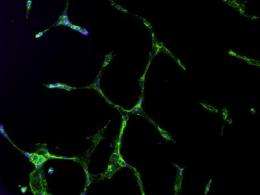
Researchers at Rice University and Texas Children's Hospital have turned stem cells from amniotic fluid into cells that form blood vessels. Their success offers hope that such stem cells may be used to grow tissue patches to repair infant hearts.
"We want to come up with technology to replace defective tissue with beating heart tissue made from stem cells sloughed off by the infant into the amniotic fluid," said Rice bioengineer Jeffrey Jacot, who led the study. "Our findings serve as proof of principle that stem cells from amniotic fluid have the potential to be used for such purposes."
The results were published online by the journal Tissue Engineering Part A. The research was conducted at Texas Children's Hospital.
According to the American Heart Association, about 32,000 infants a year in the United States are born with congenital heart defects, 10,000 of which either result in death or require some sort of surgical intervention before they're a year old.
Jacot, an assistant professor of bioengineering based at Rice's BioScience Research Collaborative and director of the Pediatric Cardiac Bioengineering Laboratory at the Congenital Heart Surgery Service at Texas Children's Hospital, hopes to grow heart patches from the amniotic stem cells of a fetus diagnosed in the womb with a congenital heart defect. Because the cells would be a genetic match, there would be no risk of rejection, he said.
"Between 60 and 80 percent of severe heart defects are caught by ultrasound," he said. "Ultimately, when a heart defect is diagnosed in utero, we will extract amniotic cells. By birth, we will have made tissue for the repair out of the infant's own cells. The timing is critical because the surgery needs to be done within weeks of the infant's birth."
Surgeons currently use such nonbiological materials as Dacron or Teflon, which do not contract or grow with the patient, or native pericardium, the membrane that surrounds the heart. Pericardium generally forms scar tissue and can only be used in the first operation. Both solutions require further operations and raise the risk of cardiac arrest, Jacot said.
Stem cells, the focus of both great hope and great controversy, are the cells in every organism that differentiate into specialized cells in the body. Stem cells drawn from human embryos are known to have great potential for treatment of defects and disease, but research into their use has been limited by political and other concerns, Jacot said.
That isn't the case with cells found in amniotic fluid, he said. Amniotic fluid is the liquid that protects and nourishes a fetus in the womb. Fluid is sometimes taken from pregnant women through amniocentesis, but cells for the Jacot lab's studies were drawn from women undergoing treatment for twin-twin transfusion syndrome. "This is where two identical twins share a placenta and one is getting more blood than the other. It's not common," he said, noting that Texas Children's is one of the few hospitals that treat the syndrome. "Part of the general treatment is to remove fluid with the goal of saving both lives, and that fluid is usually discarded."
Jacot said other labs have tested amniotic fluid as a source of stem cells with promising results. "Our work is based on five years of work from other labs in which they've discovered a very small population of amniotic stem cells – maybe one in every 10,000 – that naturally express markers characteristic of embryonic and mesenchymal stem cells."
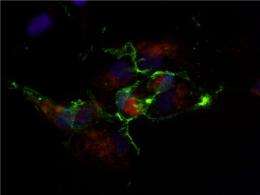
Jacot and his team created a population of amniotic stem cells through a complex process that involved extracting cells via centrifugation and fluorescence-activated sorting. They sequestered cells with a surface receptor, c-kit, a marker associated with stem cells.
The cells were cultured in endothelial growth media to make them suitable for growing into a network of capillaries, Jacot said. When the cells were placed in a bio-scaffold, a framework used for tissue engineering, they did just that.
"Anything we make will need a blood supply," he said. "That's why the first cell type we looked for is one that can form blood vessels. We need to know we can get a capillary network throughout tissue that we can then connect to the infant's blood supply."
Jacot said the cells they tested grow very fast. "We've done calculations to show that, with what we get from amniocentesis, we could more than grow an entire heart by birth," he said. "That would be really tough, but it gives us confidence that we will be able to quickly grow patches of tissue outside of the body that can then be sewn inside."
He said construction of a functional patch is some years away, but his lab is making progress. While embryonic cells have the most potential for such a project, amniotic cells already show signs of an ability to turn into heart muscle, he said.
Co-authors are graduate students Omar Benavides and Jennifer Petsche, both of Rice; and Kenneth Moise Jr. and Anthony Johnson, now professors at the Texas Center for Maternal and Fetal Treatment at The University of Texas Health Science Center at Houston with appointments at Children's Memorial Hermann Hospital.
The research was supported by the National Institutes of Health, the National Science Foundation Graduate Research Fellowship and CAREER programs, the Houston-Rice Alliance for Graduate Education and the Professoriate, the Howard Hughes Medical Institute Med into Grad Program and the Virginia and L.E. Simmons Family Foundation.
More information: online.liebertpub.com/doi/abs/ … 89/ten.TEA.2011.0392


