Trimming super-size with half-orders, plate colors
February 13, 2012 By LAURAN NEERGAARD , AP Medical Writer in Health
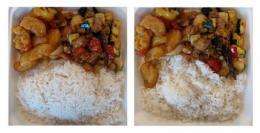
This undated two-picture combo provided by Aline Michelle Grüneisen, Lab Manager, Center for Advanced Hindsight, Duke University shows the same meal, but the photo at left shows a full serving of rice and the other a half serving of rice. A creative new experiment suggests paring down the side dishes might help a nation of over-eaters shave some calories. Researchers infiltrated a fast-food Chinese restaurant and found up to a third of diners jumped at the offer of a half-size of the usual heaping pile of rice or noodles _ even when the smaller amount cost the same. (AP Photo/Aline Michelle Grüneisen, Center for Advanced Hindsight, Duke University)
(AP) -- Call it the alter-ego of super-sizing. Researchers infiltrated a fast-food Chinese restaurant and found up to a third of diners jumped at the offer of a half-size of the usual heaping pile of rice or noodles - even when the smaller amount cost the same.
Giant portion sizes are one of the culprits behind the epidemic of bulging waistlines, and nowhere is the portion-creep more evident than in restaurants with French fry-heavy meal deals or plates overflowing with pasta. Now scientists are tapping into the psychology of eating to find ways to trim portions without people feeling cheated - focusing on everything from the starchy sides to the color of the plates.
"The small Coke now is what used to be a large 15 years ago," laments psychologist Janet Schwartz, a marketing professor at Tulane University who led the Chinese food study. "We should ask people what portion size they want," instead of large being the default.
Restaurants are paying close attention, says prominent food-science researcher Brian Wansink of Cornell University. His own tests found children were satisfied with about half the fries in their Happy Meal long before McDonald's cut back the size, and the calories, last year.
"We'll be seeing some very creative ways of down-sizing in the next couple of years," predicts Wansink, author of Mindless Eating: Why We Eat More Than We Think.
But let's call it "right-sizing," says Duke University behavioral economist Dan Ariely. Right-size suggests it's a good portion, not a cut, he says.
Couldn't you just get a doggie bag? Sure, if you've got the willpower to stop before your plate is mostly clean. Lots of research shows Americans don't. We tend to rely on visual cues about how much food is left, shoveling it in before the stomach-to-brain signal of "hey wait, I'm getting full" can arrive.
So Schwartz and Ariely tested a different approach: Could we limit our own temptation if we focus not on the tastiest reason we visited a restaurant - the entree - but on the side dishes? After all, restaurants can pile on calorie-dense starches like rice or pasta or fries because they're very inexpensive, filling the plate so it looks like a good deal, Schwartz says.
A popular Chinese franchise at Duke University, with a mix of students, staff and visitors to the campus hospital, allowed the researchers in at lunchtime.
In the serving line, customers pick the rice or noodles first. The standard serving is a whopping 10 ounces, about 400 calories even before ordering the entree, says Schwartz. There was no half-size option on the menu board.
In a series of experiments, servers asked 970 customers after their initial rice or noodle order: "Would you like a half-order to save 200 calories?" Those who said yes didn't order a higher-calorie entree to compensate. Weighing leftovers showed they threw away the same amount of food as customers who refused or weren't offered the option.
A 25-cent discount didn't spur more takers. Nor did adding calorie labels so people could calculate for themselves, the researchers report in this month's journal Health Affairs - concluding the up-front offer made the difference.
Anywhere from 14 percent to 33 percent chose the reduced portions, depending on the day and the mix of customers.
Even 200 fewer calories can add up over time. And other tricks can trim portions without people noticing, whether dining out or at home. Cornell's Wansink found people served 18 percent more pasta with marinara sauce onto a red plate than a white one - and 18 percent more pasta alfredo onto a white plate.
A stark contrast "makes you think twice before you throw on another scoop," explains Wansink. His own family bought some dark dinner plates to supplement their white ones, because people tend to overeat white starches more than veggies.
Wansink's other research has found:
-Switching from 11-inch plates to 10-inch plates makes people take less food, and waste less food. The slightly smaller plate makes a normal serving look more satisfying.
-People think they're drinking more from a tall skinny glass than a short wide one even if both hold the same volume, a finding Wansink says was widely adopted by bars.
-Beware if kids eat from the adult bowls. He found 6-year-olds serve themselves 44 percent more food in an 18-ounce bowl than a 12-ounce bowl.
Restaurants are starting to get the message that at least some customers want to eat more sensibly. Applebees, for example, has introduced a line of meals under 550 calories, including such things as steak.
And a National Restaurant Association survey found smaller-portion entrees, "mini-meals" for adults and kids, and bite-size desserts made a new trend list.
It's all consumer demand, says association nutrition director Joy Dubost: More diners now are "requesting the healthier options and paying attention to their calories."
©2012 The Associated Press. All rights reserved. This material may not be published, broadcast, rewritten or redistributed.
-
'Healthy' restaurants help make us fat, says a newl study
Sep 24, 2007 |
not rated yet |
0
-
Using contrasting colors to reduce serving sizes and lose weight
Jan 17, 2012 |
not rated yet |
0
-
You're likely to order more calories at a 'healthy' restaurant
Aug 29, 2007 |
not rated yet |
0
-
'Mindless autopilot' drives people to underestimate food decisions
Dec 26, 2006 |
not rated yet |
0
-
Mindless eating: Losing weight without thinking
Aug 05, 2011 |
not rated yet |
0
-
Motion perception revisited: High Phi effect challenges established motion perception assumptions
Apr 23, 2013 |
3 / 5 (2) |
2
-
Anything you can do I can do better: Neuromolecular foundations of the superiority illusion (Update)
Apr 02, 2013 |
4.5 / 5 (11) |
5
-
The visual system as economist: Neural resource allocation in visual adaptation
Mar 30, 2013 |
5 / 5 (2) |
9
-
Separate lives: Neuronal and organismal lifespans decoupled
Mar 27, 2013 |
4.9 / 5 (8) |
0
-
Sizing things up: The evolutionary neurobiology of scale invariance
Feb 28, 2013 |
4.8 / 5 (10) |
14
-
Classical and Quantum Mechanics via Lie algebras
Apr 15, 2011
- More from Physics Forums - Independent Research
More news stories
Driving and hands-free talking lead to spike in errors, study shows
Talking on a hands-free device while behind the wheel can lead to a sharp increase in errors that could imperil other drivers on the road, according to new research from the University of Alberta.
Health
23 hours ago |
not rated yet |
1
About one in four uninsured could be excluded from ACA
(HealthDay)—More than one in four of those eligible for new premium assistance tax credits under the Affordable Care Act (ACA) do not have a checking account and will not be able to receive premiums from ...
Health
May 24, 2013 |
not rated yet |
0
Audiologists recommend smart phone apps to monitor noise levels
After studying noise in one French Quarter neighborhood of New Orleans to determine whether or not noise levels exceeded municipal ordinances, Annette Hurley, PhD, Assistant Professor of Audiology at LSU Health Sciences Center ...
Health
May 24, 2013 |
not rated yet |
0
Young children who miss well-child visits are more likely to be hospitalized
Young children who missed more than half of recommended well-child visits had up to twice the risk of hospitalization compared to children who attended most of their visits, according to a study published today in the American Jo ...
Health
May 24, 2013 |
not rated yet |
0
Do doctors understand the individualisation of treatments?
The individualisation of drug treatments to support patients to self-manage their conditions is a concept that sits at the heart of policy, but a recent study in BMJ Open shows that there is no concrete defini ...
Health
May 24, 2013 |
3 / 5 (1) |
0
First drug to improve heart failure mortality in over a decade
Coenzyme Q10 decreases all cause mortality by half, according to the results of a multicentre randomised double blind trial presented today at Heart Failure 2013 congress. It is the first drug to improve heart failure mortality ...
Heart failure accelerates male 'menopause'
Heart failure accelerates the aging process and brings on early andropausal syndrome (AS), according to research presented today at the Heart Failure Congress 2013. AS, also referred to as male 'menopause', was four times ...
Death highest in heart failure patients admitted in January, on Friday, and overnight
Mortality and length of stay are highest in heart failure patients admitted in January, on Friday, and overnight, according to research presented today at the Heart Failure Congress 2013. The analysis of nearly 1 million ...
Feds fight morning-after pill age ruling in NY
(AP)—Department of Justice lawyers have again asked a federal appeals court in New York to delay lifting age restrictions and prescription requirements on an emergency contraceptive popularly known as the morning-after ...
Researchers identify first drug targets in childhood genetic tumor disorder
Two mutations central to the development of infantile myofibromatosis (IM)—a disorder characterized by multiple tumors involving the skin, bone, and soft tissue—may provide new therapeutic targets, according to researchers ...
New immune system discovered
(Medical Xpress)—A research team, led by Jeremy Barr, a biology post-doctoral fellow, unveils a new immune system that protects humans and animals from infection.