New point of attack for breast cancer with poor prognosis
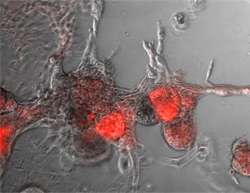
(Medical Xpress) -- Scientists from the Friedrich Miescher Institute for Biomedical Research describe how the protein phosphatase SHP2 promotes breast cancer with poor prognosis. As they report in the latest issue of Nature Medicine, SHP2 is necessary for the maintenance of the few tumor initiating cells (TICs) in a breast tumor. These cells are thought to sustain the growth of the tumor, promote metastasis and lead to relapses.
A few cells can wreak deadly havoc. This population of cells can not only initiate cancer, it may, in some tumor types, also be the one to promote growth, resist therapy, or cause relapse. In recent years, these so-called tumor initiating cells (TICs) have thus moved into the focus of attention because of their promise for therapeutic intervention: TICs seem to be the reason why patients with some cancers do not react to therapy or relapse quickly after remission, and TICs seem to be more abundant in aggressive and refractory cancers. Unfortunately, knowledge about the signaling pathways controlling the functions of TICs is only starting to become available.
The fundamental role of SHP2
In a breast cancer study, Mohamed Bentires-Alj and scientists from his group at the Friedrich Miescher Institute for Biomedical Research identified now an important player in the signaling cascades governing TICs. The protein phosphatase SHP2 plays a fundamental role in breast cancer proliferation, invasion and metastasis. When the scientists depleted SHP2 from breast cancer cells with a small hairpin RNA, it decreased proliferation and invasiveness in 3D cultures, blocked tumor growth and reduced metastasis. What is more they showed in a xenograft model that SHP2 depletion eradicated TICs as well. "We believe that one should not only target the bulk of the tumor but also the tumor initiating cells," comments Bentires-Alj. "By better understanding the signaling events governing tumor initiating cells, we hope to develop new, more efficacious, therapeutic approaches."
Labeled for invasive behavior and poor prognosis
When looking at the molecular signaling events after SHP2 depletion, the scientists realized that SHP2 activates transcription factors that are usually associated with stem cells. Together with Michael Stadler, the head of bioinformatics at the FMI, they further identified what they called "signature genes" that are being co-overexpressed in the presence of SHP2. These genes are activated in a large subset of primary breast tumors associated with invasive behavior and poor prognosis.
"The discovery of the gene signature which is induced by SHP2 in breast tumors may provide an important readout for SHP2 activity, thus allowing the identification of tumors that are likely to respond to SHP2-targeted therapy," said Nicola Aceto, first author of the publication.
"Now that we have elucidated the critical role SHP2 plays in tumor initiating cells, we are eager to see our basic research findings translated into effective therapies. To this end selective inhibitors should be developed and tested. In general, our understanding of cancer over the last decades holds promises for better therapies. It is thus very important that basic scientists, industry and clinicians work together to help these to bear fruit," said Bentires-Alj.
More information: Aceto N, et al. (2012) Tyrosine phosphatase SHP2 promotes breast cancer progression and maintains tumor-initiating cells via activation of key transcription factors and a positive feedback signaling loop. Nature Medicine, doi:10.1038/nm.2645


