Deafening affects vocal nerve cells within hours
March 7, 2012 in Neuroscience

Deafening affects vocal nerve cells within hours

Enlarge

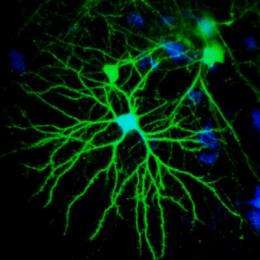
Neurons (nerve cells) are labeled with green fluorescent protein, and other neurons in the brain are labeled in the background with either red or blue tracers. The small bulbs (i.e., dendritic spines) on the spidery dendrites show places where nerve cells connect and communicate, called synapses, and when these spines shrank over time, this predicted vocal degradation in the songbirds. Credit: Katie Tschida, Duke Department of Neurobiology

Portions of a songbird's brain that control how it sings have been shown to decay within 24 hours of the animal losing its hearing.

The findings, by researchers at Duke University Medical Center, show that deafness penetrates much more rapidly and deeply into the brain than previously thought. As the size and strength of visibly changed under a microscope, researchers could even predict which would have worse songs in coming days.

"When hearing was lost, we saw rapid changes in motor areas in that control song, the bird's equivalent of speech," said senior author Richard Mooney, Ph.D., professor of at Duke. "This study provided a laser-like focus on what happens in the living songbird brain, narrowed down to the particular cell type involved."

The study was published in Neuron journal online on March 7, 2012.

This video is not supported by your browser at this time.

This bird (a male, because only male zebra finches sing) was around 90 days post hatch (dph) when he became deaf. This is around the age at which zebra finches sexually mature, so he is considered a young adult. This is the .wav file of his pre-deafening song. Credit: Katie Tschida, Duke Department of Neurobiology

Like humans, songbirds depend on hearing to learn their mating songs – males that sing poorly don't attract mates, so hearing a song, learning it, and singing correctly are all critical for songbird survival. Songbirds also resemble humans and differ from most other animals in that their songs fall apart when they lose their hearing, and this feature makes them an ideal organism to study how may affect the parts of the brain that control vocalization, Mooney said.

"I will go out on a limb and say that I think similar changes also occur in human brains after hearing loss, specifically in Broca's area, a part of the human brain that plays an important role in generating speech and that also receives inputs from the auditory system," Mooney said.

This video is not supported by your browser at this time.

This bird (a male, because only male zebra finches sing) was around 90 days post hatch (dph) when he became deaf. This is around the age at which zebra finches sexually mature, so he is considered a young adult. Two weeks after deafening, this song sounds messier. Credit: Katie Tschida, Duke Department of Neurobiology

About 30 million Americans are hard of hearing or deaf. This study could shed light on why and how some people's speech changes as their hearing starts to decline, Mooney said.

"Our vocal system depends on the auditory system to create intelligible speech." When people suffer profound hearing loss, their speech often becomes hoarse, garbled, and harder to understand, so not only do they have trouble hearing, they often can't speak fluently any more," Mooney said.

The nerve cells that showed changes after deafening send signals to the basal ganglia, a part of the brain that plays a role in learning and initiating motor sequences, including the complex vocal sequences that make up birdsong and speech.

Although other studies had looked at the effects of deafening on neurons in auditory brain areas, this is the first time that scientists have been able to watch how deafening affects connections between nerve cells in a vocal motor area of the in a living animal, said Katie Tschida, Ph.D., a postdoctoral research associate in the Mooney laboratory who led the study.

Using a protein isolated from jellyfish that can make songbird nerve cells glow bright green when viewed under a laser-powered , they were able to determine that deafening triggered rapid changes to the tiny connections between nerve cells, called synapses, which are only one thousandth of a millimeter across.

"I was very surprised that the weakening of connections between was visible and emerged so rapidly -- over the course of days these changes allowed us to predict which birds' songs would fall apart most dramatically," Tschida said. "Considering that we were only tracking a handful of neurons in each bird, I never thought we'd get information specific enough to predict such a thing."

Provided by Duke University Medical Center search and more info website

4 /5 (4 votes)  

Rank 4 /5 (4 votes)
Relevant PhysicsForums posts

More news stories

Researchers find far-reaching, microvascular damage in uninjured side of brain after stroke

While the effects of acute stroke have been widely studied, brain damage during the subacute phase of stroke has been a neglected area of research. Now, a new study by the University of South Florida reports that within a ...

Neuroscience created 2 hours ago | popularity not rated yet | comments 0 | with audio podcast

Neurons that can multitask greatly enhance the brain's computational power, study finds

Over the past few decades, neuroscientists have made much progress in mapping the brain by deciphering the functions of individual neurons that perform very specific tasks, such as recognizing the location ...

Neuroscience created 5 hours ago | popularity 5 / 5 (5) | comments 0 | with audio podcast

For combat veterans suffering from post-traumatic stress disorder, 'fear circuitry' in the brain never rests

Chronic trauma can inflict lasting damage to brain regions associated with fear and anxiety. Previous imaging studies of people with post-traumatic stress disorder, or PTSD, have shown that these brain regions can over-or ...

Neuroscience created May 18, 2013 | popularity 5 / 5 (1) | comments 0 | with audio podcast

Temporal processing in the olfactory system

The neural machinery underlying our olfactory sense continues to be an enigma for neuroscience. A recent review in Neuron seeks to expand traditional ideas about how neurons in the olfactory bulb might encode information about ...

Neuroscience created May 17, 2013 | popularity 4 / 5 (1) | comments 0 | with audio podcast report

Melon focus headband turns to Kickstarter for rollout plans

(Medical Xpress)—What if the quality of your work depends more on your focus on the piano keys or canvas or laptop than your musical or painting or computing skills? If target users can be convinced, they ...

Neuroscience created May 17, 2013 | popularity 3.7 / 5 (3) | comments 0 | with audio podcast weblog


Music therapy reduces anxiety, use of sedatives for patients receiving ventilator support

New research suggests that for some hospitalized ICU patients on mechanical ventilators, using headphones to listen to their favorite types of music could lower anxiety and reduce their need for sedative medications.

Tiny, implantable coil promises hope for emphysema patients

A small, easily implantable device called the Lung Volume Reduction Coil (LVRC) may play a key role in the treatment of two types of emphysema, according to a study conducted in Europe. Results of the study indicate the beneficial ...

Early IV nutrition for certain patients does improve survival or reduce ICU length of stay

The early (within 24 hours of intensive care unit [ICU] admission) provision of intravenous nutrition among critically ill patients with contraindications (a condition that makes a particular procedure potentially inadvisable) ...

Having a nighttime critical care physician in the ICU doesn't improve patient outcomes, research finds

With little evidence to guide them, many hospital intensive care units (ICUs) have been employing critical care physicians at night with the notion it would improve patients' outcomes. However, new results from a one-year ...

CT radiation risk less than risk of examination indicator

(HealthDay)—For young adults needing either a chest or abdominopelvic computed tomography (CT), the short-term risk of death from underlying morbidity is greater than the long-term risk of radiation-induced ...

Extra vitamin D may ease Crohn's symptoms, study finds

(HealthDay)—Vitamin D supplements may help those with Crohn's disease overcome the fatigue and decreased muscle strength associated with the inflammatory bowel disease, according to new research.