Scientists produce eye structures from human blood-derived stem cells
March 14, 2012 in Ophthalmology
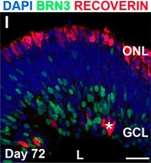
At 72 days, stem cells derived from human blood formed an early retina structure, with specialized cells resembling photoreceptors (red) and ganglion cells (green) located within the outer and inner layers, respectively. Nuclei of cells within the middle layer are shown in blue. These layers are similar to those present during normal human eye development.
(Medical Xpress) -- For the first time, scientists at the University of Wisconsin-Madison have made early retina structures containing proliferating neuroretinal progenitor cells using induced pluripotent stem (iPS) cells derived from human blood.
And in another advance, the retina structures showed the capacity to form layers of cells - as the retina does in normal human development - and these cells possessed the machinery that could allow them to communicate information. (Light-sensitive photoreceptor cells in the retina along the back wall of the eye produce impulses that are ultimately transmitted through the optic nerve and then to the brain, allowing you to see.)
Put together, these findings suggest that it is possible to assemble human retinal cells into more complex retinal tissues, all starting from a routine patient blood sample.
Many applications of laboratory-built human retinal tissues can be envisioned, including using them to test drugs and study degenerative diseases of the retina such as retinitis pigmentosa, a prominent cause of blindness in children and young adults. One day, it may also be possible replace multiple layers of the retina in order to help patients with more widespread retinal damage.
"We don't know how far this technology will take us, but the fact that we are able to grow a rudimentary retina structure from a patient's blood cells is encouraging, not only because it confirms our earlier work using human skin cells, but also because blood as a starting source is convenient to obtain," says Dr. David Gamm, pediatric ophthalmologist and senior author of the study. "This is a solid step forward."
In 2011, the Gamm lab at the Waisman Center created structures from the most primitive stage of retinal development using embryonic stem cells and stem cells derived from human skin. While those structures generated the major types of retinal cells, including photoreceptors, they lacked the organization found in more mature retina.
This time, the team, led by Gamm, assistant professor of ophthalmology and visual sciences in the UW School of Medicine and Public Health, and postdoctoral researcher and lead author Dr. Joseph Phillips, used their method to grow retina-like tissue from iPS cells derived from human blood gathered via standard blood draw techniques.
In their study, about 16 percent of the initial retinal structures developed distinct layers. The outermost layer primarily contained photoreceptors, whereas the middle and inner layers harbored intermediary retinal neurons and ganglion cells, respectively. This particular arrangement of cells is reminiscent of what is found in the back of the eye.
Further, work by Dr. Phillips showed that these retinal cells were capable of making synapses, a prerequisite for them to communicate with one another.
The iPS cells used in the study were generated through collaboration with Cellular Dynamics International (CDI) of Madison, Wisconsin, which pioneered the technique to convert blood cells into iPS cells. CDI scientists extracted a type of blood cell called a T-lymphocyte from the donor sample, and reprogrammed the cells into iPS cells. Cellular Dynamics International was founded by UW-Madison stem cell pioneer Dr. James Thomson.
"We were fortunate that CDI shared an interest in our work. Combining our lab's expertise with that of CDI was critical to the success of this study," added Gamm.
More information: The results were published in the March 12, 2012 online issue of Investigative Ophthalmology & Visual Science, the journal of the Association for Research in Vision and Ophthalmology.
Journal reference:
Investigative Ophthalmology & Visual Science
Provided by
University of Wisconsin-Madison
-
Stem cells from patients make 'early retina in a dish'
Jun 16, 2011 |
not rated yet |
0
-
Retina cells grown from skin-derived stem cells
Aug 24, 2009 |
not rated yet |
0
-
Researchers report progress using iPS cells to reverse blindness
Jun 15, 2011 |
not rated yet |
0
-
Retinal transplants may help restore sight
Nov 08, 2006 |
not rated yet |
0
-
A key mechanism regulating neural stem cell development is uncovered
Oct 08, 2008 |
not rated yet |
0
-
Motion perception revisited: High Phi effect challenges established motion perception assumptions
Apr 23, 2013 |
3 / 5 (2) |
2
-
Anything you can do I can do better: Neuromolecular foundations of the superiority illusion (Update)
Apr 02, 2013 |
4.5 / 5 (11) |
5
-
The visual system as economist: Neural resource allocation in visual adaptation
Mar 30, 2013 |
5 / 5 (2) |
9
-
Separate lives: Neuronal and organismal lifespans decoupled
Mar 27, 2013 |
4.9 / 5 (8) |
0
-
Sizing things up: The evolutionary neurobiology of scale invariance
Feb 28, 2013 |
4.8 / 5 (10) |
14
-
Force Between Two Concentric Solenoids
2 hours ago
-
Synchrotron, question about insertion devices and electron velocity
2 hours ago
-
Equating differentials => equating coefficients
3 hours ago
-
The idea behind a reverse shock
9 hours ago
-
Guass's Law for a charge distribution
9 hours ago
-
Noise dependence
10 hours ago
- More from Physics Forums - Classical Physics
More news stories
Glucosamine supplements tied to risk of eye condition
(HealthDay)—Glucosamine supplements that millions of Americans take to help treat hip and knee osteoarthritis may have an unexpected side effect: They may increase risk for developing glaucoma, a small ...
Ophthalmology
May 23, 2013 |
not rated yet |
0
Glaucoma drug can cause droopy eyelids
Prostaglandin analogues (PGAs), drugs which lower intraocular pressure, are often the first line of treatment for people with glaucoma, but their use is not without risks. PGAs have long been associated with blurred vision, ...
Ophthalmology
May 21, 2013 |
not rated yet |
0
Eyes on the sun: Child sunshine exposure and eye development
(Medical Xpress)—Exposure to sunshine as a small child is crucial to the development of a healthy eye according to results of long-term myopia study conducted by University of Sydney researchers.
Ophthalmology
May 21, 2013 |
5 / 5 (1) |
0
New study pinpoints biochemical mechanism underlying fibrosis following glaucoma surgery
The most common cause of failure after glaucoma surgery is scarring at the surgical site, so researchers are actively looking for ways to minimize or prevent scar formation. Previous work had suggested that vascular endothelial ...
Ophthalmology
May 17, 2013 |
not rated yet |
0
|
Early screenings key to diagnosing glaucoma
New research is emphasizing the importance of regular screenings for glaucoma, a disease that deteriorates the optic nerve over time and is a leading cause of irreversible blindness worldwide. The onset of glaucoma is associated ...
Ophthalmology
May 17, 2013 |
not rated yet |
0
|
First drug to improve heart failure mortality in over a decade
Coenzyme Q10 decreases all cause mortality by half, according to the results of a multicentre randomised double blind trial presented today at Heart Failure 2013 congress. It is the first drug to improve heart failure mortality ...
Seniors more likely to crash when driving with pet, study finds
(HealthDay)—Animals make great companions for senior citizens, but elderly people who always drive with a pet in the car are far more likely to crash than those who never drive with a pet, researchers have ...
Heart failure accelerates male 'menopause'
Heart failure accelerates the aging process and brings on early andropausal syndrome (AS), according to research presented today at the Heart Failure Congress 2013. AS, also referred to as male 'menopause', was four times ...
Death highest in heart failure patients admitted in January, on Friday, and overnight
Mortality and length of stay are highest in heart failure patients admitted in January, on Friday, and overnight, according to research presented today at the Heart Failure Congress 2013. The analysis of nearly 1 million ...
Feds fight morning-after pill age ruling in NY
(AP)—Department of Justice lawyers have again asked a federal appeals court in New York to delay lifting age restrictions and prescription requirements on an emergency contraceptive popularly known as the morning-after ...
New immune system discovered
(Medical Xpress)—A research team, led by Jeremy Barr, a biology post-doctoral fellow, unveils a new immune system that protects humans and animals from infection.