Tuberculosis vaccine being tested in Phase II trial
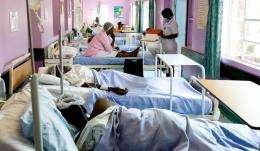
In countries like South Africa, tuberculosis is among the leading causes of death, particularly in HIV patients. Credit: Jonas Steengaard
The only tuberculosis vaccine currently available is already over 90 years old - and is unsatisfactory in terms of its effectiveness. Although it protects young children against developing tuberculosis, it quickly loses its effectiveness and does not protect young people and adults against the infection. Scientists from the Max Planck Institute for Infection Biology in Berlin have now developed an improved vaccine which has been undergoing clinical trials on humans since 2008. The safety and tolerability of the vaccine candidate is being tested in a Phase II trial on infants in South Africa. The results of the preceding Phase I trial have already shown that the vaccine candidate fulfils the relevant safety requirements and that its mechanism of action works.
Scientists have been working on an improved vaccine against the tuberculosis bacterium Mycobacterium tuberculosis for almost 90 years. The Bacillus Calmette-Guérin vaccine (BCG) was developed in the early 20th century and contains attenuated Mycobacterium bovis bacteria, the bovine tuberculosis pathogen that is transmissible to humans. BCG vaccination protects children in most cases against the disease, but not adults. Therefore, the vaccine has not contributed to reducing the global incidence of tuberculosis.
The VPM1002 vaccine, which was developed at the Max Planck Institute for Infection Biology, is based on the BCG vaccine and contains genetically modified Mycobacterium bovis bacteria. A built-in gene makes it easier for the immune cells to recognise the bacteria; the organism can thus protect itself against actual infection with dangerous tuberculosis pathogens. VPM1002 is intended to replace the current BCG vaccine and will be administered to young children to protect them against tuberculosis. However, adults may also be able to benefit from it later, says Stefan Kaufmann from the Berlin-based Max Planck Institute.
The vaccine candidate has been undergoing Phase II trials since November 2011. These should establish whether it is safe and tolerable for infants in regions with a high incidence of tuberculosis. A total of 48 infants are being immunised. No side-effects have emerged to date.
VPM1002 was licensed to Vakzine Projekt Management GmbH in Hanover, which carried out its entire pre-clinical development. The vaccine was initially tested on healthy volunteers in Germany under the name VPM1002 in autumn 2008. The safety profile of an active substance is tested in a Phase I trial. The vaccine passed this test with flying colours. No side effects arose in the course of this study. The next thing the researchers must ensure is that VPM1002 is also safe and works as planned in individuals who live in regions with a high incidence of tuberculosis. The Phase Ib study shows that VPM1002 also fulfils this requirement, says Bernd Eisele from Vakzine Projekt Management, which is responsible for the implementation of the vaccine trials.
Before VPM1002 can be introduced to the market as a vaccine, its effectiveness and safety must be confirmed in further studies on volunteers in areas with a high risk of tuberculosis. If everything goes well and VPM1002 also proves effective and safe in large-scale international studies, the new vaccine could be ready for use in around four years time, hopes Stefan Kaufmann.
In addition to VPM1002, eleven other tuberculosis vaccine candidates are currently undergoing clinical development. VPM1002 is the only one of three genetically modified variants of the current BCG vaccine that is undergoing further development in clinical trials. Two of the other candidates, which are based on a virus carrier with Mycobacterium tuberculosis antigens, are currently undergoing Phase IIb trials. The first of these vaccines could be available for use in 2016 at the earliest.
Experts estimate that a vaccine which improves on the BCG could prevent almost 8 million deaths from tuberculosis. A new booster vaccine could reduce the number of tuberculosis victims by a further 40 percent.
Provided by
Max-Planck-Gesellschaft
-
Tuberculosis vaccine passes phase I trial
Mar 24, 2011 |
not rated yet |
0
-
New tuberculosis vaccine is developed
Jun 06, 2007 |
not rated yet |
0
-
Research identifies type of vaccine that holds promise in protecting against TB
Oct 20, 2008 |
not rated yet |
0
-
2,784 vaccinations later
Apr 29, 2011 |
not rated yet |
0
-
Final child vaccinated in clinical trial of new TB vaccine
May 04, 2011 |
not rated yet |
0
-
Motion perception revisited: High Phi effect challenges established motion perception assumptions
Apr 23, 2013 |
3 / 5 (2) |
2
-
Anything you can do I can do better: Neuromolecular foundations of the superiority illusion (Update)
Apr 02, 2013 |
4.5 / 5 (11) |
5
-
The visual system as economist: Neural resource allocation in visual adaptation
Mar 30, 2013 |
5 / 5 (2) |
9
-
Separate lives: Neuronal and organismal lifespans decoupled
Mar 27, 2013 |
4.9 / 5 (8) |
0
-
Sizing things up: The evolutionary neurobiology of scale invariance
Feb 28, 2013 |
4.8 / 5 (10) |
14
-
Why is zone 1 in liver more prone to ischemic injury?
May 23, 2013
-
How can there be villous adenoma in colon, if there are no villi there
May 22, 2013
-
How can there be a term called "intestinal metaplasia" of stomach
May 21, 2013
-
Pressure-volume curve: Elastic Recoil Pressure don't make sense
May 18, 2013
-
If you became brain-dead, would you want them to pull the plug?
May 17, 2013
-
MRI bill question
May 15, 2013
- More from Physics Forums - Medical Sciences
More news stories
Merck ends development of Parkinson's disease drug
(AP)—Merck & Co. says it is ending development of an experimental Parkinson's disease drug because the drug wasn't working.
Medications
18 hours ago |
1 / 5 (1) |
0
J&J expects 10-plus new drug applications by 2017
(AP)—Johnson & Johnson is developing what could eventually be game-changing treatments for depression and pain, and it's aiming to apply for approval of more than 10 new medicines by 2017, executives said Thursday during ...
Medications
19 hours ago |
5 / 5 (1) |
0
Experts favor US approval of Merck sleeping pill (Update)
An independent panel of experts on Wednesday recommended US approval of a new Merck sleeping pill called suvorexant, but expressed concerns over the highest dosage and risks of drowsy daytime driving.
Medications
May 22, 2013 |
not rated yet |
0
Glaxo, US partnering to develop new antibiotics
GlaxoSmithKline PLC says it's starting an unusual collaboration with the U.S. government to develop several antibiotics for both bioterrorism threats and bacterial infections resistant to current medicines.
Medications
May 22, 2013 |
not rated yet |
0
Study finds new pneumococcal vaccine appears to be as safe as previously used vaccine
The new 13-valent pneumococcal conjugate vaccine (PCV13) appears to be as safe as the previous version used prior to 2010, the 7-valent pneumococcal conjugate vaccine (PCV7), according to a Kaiser Permanente study published ...
Medications
May 22, 2013 |
not rated yet |
0
Going live: Immune cell activation in multiple sclerosis
Biological processes are generally based on events at the molecular and cellular level. To understand what happens in the course of infections, diseases or normal bodily functions, scientists would need to ...
Youth with type 2 diabetes at much higher risk for heart, kidney disease
The news about youth and diabetes keeps getting worse. The latest data from the national TODAY diabetes study shows that children who develop Type 2 diabetes are at high risk to develop heart, kidney and eye problems faster ...
New animal model gives insights into mechanisms of Parkinson's disease pathogenesis
In Parkinson's disease, the protein "alpha-synuclein" aggregates and accumulates within neurons. Specific areas of the brain become progressively affected as the disease develops and advances. The mechanism underlying this ...
Audiologists recommend smart phone apps to monitor noise levels
After studying noise in one French Quarter neighborhood of New Orleans to determine whether or not noise levels exceeded municipal ordinances, Annette Hurley, PhD, Assistant Professor of Audiology at LSU Health Sciences Center ...
Registry confirms TAVI efficacy and safety in Asian patients
Transcatheter aortic valve implantation (TAVI) is effective and safe in Asian patients, according to early experience based on first results from a multicentre Asian registry reported at EuroPCR 2013.
Young children who miss well-child visits are more likely to be hospitalized
Young children who missed more than half of recommended well-child visits had up to twice the risk of hospitalization compared to children who attended most of their visits, according to a study published today in the American Jo ...