First gene linked to common form of psoriasis identified
Scientists led by Washington University School of Medicine in St. Louis have identified the first gene directly linked to the most common form of psoriasis, a chronic skin condition.
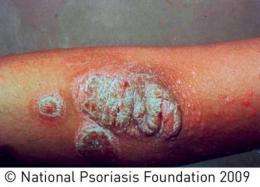
The research shows that rare mutations in the CARD14 gene, when activated by an environmental trigger, can lead to plaque psoriasis. This type of psoriasis accounts for 80 percent of all cases and is characterized by dry, raised, red patches covered with silvery scales that can be itchy and painful.
The new findings also indicate that mutations in CARD14 can be involved in the pustular form of psoriasis and in a debilitating arthritis linked to the psoriasis. The discovery may lead to more effective, targeted therapies for plaque psoriasis and other forms of the disease.
The research is published May 4 in two separate papers in The American Journal of Human Genetics.
"We have searched for almost two decades to find a single gene linked to plaque psoriasis," says the senior author of both papers, Anne Bowcock, PhD, professor of genetics. "Individually, the rare mutations we have found likely confer a high risk for the disease, and we think they will be important in the search to find new, more effective treatments."
Although psoriasis has long been thought to be caused by an overactive immune system, the genetic pathway uncovered by the scientists points to defects in the skin as the main culprit of the condition and to immune cells as secondary players.
Now, the researchers want to find out how common the altered pathway is in the different types of psoriasis and in patients with psoriatic arthritis. Their work suggests that in at least some patients with different forms of psoriasis, this pathway is the same.
An estimated 7.5 million Americans have psoriasis, and about 30 percent of them develop psoriatic arthritis. Like other common diseases, psoriasis runs in families and has been thought to have a genetic component, but it's been difficult to pin down the genes involved. That's because common variations in genes likely contribute very little to the overall genetic risk of the disease, and mutations that substantially increase a person's risk are so rare they have been impossible to find.
With early support from the National Psoriasis Foundation, Bowcock initiated the research with co-author Alan Menter, MD, of the Psoriasis Research Institute at the Baylor College of Medicine.
Using the latest DNA technology to sequence all of a patient's genes, Bowcock and her colleagues uncovered a rare CARD14 mutation in a large family of northern European descent in which plaque psoriasis was prevalent. They also found the mutation in the one-third of family members who had developed psoriatic arthritis, suggesting that the same rare mutation can play a role in both conditions.
The scientists also identified another rare CARD14 mutation in an extended family from Taiwan that had a large number of plaque psoriasis cases.
But mutations in the gene do not only occur in families with a genetic predisposition.
The researchers, including the papers' first author Catherine Jordan, an MD/PhD student at Washington University, also found a CARD14 mutation in a 3-year-old girl with a severe case of pustular psoriasis, a rare form of psoriasis. Neither of the girls' parents had mutations in CARD14, indicating that the rare mutation was not inherited but had occurred spontaneously.
Psoriasis typically develops after an environmental trigger, which can include an infection, such as strep throat, or injury to the skin, including a cut or bug bite. Certain medications, smoking and heavy alcohol consumption also are triggers.
The young girl, from Haiti, developed psoriasis in infancy, like some members of the family with origins in northern Europe.
"This is significant because it tells us that CARD14 mutations alone are enough to lead to psoriasis, possibly after an early trigger such as an infection," Bowcock explains. "You don't need anything else. This really highlights the importance of finding rare mutations for common diseases like psoriasis."
The researchers also found 15 other rare mutations in CARD14. In a finding that is statistically significant, the mutations were more common in more than 6,000 patients with psoriasis compared to 4,000 healthy controls.
The scientists showed that in specialized skin cells called keratinocytes, mutations in CARD14 increase the activity of NF-kappaB, a protein that turns on genes. This protein increases the production of certain signaling molecules that attract inflammatory cells to the skin, unleashing a vicious cycle of inflammation that is so notable in psoriasis.
Psoriasis affects the life cycle of skin cells, causing them to mature rapidly in just a few days and accumulate to form thick, scaly patches. Interestingly, in psoriasis patients with CARD14 mutations, the researchers found the gene's activity was increased in the upper layers of the skin, which may explain the flakiness that characterizes the condition.
"Now, we have a much clearer picture of what is happening in psoriasis," Bowcock says. "And with all kinds of new therapeutic targets that lie within the CARD14 pathway, the field is wide open."
More information: The American Journal of Human Genetics. May 4, 2012. www.cell.com/AJHG/


