New insight into pain mechanisms
April 25, 2012 in Medical research

New insight into pain mechanisms

Enlarge

(Medical Xpress) -- Researchers in the UCL Wolfson Institute for Biomedical Research have made a discovery which could help the development of analgesic drugs able to treat nerve damage-related pain.

The research is published today in the journal Nature Communications and funded by the Biotechnology and Biological Sciences Research Council (BBSRC).

Current work well for some types of pain, but are not very effective for easing the chronic pain associated with . This type of pain is called neuropathic pain and it is associated with diseases like or trauma.

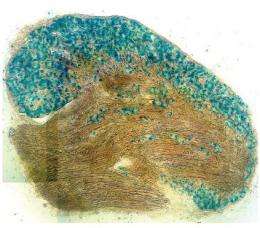
New findings from Professor John Wood (UCL Wolfson Institute for Biomedical Research) could help change this. They have identified the specific in mice that are important for transmitting particular types of pain and that the transmission of neuropathic pain is dependent on a specific pain-signalling channel called Nav1.7.

Professor Wood and his team studied mice in which Nav1.7 is lost and were able to demonstrate that mice without the Nav 1.7 channel did not suffer from neuropathic pain. This suggests it could be a for drugs to treat neuropathic pain.

The research also improves our understanding of the role of the Nav1.7 channel in the release of transmitters that cause pain sensations and suggested that new pain killers may work best if they can be directed both to the ends of the nerves in the skin and to the .

While it was already known that the loss of this Nav 1.7 channel in humans stops the experience of acute and , such as that caused by a cut or a burn, or a long term condition like arthritis, this is the first research to show a connection with neuropathic pain. It provides important clues for the development of effective new Nav1.7-targeted pain killers.

Professor John Wood, said: “Chronic pain is debilitating, but not all pain is bad pain. For example, if we touch a scalding saucepan, acute pain makes us withdraw our hand. What we are trying to do is to find targets for drugs which mean chronic pain can be alleviated, while enabling our body to still respond to other types of acute pain that protect us. ”

This research highlights the crucial role of fundamental bioscience in providing new knowledge to pave the way for the production of new pharmaceuticals.

Provided by University College London search and more info website

5 /5 (2 votes)  

Rank 5 /5 (2 votes)
Related Stories
Relevant PhysicsForums posts

More news stories

H. pylori, smoking trends, and gastric cancer in US men

Trends in Helicobacter pylori (H. pylori) and smoking explain a significant proportion of the decline of intestinal-type noncardia gastric adenocarcinoma (NCGA) incidence in US men between 1978 and 2008, and are estimated ...

Medical research created 8 hours ago | popularity not rated yet | comments 0

Common food supplement fights degenerative brain disorders

Widely available in pharmacies and health stores, phosphatidylserine is a natural food supplement produced from beef, oysters, and soy. Proven to improve cognition and slow memory loss, it's a popular treatment for older ...

Medical research created 12 hours ago | popularity 5 / 5 (2) | comments 0 | with audio podcast

Finding a family for a pair of orphan receptors in the brain

Researchers at Emory University have identified a protein that stimulates a pair of "orphan receptors" found in the brain, solving a long-standing biological puzzle and possibly leading to future treatments for neurological ...

Medical research created 13 hours ago | popularity 5 / 5 (1) | comments 0 | with audio podcast

Insight into the dazzling impact of insulin in cells

Australian scientists have charted the path of insulin action in cells in precise detail like never before. This provides a comprehensive blueprint for understanding what goes wrong in diabetes.

Medical research created 13 hours ago | popularity 4.5 / 5 (6) | comments 0 | with audio podcast

Do men's and women's hearts burn fuel differently?

Researchers at the University of Illinois at Chicago College of Medicine will study gender differences in how the heart uses and stores fat—its main energy source—and how changes in fat metabolism play ...

Medical research created 16 hours ago | popularity not rated yet | comments 0


If you can remember it, you can remember it wrong

(Medical Xpress)—Native peoples in regions where cameras are uncommon sometimes react with caution when their picture is taken. The fear that something must have been stolen from them to create the photo ...

B vitamins could delay dementia

(Medical Xpress)—Despite spending billions of dollars on research and development, drug companies have been unable to come up with effective treatments for dementia and Alzheimer's Disease (AD). Now, A. ...

New sleeping pill poised to hit US markets

An experimental sleeping pill from US drug company Merck is effective at helping people fall and stay asleep, according to reviewers at the US Food and Drug Administration, which could soon approve the new drug.

Reducing caloric intake delays nerve cell loss

Activating an enzyme known to play a role in the anti-aging benefits of calorie restriction delays the loss of brain cells and preserves cognitive function in mice, according to a study published in the May ...

Antidepressant reduces stress-induced heart condition

A drug commonly used to treat depression and anxiety may improve a stress-related heart condition in people with stable coronary heart disease, according to researchers at Duke Medicine.

Drugs found to both prevent and treat Alzheimer's disease in mice

Researchers at USC have found that a class of pharmaceuticals can both prevent and treat Alzheimer's Disease in mice.