Wiring the brain

April 13, 2012 in Neuroscience

Wiring the brain

Enlarge

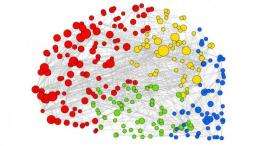
Brain. Image provided by Petra Vertes

(Medical Xpress) -- Researchers at the University of Cambridge have developed a simple mathematical model of the brain which provides a remarkably complete statistical account of the complex web of connections between various brain regions.  Their findings have been published this week in the journal Proceedings of the National Academy of Sciences (PNAS).

The shares a similar pattern of connections with other complex networks such as social networks and the world wide web.  However, until now, it was not known what rules were involved in the formation of the human brain network.

The scientists, from the Behavioral and Clinical Neuroscience Institute in the Department of Psychiatry, and the National Institute of Mental Health in the US, discovered that the network can be modeled as a result of just two different competing factors:  a distance penalty based on the cost of maintaining long-range connections between various brain regions and a second term modeling the preference for links between regions sharing similar input.

This video is not supported by your browser at this time.

Professor Ed Bullmore, lead author on the paper, explains the dynamic between the parameters they identified: “There is a huge amount of evidence that the wiring of brain networks tends to minimize connection costs. Less costly, short-distance connections are much more numerous than more costly, long-distance connections. So our realistically includes a distance penalty on long-distance connections, which will tend to keep connection costs low.

“However, we found that cost control alone was not enough to reproduce a wide range of network properties. To do that, we had to model an economical trade-off between cost control and another term which favoured new, direct connections between regions that shared similar input or were otherwise already indirectly linked.”

The model not only increases our understanding of healthy brains, but the researchers believe it could also provide unique insight into disorders such as schizophrenia.

Dr. Petra Vertes, one of the authors of the paper, said: “Our model hints at possible mechanisms behind schizophrenia, which will be interesting to investigate further.  We have been able to model the disease by tuning the parameters to allow a greater probability of connection between distant .  This result echoes some prior neuroimaging results which suggest that brain networks in schizophrenia may be associated with an abnormal trade-off between connection costs and other topological properties of .”

Journal reference: Proceedings of the National Academy of Sciences search and more info website

Provided by University of Cambridge search and more info website

5 /5 (10 votes)  

Rank 5 /5 (10 votes)
Related Stories
Relevant PhysicsForums posts

More news stories

For combat veterans suffering from post-traumatic stress disorder, 'fear circuitry' in the brain never rests

Chronic trauma can inflict lasting damage to brain regions associated with fear and anxiety. Previous imaging studies of people with post-traumatic stress disorder, or PTSD, have shown that these brain regions can over-or ...

Neuroscience created May 18, 2013 | popularity 5 / 5 (1) | comments 0 | with audio podcast

Temporal processing in the olfactory system

The neural machinery underlying our olfactory sense continues to be an enigma for neuroscience. A recent review in Neuron seeks to expand traditional ideas about how neurons in the olfactory bulb might encode information about ...

Neuroscience created May 17, 2013 | popularity 4 / 5 (1) | comments 0 | with audio podcast report

Melon focus headband turns to Kickstarter for rollout plans

(Medical Xpress)—What if the quality of your work depends more on your focus on the piano keys or canvas or laptop than your musical or painting or computing skills? If target users can be convinced, they ...

Neuroscience created May 17, 2013 | popularity 3.7 / 5 (3) | comments 0 | with audio podcast weblog

Deep brain stimulation: A fix when the drugs don't work

Neurological disorders can have a devastating impact on the lives of sufferers and their families.

Neuroscience created May 17, 2013 | popularity 5 / 5 (1) | comments 0 | with audio podcast

Brain makes call on which ear is used for cell phone

If you're a left-brain thinker, chances are you use your right hand to hold your cell phone up to your right ear, according to a newly published study from Henry Ford Hospital in Detroit.

Neuroscience created May 16, 2013 | popularity 2 / 5 (2) | comments 0 | with audio podcast


Researchers identify a potential new risk for sleep apnea: Asthma

Researchers at the University of Wisconsin have identified a potential new risk factor for obstructive sleep apnea: asthma. Using data from the National Institutes of Health (Heart, Lung, and Blood Institute)-funded Wisconsin ...

Study finds that sleep apnea and Alzheimer's are linked

A new study looking at sleep-disordered breathing (SDB) and markers for Alzheimer's disease (AD) risk in cerebrospinal fluid (CSF) and neuroimaging adds to the growing body of research linking the two.

Computational tool translates complex data into simplified 2-dimensional images

In their quest to learn more about the variability of cells between and within tissues, biomedical scientists have devised tools capable of simultaneously measuring dozens of characteristics of individual ...

New theory on genesis of osteoarthritis comes with successful therapy in mice

Scientists at Johns Hopkins have turned their view of osteoarthritis (OA) inside out. Literally. Instead of seeing the painful degenerative disease as a problem primarily of the cartilage that cushions joints, ...

'Gap' for HIV vaccine efforts after latest setback

The hunt for an HIV vaccine has gobbled up $8 billion in the past decade, and the failure of the most recent efficacy trial has delivered yet another setback to 26 years of efforts.

Ginger compounds may be effective in treating asthma symptoms

Gourmands and foodies everywhere have long recognized ginger as a great way to add a little peppery zing to both sweet and savory dishes; now, a study from researchers at Columbia University shows purified components of the ...