HIV hides soon after infection, research shows
May 30, 2012 By Lisa Chensvold in HIV & AIDS

HIV hides soon after infection, UNC research shows

Enlarge

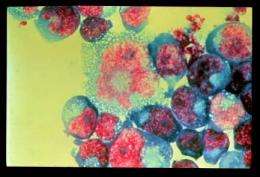
HIV-infected T-cells. Credit: NIAID

(Medical Xpress) -- A team of researchers led by the University of North Carolina School of Medicine has demonstrated that latency develops soon after infection and slows when antiretroviral therapy is given.

While current therapies are effective at controlling HIV, some virus remains hidden in certain CD4+ T cells, specialized that the virus uses to replicate. This latent infection remains a significant challenge to curing HIV.

A team of researchers led by the University of North Carolina School of Medicine has demonstrated that develops soon after infection and slows when antiretroviral therapy is given.

The results were published today online in the early edition of .

The team studied 27 patients with acute HIV infection (AHI). AHI occurs soon after exposure, when virus is found in but are not yet detectible. All but one of the patients studied had been infected in the last 45 days. The study team developed a to predict how often latent cells were infected based on when ART was started. They found that early treatment reduced the production of latently infected cells.

In addition, the researchers found that there are two types of latently infected cells, one short-lived, but another extremely durable, what the authors refer to as a “deep” latent infection. “We found that decayed in some patients, but that all had a few deeply latent infected cells,” said David Margolis, MD, professor of medicine, microbiology and immunology, and epidemiology at UNC and senior author on the study. “These are the cells that we must eliminate to cure infection.”

The team made other hopeful observations. “The immune response of some patients appear to play a role in limiting the size of the latent reservoir,” said Nancie Archin, PhD, the study’s lead author and a research scientist at the medical school. “Efforts to improve the immune response to prevent HIV infection may also teach us to eradicate it.”

The research was conducted through the Center for HIV/AIDS Vaccine Immunology and as part of a UNC-led consortium, the Collaboratory of AIDS Researchers for Eradication (CARE), funded by the National Institute of Allergy and Infectious Diseases. The consortium is administered by the North Carolina Translational and Clinical Sciences (NC TraCS) Institute at UNC, one of 60 medical research institutions in the US working to improve biomedical research through the NIH Clinical and Translational Science Awards (CTSA) program.

Journal reference: Proceedings of the National Academy of Sciences search and more info website

Provided by University of North Carolina at Chapel Hill School of Medicine search and more info website

3.5 /5 (4 votes)  

Rank 3.5 /5 (4 votes)
Relevant PhysicsForums posts

More news stories

Engineered cytomegalovirus protects monkeys from HIV equivalent

(Medical Xpress)—A new study by researchers in the US has shown that an ancient virus can be modified to help in the fight against the simian immunodeficiency virus SIV, which is the equivalent in monkeys ...

HIV & AIDS created May 24, 2013 | popularity 5 / 5 (3) | comments 0 | with audio podcast report

New microsphere-based methods for detecting HIV antibodies

Detection of HIV antibodies is used to diagnose HIV infection and monitor trials of experimental HIV/AIDS vaccines. New, more sensitive detection systems being developed use microspheres to capture HIV antibodies ...

HIV & AIDS created May 23, 2013 | popularity 5 / 5 (1) | comments 0

Fecal microbiota tx feasible for recurrent C. difficile in HIV

(HealthDay)—For HIV-infected individuals with recurrent Clostridium difficile infection, fecal microbiota therapy is feasible, according to a letter published in the May 21 issue of the Annals of Intern ...

HIV & AIDS created May 22, 2013 | popularity not rated yet | comments 0

Canada lifts ban on gay men donating blood

Canadian health authorities lifted Wednesday what was effectively a ban on gay men giving blood, announcing new rules making men who have not had sex with men in the past five years eligible.

HIV & AIDS created May 22, 2013 | popularity not rated yet | comments 1

AIDS scientists optimistic of AIDS cure, for some

Top AIDS scientists were optimistic Wednesday of finding a cure for the disease that has claimed 30 million lives—but said it might not work for all people.

HIV & AIDS created May 22, 2013 | popularity not rated yet | comments 0


First drug to improve heart failure mortality in over a decade

Coenzyme Q10 decreases all cause mortality by half, according to the results of a multicentre randomised double blind trial presented today at Heart Failure 2013 congress. It is the first drug to improve heart failure mortality ...

Heart failure accelerates male 'menopause'

Heart failure accelerates the aging process and brings on early andropausal syndrome (AS), according to research presented today at the Heart Failure Congress 2013. AS, also referred to as male 'menopause', was four times ...

Death highest in heart failure patients admitted in January, on Friday, and overnight

Mortality and length of stay are highest in heart failure patients admitted in January, on Friday, and overnight, according to research presented today at the Heart Failure Congress 2013. The analysis of nearly 1 million ...

Feds fight morning-after pill age ruling in NY

(AP)—Department of Justice lawyers have again asked a federal appeals court in New York to delay lifting age restrictions and prescription requirements on an emergency contraceptive popularly known as the morning-after ...

Researchers identify first drug targets in childhood genetic tumor disorder

Two mutations central to the development of infantile myofibromatosis (IM)—a disorder characterized by multiple tumors involving the skin, bone, and soft tissue—may provide new therapeutic targets, according to researchers ...

Driving and hands-free talking lead to spike in errors, study shows

Talking on a hands-free device while behind the wheel can lead to a sharp increase in errors that could imperil other drivers on the road, according to new research from the University of Alberta.