Killer T-cells found to counter obesity-related diabetes
May 8, 2012 By Krishna Ramanujan in Diabetes
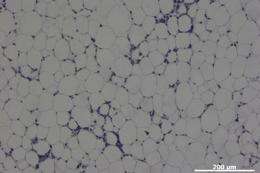
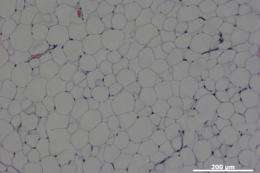
The two images show histological sections of white fat tissues from mice; the top panel shows tissues have been injected with the compound α-galactosylceramide that activates NKT cells (stained blue); image below is a control. (Qi Lab)
(Medical Xpress) -- For years, researchers have known that obesity, type 2 diabetes and low-level inflammation are linked, but how they are connected has not been well understood.
A recent Cornell-led study has found that a type of immune cells -- called natural killer T (NKT) cells -- is an important part of the puzzle.
Two hallmarks of diabetes include insulin resistance, the inability to effectively respond to insulin to control blood sugar, and glucose intolerance, the inability to metabolize glucose.
(Qi Lab)
"When tissue is inflamed, it becomes insulin resistant," said Ling Qi, assistant professor of nutritional sciences.The study found, however, that "activation of NKT cells reduces inflammation, and also reduces insulin resistance and increases glucose tolerance," added Qi, senior author of the study published April 20 in the Journal of Biological Chemistry. Yewei Ji, a postdoctoral researcher in Qi's lab, is the paper's lead author.
In the study, team members at the University of Hong Kong examined tissues from 39 healthy premenopausal Chinese adult women and correlated the NKT cell levels with the women's body mass index (BMI). They found that as BMI increased, NKT cell levels in adipose (fat) tissue decreased significantly.
"The mechanism for that is not clear," said Qi, "but it points to the significance of our study that you need to activate these cells to have some sort of impact."
At Cornell, Qi and colleagues injected mice that were fed Western-type diets --where 60 percent of calories come from fat -- with a lipid compound (α-galactosylceramide) that is known to strongly and specifically activate NKT cells. The result: The inflammation and degrees of insulin resistance and glucose intolerance in the mice fell.
"The mice were eating a Western diet but their metabolic response was closer to mice that were eating a healthy diet," Qi said.
Next, the researchers plan to alter the regimen of lipid treatment to see if they can induce an even better effect in animals and try to identify compounds in foods that naturally activate NKT cells in humans. The researchers hope to identify particular foods that obese diabetics could eat to achieve the positive effects.
A patent has been filed as a result of this study.
Co-authors include researchers from the University of Hong Kong, Harvard University's School of Public Health, the National Institute on Alcohol Abuse and Alcoholism of the National Institutes of Health, and Wageningen University in the Netherlands.
The study was funded by the National Institutes of Health, Hong Kong Collaborative Research Fund, Netherlands Nutrigenomics Center, Cornell, Howard Hughes Medical Institute, and the American Diabetes Association.
Provided by
Cornell University
-
Early research shows dietary supplement may lower risk of developing type 2 diabetes
Sep 22, 2011 |
not rated yet |
0
-
Apelin hormone injections powerfully lower blood sugar
Nov 04, 2008 |
not rated yet |
0
-
Infection is an important post-stroke problem
Oct 26, 2011 |
not rated yet |
0
-
Enzyme boosts metabolism, prevents weight gain in mice
Nov 14, 2011 |
not rated yet |
0
-
Inflammation in body fat is not only pernicious
Mar 25, 2010 |
not rated yet |
0
-
Motion perception revisited: High Phi effect challenges established motion perception assumptions
Apr 23, 2013 |
3 / 5 (2) |
2
-
Anything you can do I can do better: Neuromolecular foundations of the superiority illusion (Update)
Apr 02, 2013 |
4.5 / 5 (11) |
5
-
The visual system as economist: Neural resource allocation in visual adaptation
Mar 30, 2013 |
5 / 5 (2) |
9
-
Separate lives: Neuronal and organismal lifespans decoupled
Mar 27, 2013 |
4.9 / 5 (8) |
0
-
Sizing things up: The evolutionary neurobiology of scale invariance
Feb 28, 2013 |
4.8 / 5 (10) |
14
-
Calculating on-axis elements of a solenoid
7 hours ago
-
latitude & longitude & air pressure
8 hours ago
-
Differences of Classical Mechanics when learned with Calc vs algebra?
11 hours ago
-
what is the distance traveled
15 hours ago
-
Image of a Convex Lens Cut in Half Horizontally
19 hours ago
-
Ray tracing through optical system of thick lenses
19 hours ago
- More from Physics Forums - Classical Physics
More news stories
Fish oil supplements may help fight against Type 2 diabetes
Widely-used fish oil supplements modestly increase amounts of a hormone that is associated with lower risk of diabetes and heart disease, according to a study accepted for publication in The Endocrine Society's Journal of ...
Diabetes
14 hours ago |
5 / 5 (1) |
0
Study shows that women who smoke during pregnancy increase the risk of both obesity and gestational diabetes in their da
Women who smoke during pregnancy increase the risk of both obesity and gestational diabetes, in their daughters, concludes research published in Diabetologia, the journal of the European Association for the Study of Diabet ...
Diabetes
May 20, 2013 |
not rated yet |
0
Rise in type 2 diabetes amongst young
The number of young people diagnosed with type 2 diabetes has seen the sharpest rise over the last twenty years compared to a background of a general increase across the board, new University research has ...
Diabetes
May 20, 2013 |
not rated yet |
0
Research uncovers a potential role of two proteins in diabetes
(Medical Xpress)—Flinders University researchers are breaking new ground in a decade-long journey to pinpoint the function of two closely related proteins.
Diabetes
May 20, 2013 |
5 / 5 (2) |
0
|
Exercise prevents fructose-induced hypertriglyceridemia
(HealthDay)—Moderate aerobic exercise prevents fructose-induced hypertriglyceridemia in healthy males, according to a study published online May 14 in Diabetes.
Diabetes
May 17, 2013 |
5 / 5 (1) |
0
|
Slowing the aging process—only with antibiotics
Swiss scientists reveal the mechanism responsible for aging hidden deep within mitochondria—and dramatically slow it down in worms by administering antibiotics to the young.
Researchers complete largest genetic sequencing study of human disease
Researchers from Queen Mary, University of London have led the largest sequencing study of human disease to date, investigating the genetic basis of six autoimmune diseases.
Rate of bicycle-related fatalities significantly lower in states with helmet laws
Existing research shows that bicyclists who wear helmets have an 88 percent lower risk of brain injury, but researchers at Boston Children's Hospital found that simply having bicycle helmet laws in place showed a 20 percent ...
Brain can be trained in compassion, study shows
Until now, little was scientifically known about the human potential to cultivate compassion—the emotional state of caring for people who are suffering in a way that motivates altruistic behavior.
Having both migraines, depression may mean smaller brain
(HealthDay)—Migraines and depression can each cause a great deal of suffering, but new research indicates the combination of the two may be linked to something else entirely—a smaller brain.
Novel approach for influenza vaccination shows promise in early animal testing
A new approach for immunizing against influenza elicited a more potent immune response and broader protection than the currently licensed seasonal influenza vaccines when tested in mice and ferrets. The vaccine ...
