Clues found to way embryonic kidney maintains its fleeting stem cells
June 11, 2012 in Medical research
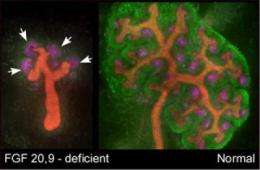
The image on the right shows a normal mouse kidney at a very early stage of development. The green staining marks the stem cells. The pink staining shows the early daughter cells taking the first steps toward becoming adult nephrons. The image on the left shows a mouse kidney at the same early developmental stage, but without both FGF9 and FGF20. Without these two proteins maintaining the stem cell niche, all the green stem cells differentiate to pink daughter cells right away. The pool of stem cells is exhausted and there is no further kidney growth. Credit: Raphael Kopan, Ph.D., and David M. Ornitz, M.D., Ph.D.
Studying mice and humans, researchers at Washington University School of Medicine in St. Louis and their collaborators in Paris have identified two proteins that are required to maintain a supply of stem cells in the developing kidney.
In the presence of the two proteins, FGF9 and FGF20, mouse kidney stem cells stayed alive outside the body longer than previously reported. Though the cells were maintained only five days (up from about two), the work is a small step toward the future goal of growing kidney stem cells in the lab.
In the developing embryo, these early stem cells give rise to adult cells called nephrons, the blood filtration units of the kidneys.
The results appear online June 11 in Developmental Cell.
"When we are born, we get a certain allotment of nephrons," says Raphael Kopan, PhD, the Alan A. and Edith L. Wolff Professor of Developmental Biology. "Fortunately, we have a large surplus. We can donate a kidney give away 50 percent of our nephrons and still do fine. But, unlike our skin and gut, our kidneys can't build new nephrons."
The skin and the gut have small pools of stem cells that continually renew these organs throughout life. Scientists call such pools of stem cells and their support system a niche. During early development, the embryonic kidney has a stem cell niche as well. But at some point before birth or shortly after, all stem cells in the kidney differentiate to form nephrons, leaving no self-renewing pool of stem cells.
"In other organs, there are cells that specifically form the niche, supporting the stem cells in a protected environment," Kopan says. "But in the embryonic kidney, it seems the stem cells form their own niche, making it a bit more fragile. And the signals and conditions that lead the cells to form this niche have been elusive."
Surprisingly, recent clues to the signals that maintain the embryonic kidney's stem cell niche came from studies of the inner ear. David M. Ornitz, MD, PhD, the Alumni Endowed Professor of Developmental Biology, investigates FGF signaling in mice. Earlier this year, Ornitz and his colleagues published a paper in PLoS Biology showing that FGF20 plays an important role in inner ear development.
"Mice without FGF20 are profoundly deaf," Ornitz says. "While they are otherwise viable and healthy, in some cases we noticed that their kidneys looked small."
Past work from his own lab and others suggested that FGF9, a close chemical cousin of FGF20, might also participate in kidney development. FGF20 and FGF9 are members of a family of proteins known as fibroblast growth factors. In general, members of this family are known to play important and broad roles in embryonic development, tissue maintenance, and wound healing. Mice lacking FGF9 have defects in development of the male urogenital tract and die after birth due to defects in lung development.
Since FGF9 and 20 are so closely related, Ornitz and Sung-Ho Huh, PhD, a postdoctoral research associate, and former postdoctoral researcher Hila Barak, PhD, thought the two proteins might serve redundant functions in the developing kidney, compensating for each other if one is missing. The next logical question, according to Ornitz, was what happens when both are missing.
"When we examined mice lacking both FGF9 and FGF20, we saw that the embryos had no kidneys," Ornitz says.
Evidence further supporting the role of FGF signaling in kidney development came from collaborators in France. There, researchers had identified two families that lost more than one pregnancy because the fetuses developed without kidneys, a condition called renal agenesis.
Analyzing DNA from the fetuses, they found mutations in four genes known to be involved in kidney development. One of these mutations resulted in the total loss of FGF20. This analysis also highlighted an important difference between mice and humans. In mice, FGF9 appears to compensate for a total loss of FGF20. But in the human DNA analysis, the fetuses that developed without kidneys had normal FGF9.
"In humans, FGF9 is not enough to rescue the kidney if FGF20 is missing," Kopan says.
Now that at least some of the proteins necessary to support the kidney stem cell niche have been identified, Kopan and Ornitz both look to future work to further extend the life of such cells in the lab.
"The holy grail would be to deliver these cells back to a diseased kidney," Kopan says. "This is a very small step. But we hope this will be a stimulus to the field, for us and for others to continue thinking about how to convince these cells to stick around longer."
More information: Barak H, Huh SH, Chen S, Jeanpierre C, Martinovic J, Parisot M, Bole-Feysot C, Nitschke P, Salomon R, Antignac C, Ornitz DM, Kopan R. FGF9 and FGF20 maintain the stemness of nephron progenitors in mice and man. Developmental Cell. Online June 11, 2012.
Huh SH, Jones J, Warchol ME, Ornitz DM. Differentiation of the lateral compartment of the cochlea requires a temporally restricted FGF20 signal. PLoS Biology. Jan. 3, 2012.
Journal reference:
Developmental Cell
PLoS Biology
Provided by
Washington University School of Medicine
-
New clues to human deafness found in mice
Jan 03, 2012 |
not rated yet |
0
-
Key gene in kidney development found
Oct 10, 2006 |
not rated yet |
0
-
Winding back the clock with kidney stem cells
May 16, 2011 |
not rated yet |
0
-
Adult kidney stem cells found in fish
Jan 26, 2011 |
not rated yet |
0
-
Italians report stem-cell advances
Sep 06, 2006 |
not rated yet |
0
-
Motion perception revisited: High Phi effect challenges established motion perception assumptions
Apr 23, 2013 |
3 / 5 (2) |
2
-
Anything you can do I can do better: Neuromolecular foundations of the superiority illusion (Update)
Apr 02, 2013 |
4.5 / 5 (11) |
5
-
The visual system as economist: Neural resource allocation in visual adaptation
Mar 30, 2013 |
5 / 5 (2) |
9
-
Separate lives: Neuronal and organismal lifespans decoupled
Mar 27, 2013 |
4.9 / 5 (8) |
0
-
Sizing things up: The evolutionary neurobiology of scale invariance
Feb 28, 2013 |
4.8 / 5 (10) |
14
-
How can there be a term called "intestinal metaplasia" of stomach
9 hours ago
-
Pressure-volume curve: Elastic Recoil Pressure don't make sense
May 18, 2013
-
If you became brain-dead, would you want them to pull the plug?
May 17, 2013
-
MRI bill question
May 15, 2013
-
Ratio of Hydrogen of Oxygen in Dessicated Animal Protein
May 13, 2013
-
Alcohol and acetaminophen
May 13, 2013
- More from Physics Forums - Medical Sciences
More news stories
Common food supplement fights degenerative brain disorders
Widely available in pharmacies and health stores, phosphatidylserine is a natural food supplement produced from beef, oysters, and soy. Proven to improve cognition and slow memory loss, it's a popular treatment for older ...
Medical research
4 hours ago |
5 / 5 (1) |
0
|
Finding a family for a pair of orphan receptors in the brain
Researchers at Emory University have identified a protein that stimulates a pair of "orphan receptors" found in the brain, solving a long-standing biological puzzle and possibly leading to future treatments for neurological ...
Medical research
4 hours ago |
not rated yet |
0
|
Insight into the dazzling impact of insulin in cells
Australian scientists have charted the path of insulin action in cells in precise detail like never before. This provides a comprehensive blueprint for understanding what goes wrong in diabetes.
Medical research
5 hours ago |
4.5 / 5 (2) |
0
|
Do men's and women's hearts burn fuel differently?
Researchers at the University of Illinois at Chicago College of Medicine will study gender differences in how the heart uses and stores fat—its main energy source—and how changes in fat metabolism play ...
Medical research
7 hours ago |
not rated yet |
0
Study suggests new source of kidneys for transplant
Nearly 20 percent of kidneys that are recovered from deceased donors in the U.S. are refused for transplant due to factors ranging from scarring in small blood vessels of the kidney's filtering units to the organ going too ...
Medical research
May 20, 2013 |
5 / 5 (2) |
0
|
Antidepressant reduces stress-induced heart condition
A drug commonly used to treat depression and anxiety may improve a stress-related heart condition in people with stable coronary heart disease, according to researchers at Duke Medicine.
Americans still making unhealthy choices, CDC reports
(HealthDay)—The overall health of Americans isn't improving much, with about six in 10 people either overweight or obese and large numbers engaging in unhealthy behaviors like smoking, heavy drinking or ...
CDC presents recent trends in health behaviors of US adults
(HealthDay)—In 2008 to 2010, the prevalence of key health behaviors among U.S. adults varied, with about one in five adults current smokers and 62.1 percent overweight or obese, according to a report presented ...
Study examines outbreak of spinal infections in Michigan
(HealthDay)—Factors such as increased case finding may explain why Michigan had half of the total spinal infections associated with contaminated methylprednisolone acetate in the recent fungal meningitis ...
Early use of tracheostomy for mechanically ventilated patients not associated with improved survival
For critically ill patients receiving mechanical ventilation, early tracheostomy (within the first 4 days after admission) was not associated with an improvement in the risk of death within 30 days compared to patients who ...
CDC says high number of public pools contain microbes
(HealthDay)—Three-quarters of public schools in the metro Atlanta area contain microbes, including bacteria indicating the presence of fecal matter, according to research published in the May 17 issue of ...