Researchers prevent mice from developing diabetes
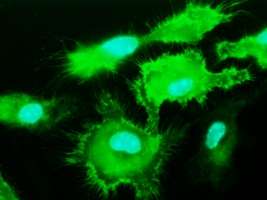
Macrophages. Copyright: Roham Parsa
(Medical Xpress) -- Swedish research group headed at Karolinska Institutet has been able to prevent onset of Type 1 diabetes in mice that are genetically susceptible to the disease. Through injection of specifically prepared cells, the researchers managed to stop the ongoing destruction of insulin-producing pancreatic beta cells in mice just prior to clinical debut of diabetes.
Type 1 diabetes is an autoimmune disease in which the immune system begins to attack and destroy the insulin-producing beta cells. This leads to a deficiency in production of insulin, which individuals with Type 1 diabetes thereafter have to inject. The initial cause of this autoimmune destruction is currently not known.
However, it is known that macrophages, a particular type of immune cells, have an active role in the destruction of pancreatic beta cells in Type 1 diabetes. Yet macrophages can also exhibit the opposite properties; earlier studies have demonstrated that macrophages can protect against inflammation-mediated tissue damage.
Immune cells utilise signal molecules termed cytokines in order to communicate with each other, giving instructions as to how the cells should act. In the current article, published in the scientific journal Diabetes, the researchers aimed to determine which cytokines were necessary to instruct macrophages to become protective cells.
"We managed to achieve this aim, defining a novel combination of cytokines that confer on macrophages the ability to protect mice from developing Type 1 diabetes", says Robert Harris, lead researcher at the Department of Clinical Neuroscience and based at the Centre for Molecular Medicine, Karolinska Institutet. "It has never previously been reported, that such an adoptive transfer cell therapy can be used in Type 1 diabetes and this study could thus represent a major advance towards disease prevention"
The researchers used so-called NOD mice which are genetically susceptible to developing Type 1 diabetes spontaneously between 12-30 weeks of age. The researchers grew macrophages from bone marrow progenitors from these mice. The mature macrophages were then stimulated with the defined combination of cytokines. When NOD mice were 16 weeks old separate groups were treated with either cytokine-stimulated macrophages, untreated macrophages of were not treated.
The mice were monitored for a further 12 weeks post-treatment. Using a specific three-dimensional imaging technique developed at Umeå University, Sweden, the degree of immune-mediated attack of the beta cells could be visualized in each treatment group. At the end of the follow-up period only 25% of the mice receiving the cytokine-treated macrophages had developed Type 1 diabetes, while 83% of the control groups had become sick.
"The cell therapy was initiated just 2 weeks before mice developed clinical diabetes", says Dr Harris. "At this stage few insulin-producing beta cells remain in the pancreas, yet we were able to protect these so that the mice never developed diabetes. Such a successful late-stage intervention has never previously been reported and is a significant result of our study. At the time of their clinical Type 1 diabetes diagnosis, most human individuals have already lost most of their insulin-producing beta cells."
Journal reference:
Diabetes
Provided by
Karolinska Institutet
-
Gene therapy reverses type 1 diabetes in mice
Jun 06, 2011 |
not rated yet |
0
-
Connexins: Providing protection to cells destroyed in Type 1 diabetes
Nov 07, 2011 |
not rated yet |
0
-
Chemical produced in pancreas prevented and reversed diabetes in mice
Jun 28, 2011 |
not rated yet |
0
-
Gene therapy reverses type 1 diabetes in mice
Jun 21, 2010 |
not rated yet |
0
-
Cytokine resistance contributes to pathology of type 2 diabetes
Jun 14, 2007 |
not rated yet |
0
-
Motion perception revisited: High Phi effect challenges established motion perception assumptions
Apr 23, 2013 |
3 / 5 (2) |
2
-
Anything you can do I can do better: Neuromolecular foundations of the superiority illusion (Update)
Apr 02, 2013 |
4.5 / 5 (11) |
5
-
The visual system as economist: Neural resource allocation in visual adaptation
Mar 30, 2013 |
5 / 5 (2) |
9
-
Separate lives: Neuronal and organismal lifespans decoupled
Mar 27, 2013 |
4.9 / 5 (8) |
0
-
Sizing things up: The evolutionary neurobiology of scale invariance
Feb 28, 2013 |
4.8 / 5 (10) |
14
-
understanding the dipole model for Rayleigh scattering
1 hour ago
-
question on coriolis effect with drag force
7 hours ago
-
Question of reflection and transmission of TEM wave in normal incidenc
12 hours ago
-
the rudyak-krasnolutski effective potencial
13 hours ago
-
Normal force for a lever model
14 hours ago
-
gravity is std. therefore can we rate a 'mass at height' by watts?
20 hours ago
- More from Physics Forums - Classical Physics
More news stories
Type 2 diabetes progresses faster in kids, study finds
(HealthDay)—Type 2 diabetes is more aggressive in children than adults, with signs of serious complications seen just a few years after diagnosis, new research finds.
Diabetes
8 hours ago |
not rated yet |
0
Statin use is linked to increased risk of developing diabetes, warn researchers
Treatment with high potency statins (especially atorvastatin and simvastatin) may increase the risk of developing diabetes, suggests a paper published today in BMJ.
Diabetes
10 hours ago |
not rated yet |
0
Diabetes' genetic underpinnings can vary based on ethnic background, studies say
Ethnic background plays a surprisingly large role in how diabetes develops on a cellular level, according to two new studies led by researchers at the Stanford University School of Medicine.
Diabetes
13 hours ago |
not rated yet |
0
|
Fish oil supplements may help fight against Type 2 diabetes
Widely-used fish oil supplements modestly increase amounts of a hormone that is associated with lower risk of diabetes and heart disease, according to a study accepted for publication in The Endocrine Society's Journal of ...
Diabetes
May 22, 2013 |
5 / 5 (2) |
1
Study shows that women who smoke during pregnancy increase the risk of both obesity and gestational diabetes in their da
Women who smoke during pregnancy increase the risk of both obesity and gestational diabetes, in their daughters, concludes research published in Diabetologia, the journal of the European Association for the Study of Diabet ...
Diabetes
May 20, 2013 |
not rated yet |
0
Hormone replacement therapy—clarity at last
The British Menopause Society and Women's Health Concern have today released updated guidelines on Hormone Replacement Therapy (HRT) to provide clarity around the role of HRT, the benefits and the risks. The new guidelines ...
Controlling mood through the motions of mitochondria
(Medical Xpress)—Regulating the distribution of power in neurons is done by a system that makes the national electric grid look simple by comparison. Each neuron has several thousand mitochondria confined ...
Motion quotient: IQ predicted by ability to filter motion (w/ video)
A brief visual task can predict IQ, according to a new study. This surprisingly simple exercise measures the brain's unconscious ability to filter out visual movement. The study shows that individuals whose ...
Multiple research teams unable to confirm high-profile Alzheimer's study
Teams of highly respected Alzheimer's researchers failed to replicate what appeared to be breakthrough results for the treatment of this brain disease when they were published last year in the journal Science.
Scientists discover molecule triggers sensation of itch
Scientists at the National Institutes of Health report they have discovered in mouse studies that a small molecule released in the spinal cord triggers a process that is later experienced in the brain as ...
Researchers find common childhood asthma unconnected to allergens or inflammation
Little is known about why asthma develops, how it constricts the airway or why response to treatments varies between patients. Now, a team of researchers at Weill Cornell Medical College, Columbia University Medical Center ...