Scientists identify brain area that determines distance from which sound originates
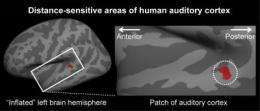
This is an image of human cerebral cortex, digitally "inflated" to smooth out normal folds and ridges, showing in red the portion of auditory cortex that responds to the distance from which sounds arrive. Credit: Jyrki Ahveninen, Ph.D., Martinos Center for Biomedical Imaging, Massachusetts General Hospital
Researchers at the Martinos Center for Biomedical Imaging at Massachusetts General Hospital have identified a portion of the brain responsible for determining how far away a sound originates, a process that does not rely solely on how loud the sound is. The investigators' report, which will appear in the early edition of Proceeding of the National Academy of Sciences, is receiving early online release this week.
"Although sounds get louder when the source approaches us, humans are able to discriminate between loud sounds that come from far away and softer sound from a closer source, suggesting that our brains use distance cues independent of loudness," says Jyrki Ahveninen, PhD, of the Martinos Center, senior author of the PNAS report. "Using functional MRI we found a group of neurons in the auditory cortex sensitive to the distance of sound sources and different from those that process changes in loudness. In addition to providing basic scientific information, our results could help future studies of hearing disorders."
The human brain has distinct areas for processing sensory information signals responsible for vision, hearing, taste etc. Studies of the visual cortex, located at the back of the brain, have produced detailed maps of areas handling particular portions of the visual field. But understanding of the auditory cortex, located on the side of the head above and behind the ear, is quite limited. While it is known that the portion of the auditory cortex extending toward the back of the head determines where a sound comes from, exactly how the brain translates complex auditory signals to determine both the location and distance from which a sound originates is not yet known.
In their search for auditory neurons that process sound distance, the research team faced some particular challenges. In research laboratories that study hearing, sounds must be delivered to study participants through headphones, which means the acoustical "space" in which a sound is generated must be simulated. This must be done with exquisite accuracy, since environmental aspects causing sound to reverberate probably contribute to distance perception. Since the MRI equipment itself generates a loud noise, the researchers scanned participants' brains once every 12 seconds to measure responses to sounds presented during intervening quiet periods.
In the first experiment, study participants 12 adults with normal hearing listened to a series of paired sounds of varying degrees of loudness and at simulated distances ranging from 15 to 100 cm and were asked to indicate whether the second sound was closer or farther away than the first. Although the differences in loudness varied randomly, participants were quite accurate in distinguishing the simulated distances of the sounds. Acoustical analysis of the particular sound cues presented indicated that the reverberations produced by a sound, which are more pronounced in a closed environment and for sounds traveling farther, may be more important distance cues than are the differences between sounds perceived by a participant's two ears.
After the first experiment confirmed the accuracy of the simulated acoustical environment, functional MR images taken while participants listened to another series of paired sounds recorded how activity in the auditory cortex changed in response to sounds of varying loudness and direction as well as during sound of constant levels and silence. The images produced identified a small area that appears to be sensitive to cues indicating distance but not loudness. As far as the investigators know, this is the first time neurons sensitive to sound-source distances have been discovered.
"The identified area is located near other auditory cortical areas that process spatial information," says corresponding author Norbert Kopco, PhD. "This is consistent with a general model of perceptual processing in the brain, suggesting that in hearing, as in vision and other senses, spatial information is processed separately from information about the object's identity or characteristics such as the musical pitch of sound. Our study also illustrates how important it is to combine expertise from different fields in our case imaging/physiology, psychology, and computational neuroscience to advance our understanding of such a complex system as the human brain."
Provided by
Massachusetts General Hospital
-
Lend me your ears -- and the world will sound very different
Jan 14, 2008 |
not rated yet |
0
-
Brain center for 'sound space' identified
Sep 19, 2007 |
not rated yet |
0
-
Do you hear what i see?
Feb 20, 2007 |
not rated yet |
0
-
Sound, vision & hearing loss
Jun 24, 2011 |
not rated yet |
0
-
Researchers identify components of speech recognition pathway in humans
Jun 22, 2011 |
not rated yet |
0
-
Motion perception revisited: High Phi effect challenges established motion perception assumptions
Apr 23, 2013 |
3 / 5 (2) |
2
-
Anything you can do I can do better: Neuromolecular foundations of the superiority illusion (Update)
Apr 02, 2013 |
4.5 / 5 (11) |
5
-
The visual system as economist: Neural resource allocation in visual adaptation
Mar 30, 2013 |
5 / 5 (2) |
9
-
Separate lives: Neuronal and organismal lifespans decoupled
Mar 27, 2013 |
4.9 / 5 (8) |
0
-
Sizing things up: The evolutionary neurobiology of scale invariance
Feb 28, 2013 |
4.8 / 5 (10) |
14
-
Pressure-volume curve: Elastic Recoil Pressure don't make sense
May 18, 2013
-
If you became brain-dead, would you want them to pull the plug?
May 17, 2013
-
MRI bill question
May 15, 2013
-
Ratio of Hydrogen of Oxygen in Dessicated Animal Protein
May 13, 2013
-
Alcohol and acetaminophen
May 13, 2013
-
Marie Curie's leukemia
May 13, 2013
- More from Physics Forums - Medical Sciences
More news stories
Neurons that can multitask greatly enhance the brain's computational power, study finds
Over the past few decades, neuroscientists have made much progress in mapping the brain by deciphering the functions of individual neurons that perform very specific tasks, such as recognizing the location ...
Neuroscience
2 hours ago |
5 / 5 (3) |
0
|
For combat veterans suffering from post-traumatic stress disorder, 'fear circuitry' in the brain never rests
Chronic trauma can inflict lasting damage to brain regions associated with fear and anxiety. Previous imaging studies of people with post-traumatic stress disorder, or PTSD, have shown that these brain regions can over-or ...
Neuroscience
May 18, 2013 |
5 / 5 (1) |
0
|
Temporal processing in the olfactory system
The neural machinery underlying our olfactory sense continues to be an enigma for neuroscience. A recent review in Neuron seeks to expand traditional ideas about how neurons in the olfactory bulb might encode information about ...
Neuroscience
May 17, 2013 |
4 / 5 (1) |
0
|
Melon focus headband turns to Kickstarter for rollout plans
(Medical Xpress)—What if the quality of your work depends more on your focus on the piano keys or canvas or laptop than your musical or painting or computing skills? If target users can be convinced, they ...
Neuroscience
May 17, 2013 |
3.7 / 5 (3) |
0
|
Deep brain stimulation: A fix when the drugs don't work
Neurological disorders can have a devastating impact on the lives of sufferers and their families.
Neuroscience
May 17, 2013 |
5 / 5 (1) |
0
|
First long-term study reveals link between childhood ADHD and obesity
A new study conducted by researchers at the Child Study Center at NYU Langone Medical Center found men diagnosed as children with attention-deficit/hyperactivity disorder (ADHD) were twice as likely to be obese in a 33-year ...
New study finds blind people have the potential to use their 'inner bat' to locate objects
New research from the University of Southampton has shown that blind and visually impaired people have the potential to use echolocation, similar to that used by bats and dolphins, to determine the location of an object.
Germ-fighting vaccine system makes great strides in delivery
A novel vaccine study from South Dakota State University (SDSU) will headline the groundbreaking research that will be unveiled at the American Association of Pharmaceutical Scientists' (AAPS) National Biotechnology Conference ...
Diabetes drug tested in Parkinson's disease patients
Parkinson's disease (PD) is a degenerative neurological disorder marked by a progressive loss of motor control. Despite intensive research, there are currently no approved therapies that have been demonstrated to alter the ...
Impossible to predict outcome in China's bird flu outbreak, WHO says
It is impossible to predict the evolution of China's human H7N9 bird flu outbreak as researchers are still trying to understand the source of human transmission, the head of the World Health Organisation said Monday.
FDA has safety concerns on Merck insomnia drug
Federal health regulators say an experimental insomnia drug from Merck can help patients fall asleep, but it also carries worrisome side effects, including daytime drowsiness and suicidal thinking.
Jun 11, 2012
Rank: not rated yet
Has it been shown that the suggested area is truly a specialised nuclei evolved to this task, or is it rather the case that the frequency range of stereoscopic BADs just happens to coalesce at this loci within a broader spectrum of similarly-functioning cortex? For instance, is there a relationship to the inter-ear distance (since this is a factor in determining the size of any such delay)?
To test such a possibility, an apparatus could be designed to artificially alter the distance between the subjects "ears" (ie. headsets connected to arbitrarily-spaced pairs of microphones, for example) - would this shift location of the purported BAD nuclei accordingly?