Scientists find new genetic path to deadly diarrheal disease
June 11, 2012 in Diseases, Conditions, Syndromes
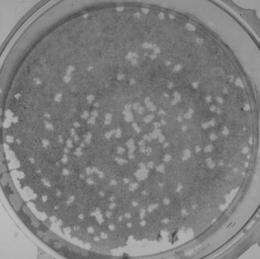
Bright spots among intestinal cells show where the shigella bacteria were able to replicate, indicating their ability to cause disease. Credit: Erin Murphy/Ohio University
Scientists have found new genetic information that shows how harmful bacteria cause the acute diarrheal disease shigellosis, which kills more than a million people worldwide each year.
The research, which could lead to the development of future treatments, was published today in the journal PLoS ONE. The study was led by Ohio University scientist Erin Murphy and doctoral student William Broach, with contributions from University of Nevada, Las Vegas and University of Texas at Austin researchers.
When the disease-causing bacterium Shigella invades a human host, environmental conditions there, such as changes in temperature or pH, stimulate a genetic expression pathway within the bacterium that allows it to survive and cause disease. Central to this genetic pathway are two proteins, VirF and VirB. VirF functions to increase production of VirB which, in turn, promotes the production of factors that increases the bacterium's virulence, or ability to cause illness in its host.
"It's like a domino effect," said Murphy, assistant professor of bacteriology in the Ohio University Heritage College of Osteopathic Medicine.
Murphy and Broach's new study, however, suggests that production of VirB can be controlled independently of VirF. It also shows that the VirF-independent regulation is mediated by a specific small RNA, a special type of molecule whose job is to control the production of particular targets. This is the first study to demonstrate that transcription of virB is regulated by any factor other than VirF, Murphy explained.
The research not only reveals the intricate level of gene expression the bacteria employ to survive in the human body, but potentially could lead to new treatments. Currently, antibiotics are prescribed to patients with the disease.
"These findings are feeding into the basic understanding of this gene expression so that future researchers can work to disrupt it," Broach said. "The more we know about it, the more targets we have to disrupt it and to possibly develop targeted antibiotic treatments."
For those living in developing countries, where access to clean drinking water can be scarce, an improved medical treatment for shigellosis could mean the difference between life and death.
"In the United States, if we get severe diarrhea we can go to the store and get Gatorade," Murphy said. "But if you're already starving to begin with because you don't have access to good food and clean water, then you get shigellosis on top of thatand you don't have good water to rehydrate yourselfthat's when the deaths happen."
The disease, which is transmitted person to person or through contaminated food or water sources, has an infectious dose of just 10 organisms, meaning as few as 10 organisms can cause disease in a healthy person. This infectious dose is exceedingly low compared to other bacteria that require tens of thousands of organisms to cause disease.
While it is often thought to be a third-world problem, shigellosis causes a reported 14,000 cases in the United States each year. The Centers for Disease Control suggests that the actual number may be 20 times higher, as mild cases often aren't reported or diagnosed.
"In the United States it's probably even more underreported than in developing countries because of access to healthy, clean drinking water," Murphy said. "If you're a healthy individual and you've got access to clean drinking water, chances are you're going to get severe diarrhea, but you're not going to die."
More information: The PLoS ONE paper can be accessed online: dx.plos.org/10.137… pone.0038592
Journal reference:
PLoS ONE
Provided by
Ohio University
-
Researchers identify novel pathway responsible for infection of a common STD pathogen
Feb 27, 2012 |
not rated yet |
0
-
Bacteria control how infectious they become, study finds
Apr 12, 2007 |
not rated yet |
0
-
Researchers determine how Legionnaires' bacteria proliferate, cause disease
Nov 17, 2011 |
not rated yet |
0
-
'Miracle tree' substance produces clean drinking water inexpensively and sustainably
Jan 18, 2012 |
not rated yet |
0
-
Fish may provide key to stopping disease spread, researcher says
Dec 12, 2011 |
not rated yet |
0
-
Motion perception revisited: High Phi effect challenges established motion perception assumptions
Apr 23, 2013 |
3 / 5 (2) |
2
-
Anything you can do I can do better: Neuromolecular foundations of the superiority illusion (Update)
Apr 02, 2013 |
4.5 / 5 (11) |
5
-
The visual system as economist: Neural resource allocation in visual adaptation
Mar 30, 2013 |
5 / 5 (2) |
9
-
Separate lives: Neuronal and organismal lifespans decoupled
Mar 27, 2013 |
4.9 / 5 (8) |
0
-
Sizing things up: The evolutionary neurobiology of scale invariance
Feb 28, 2013 |
4.8 / 5 (10) |
14
-
Classical and Quantum Mechanics via Lie algebras
Apr 15, 2011
- More from Physics Forums - Independent Research
More news stories
Swine flu pandemic of 2009 more deadly for younger adults, study finds
As the world prepares for what may be the next pandemic strain of influenza virus, in the H7N9 bird flu, a new UC Irvine study reveals that the 2009 H1N1 swine flu pandemic was deadliest for people under the age of 65, while ...
Diseases, Conditions, Syndromes
8 hours ago |
not rated yet |
0
Polio cases found in Kenya and Somalia, WHO says
The World Health Organization says the Horn of Africa is experiencing an outbreak of polio with cases confirmed in Kenya and Somalia.
Diseases, Conditions, Syndromes
9 hours ago |
not rated yet |
0
SARS-like virus claims new life in Saudi
A man who had contracted the coronavirus has died in Saudi Arabia, raising the death toll in the kingdom from the SARS-like virus to 17, the health ministry announced on its website on Wednesday.
Diseases, Conditions, Syndromes
9 hours ago |
not rated yet |
0
Novel approach for influenza vaccination shows promise in early animal testing
A new approach for immunizing against influenza elicited a more potent immune response and broader protection than the currently licensed seasonal influenza vaccines when tested in mice and ferrets. The vaccine ...
Diseases, Conditions, Syndromes
9 hours ago |
not rated yet |
0
|
Mild hypothyroidism raises mortality risk among heart failure patients
Patients with underlying heart failure are more likely to experience adverse outcomes from mild hypothyroidism, according to a recent study accepted for publication in The Endocrine Society's Journal of Clinical Endocrinology & ...
Diseases, Conditions, Syndromes
11 hours ago |
not rated yet |
0
Rate of bicycle-related fatalities significantly lower in states with helmet laws
Existing research shows that bicyclists who wear helmets have an 88 percent lower risk of brain injury, but researchers at Boston Children's Hospital found that simply having bicycle helmet laws in place showed a 20 percent ...
Slowing the aging process—only with antibiotics
Swiss scientists reveal the mechanism responsible for aging hidden deep within mitochondria—and dramatically slow it down in worms by administering antibiotics to the young.
Researchers complete largest genetic sequencing study of human disease
Researchers from Queen Mary, University of London have led the largest sequencing study of human disease to date, investigating the genetic basis of six autoimmune diseases.
Brain can be trained in compassion, study shows
Until now, little was scientifically known about the human potential to cultivate compassion—the emotional state of caring for people who are suffering in a way that motivates altruistic behavior.
Having both migraines, depression may mean smaller brain
(HealthDay)—Migraines and depression can each cause a great deal of suffering, but new research indicates the combination of the two may be linked to something else entirely—a smaller brain.
Calorie information in fast food restaurants used by 40 percent of 9-18 year olds when making food choices
A new study published online today (Thursday) in the Journal of Public Health has found that of young people who visited fast food or chain restaurants in the U.S. in 2010, girls and youth who were obese were more likely ...