Researchers decode molecular mechanism that sheds light on how trauma can become engraved in the brain
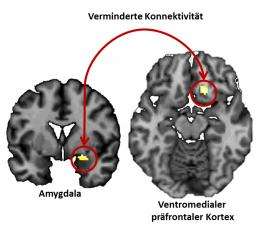
(Medical Xpress) -- Researchers decode a molecular mechanism that sheds light on how trauma can become engraved in the brain
Scientists at the Universities of Bonn and Berlin have discovered a mechanism which stops the process of forgetting anxiety after a stress event. In experiments they showed that feelings of anxiety don’t subside if too little dynorphin is released into the brain. The results can help open up new paths in the treatment of trauma patients. The study has been published in the current edition of the Journal of Neuroscience.
Feelings of anxiety very effectively prevent people from getting into situations that are too dangerous. Those who have had a terrible experience initially tend to avoid the place of tragedy out of fear. If no other oppressive situation arises, normally the symptoms of fear gradually subside. “The memory of the terrible events is not just erased.” states first author, PD Dr. Andras Bilkei Gorzo, from the Institute for Molecular Psychiatry at the University of Bonn. “Those impacted learn rather via an active learning process that they no longer need to be afraid because the danger has passed.” But following extreme psychical stress resulting from wars, hostage-takings, accidents or catastrophes chronic anxiety disorders can develop which even after months don’t subside.
Body’s own dynorphin weakens fears
Why is it that in some people terrible events are deeply engraved in their memory, while after a while others seem to have completely put aside any anxiety related to the incident? Scientists in the fields of psychiatry, molecular psychiatry and radiology at the University of Bonn are all involved in probing this issue. “We were able to demonstrate by way of a series of experiments that dynorphin plays an important role in weakening anxiety,” says Prof. Dr. Andreas Zimmer, Director of the Institute for Molecular Psychiatry at the University of Bonn. The substance group in question is opiods which also includes, for instance, endorphins. The latter are released by the body of athletes and have an analgesic and euphoric effect. The reverse, however, is true of dynorphins: They are known for putting a damper on emotional moods.
Mice with disabled gene exhibit persistent anxiety
The team working with Prof. Zimmer tested the exact impact of dynorphins on the brain using mice whose gene for the formation of this substance had been disabled. After being exposed to a brief and unpleasant electric shock, the animals exhibited persistent anxiety symptoms, even if they hadn’t been confronted with the negative stimulus over a longer time. Mice exhibiting a normal amount of released dynorphin were anxious to begin with as well, but the symptoms quickly subsided. “This behavior is the same in humans: If you burn your hand on the stove once, you don’t forget the incident that quickly,” explains Prof. Zimmer. “Learning vocabulary, on the other hand, typically tends to be more tedious because it’s not tied to emotions.”
Results are transferrable to people
Next the researchers showed that these results can be transferred to people. “We took advantage of the fact that people exhibit natural variations of the dynorphin gene that lead to different levels of this substance being released in the brain,” reports Prof. Dr. Henrik Walter, Director of the Research Area Mind and Brain at the Psychiatric University Clinic at the Charité in Berlin, who also used to perform research in this area at the University Clinic in Bonn. A total of 33 healthy probands were divided into two groups: One with the genetically stronger dynorphin release and the other which exhibits less gene activity.
Unpleasant stimulus leads to stress reactions in the probands
Equipped with computer glasses the probands observed blue and green squares which appeared and then disappeared again in a magnetic resonance tomograph (MRT). When the green square was visible the scientists repeatedly gave probands an unpleasant stimulus on the hand using a laser. Scientists were able to prove that these negative stimuli actually led to a stress reaction given the increased sweat on the skin. At the same time, researchers recorded the activities of various brain areas with the tomograph. After this conditioning stage came part two of the experiment: The researchers showed the colored squares without any unpleasant stimuli and recorded how long the stress reaction acquired earlier lasted. The next day the experiment was continued without the laser stimulus in an effort to monitor the longer-term development.
New paths in the treatment of trauma patients
It became apparent that, as in mice human, probands with lower gene activity for dynorphin exhibited stress reactions lasting considerably longer than those probands who released considerably more. Moreover, in brain scans it could be observed that the amygdala – a brain structure in the temporal lobes that processes emotional contents - was also active even if in later testing rounds a green square was shown without the subsequent laser stimulus.
“After the negative laser stimulus stopped this amygdala activity gradually became weaker. This means that the acquired anxiety reaction to the stimulus was forgotten,” reports Prof. Walter. This effect was not as pronounced in the group with less dynorphin activity and prolonged anxiety. “But the ‘forgetting' of acquired anxiety reactions isn’t a fading, but, rather, an active process which involves the ventromedial prefrontal cortex,” emphasizes Prof. Walter. To corroborate this, researchers found that in the group with less dynorphin activity there was reduced coupling between the prefrontal cortex and the amygdala. “In all likelihood dynorphins affect fear forgetting in a crucial way through this structure,” says Prof. Walter. The scientists now hope that by using the results they will be able to develop long-term approaches for new strategies when it comes to the treatment of trauma patients.
More information: Dynorphins Regulate Fear Memory: From Mice to Men, The Journal of Neuroscience, DOI: 10.1523/JNEUROSCI.1034-12.2012; www.jneurosci.org/content/32/27/9335.full


