With drug-loaded nanogel, researchers attack cancerous tumors
July 17, 2012 By Eric Gershon in Cancer
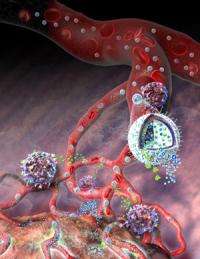
This illustration depicts a nanolipogel administering its immunotherapy cargo. The light-blue spheres within the blood vessels and the cutaway sphere in the foreground are the nanolipogels. (Illustration by Nicolle Rager Fuller, NSF)
(Medical Xpress) -- Yale University scientists have developed a new mechanism for attacking cancerous tumors that intensifies the bodys immune response while simultaneously weakening the tumors ability to resist it.
We believe this is a paradigm-changing immunotherapeutic method for cancer therapy, said Tarek M. Fahmy, a bioengineer at Yale and the projects principal investigator. In essence, its a one-two punch strategy that seems to work well for melanoma and may work even better with other cancers.
The researchers report results July 15 online in the journal Nature Materials. Dr. Richard A. Flavell of Yale School of Medicine and the Howard Hughes Medical Institute collaborated on the project.
Tumors in this case metastatic melanomas, or spreading skin cancers are adept at overcoming their hosts natural defenses, in part by emitting agents that disrupt production and operation of the immune system.
The Yale team developed a new biodegradable nanoparticle that delivers a combination of two very different therapeutic agents to tumor sites, gradually releasing the agents into the tumor vasculature. One agent, a large soluble protein called a cytokine, stimulates the bodys innate immune response. The other, a small-molecule inhibitor, interferes with the tumors ability to suppress the immune response. Other drug combinations are possible.
In tests on live mice, the double-loaded particle, called a nanogel, significantly delayed tumor growth and increased survival, the researchers report. They administered the nanogels intravenously and, in separate experiments, directly into the tumors. Further animal tests are planned.
The main challenge researchers faced was devising a particle that enabled gradual, sustained release of two therapeutic agents with very different properties: the protein, which readily dissolves in the body, and the small-molecule drug, which doesnt. Researchers describe the materials and unique structure of their solution in the Nature Materials paper.
They exclusively used components already approved by the U.S. Food and Drug Administration. This could potentially expedite future experiments with other ingredients and human trials, they said.
Other authors are Jason Park, Stephen H. Wrzesinski, Eric Stern, Michael Look, Jason Criscione, Ragy Ragheb, Steven M. Jay, Stacey L. Demento, Atu Agawu, Paula Licona Limon, Anthony F. Ferrandino, David Gonzalez, and Ann Habermann, all of Yale.
Support for the project was provided by the National Institutes of Health; the National Science Foundation; Yale University; the Howard Hughes Medical Institute; and the PEW Charitable Trust.
Journal reference:
Nature Materials
Provided by
Yale University
-
Study reveals trigger that may speed melanoma growth
Mar 28, 2012 |
not rated yet |
0
-
Novel technique for delivering multiple cancer treatments may solve hurdle for combinatorial drug therapies
Jul 15, 2012 |
not rated yet |
0
-
Polymer Nanoparticles Create Potential Anticancer Vaccine
Jan 29, 2007 |
not rated yet |
0
-
Nanoparticles cut off 'addicted' tumors from source of their survival
May 28, 2012 |
not rated yet |
0
-
How malaria evades the body's immune response
Jul 12, 2012 |
not rated yet |
0
-
Motion perception revisited: High Phi effect challenges established motion perception assumptions
Apr 23, 2013 |
3 / 5 (2) |
2
-
Anything you can do I can do better: Neuromolecular foundations of the superiority illusion (Update)
Apr 02, 2013 |
4.5 / 5 (11) |
5
-
The visual system as economist: Neural resource allocation in visual adaptation
Mar 30, 2013 |
5 / 5 (2) |
9
-
Separate lives: Neuronal and organismal lifespans decoupled
Mar 27, 2013 |
4.9 / 5 (8) |
0
-
Sizing things up: The evolutionary neurobiology of scale invariance
Feb 28, 2013 |
4.8 / 5 (10) |
14
-
How can there be a term called "intestinal metaplasia" of stomach
17 hours ago
-
Pressure-volume curve: Elastic Recoil Pressure don't make sense
May 18, 2013
-
If you became brain-dead, would you want them to pull the plug?
May 17, 2013
-
MRI bill question
May 15, 2013
-
Ratio of Hydrogen of Oxygen in Dessicated Animal Protein
May 13, 2013
-
Alcohol and acetaminophen
May 13, 2013
- More from Physics Forums - Medical Sciences
More news stories
Small cancer risk following CT scans in childhood and adolescence confirmed
The gap between life expectancy in patients with a mental illness and the general population has widened since 1985 and efforts to reduce this gap should focus on improving physical health, suggest researchers in a paper ...
Cancer
5 hours ago |
not rated yet |
0
Changing cancer's environment to halt its spread
By studying the roles two proteins, thrombospondin-1 and prosaposin, play in discouraging cancer metastasis, a trans-Atlantic research team has identified a five-amino acid fragment of prosaposin that significantly reduces ...
Cancer
6 hours ago |
not rated yet |
0
Novel RNA-based classification system for colorectal cancer
A novel transcriptome-based classification of colon cancer that improves the current disease stratification based on clinicopathological variables and common DNA markers is presented in a study published in PLOS Medicine this w ...
Cancer
7 hours ago |
not rated yet |
0
Low radiation scans help identify cancer in earliest stages
A study of veterans at high risk for developing lung cancer shows that low-dose computed tomography (LDCT) can be highly effective in helping clinicians spot tiny lung nodules which, in a small number of patients, may indicate ...
Cancer
8 hours ago |
not rated yet |
0
Poliovirus vaccine trial shows early promise for recurrent glioblastoma
An attack on glioblastoma brain tumor cells that uses a modified poliovirus is showing encouraging results in an early study to establish the proper dose level, researchers at Duke Cancer Institute report.
Cancer
10 hours ago |
not rated yet |
0
If you can remember it, you can remember it wrong
(Medical Xpress)—Native peoples in regions where cameras are uncommon sometimes react with caution when their picture is taken. The fear that something must have been stolen from them to create the photo ...
B vitamins could delay dementia
(Medical Xpress)—Despite spending billions of dollars on research and development, drug companies have been unable to come up with effective treatments for dementia and Alzheimer's Disease (AD). Now, A. ...
Reducing caloric intake delays nerve cell loss
Activating an enzyme known to play a role in the anti-aging benefits of calorie restriction delays the loss of brain cells and preserves cognitive function in mice, according to a study published in the May ...
Insight into the dazzling impact of insulin in cells
Australian scientists have charted the path of insulin action in cells in precise detail like never before. This provides a comprehensive blueprint for understanding what goes wrong in diabetes.
New sleeping pill poised to hit US markets
An experimental sleeping pill from US drug company Merck is effective at helping people fall and stay asleep, according to reviewers at the US Food and Drug Administration, which could soon approve the new drug.
Antidepressant reduces stress-induced heart condition
A drug commonly used to treat depression and anxiety may improve a stress-related heart condition in people with stable coronary heart disease, according to researchers at Duke Medicine.