Study: Heart repairs very early in life, but not as adults
July 31, 2012 By Krishna Ramanujan in Cardiology
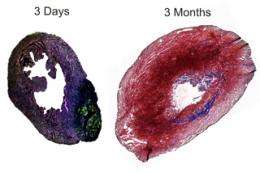
The picture on the left shows green c-kit+ precursor stem cells within an infarct (lower right) in a three-day old mouse. These cells are becoming new myocytes and also new vessels. On the right is another image of a heart taken after three months showing a small residual scar (on bottom) remaining from what was an infarct, and new myocytes (red areas) throughout the region. Image: Kotlikoff Lab
(Medical Xpress) -- In a two-day-old mouse, a heart attack causes active stem cells to grow new heart cells; a few months later, the heart is mostly repaired. But in an adult mouse, recovery from such an attack leads to classic after-effects: scar tissue, permanent loss of function and life-threatening arrhythmias.
A new study by Cornell and University of Bonn researchers found that stem cells did not create new heart cells in adult mice after a heart attack, settling a decades-old controversy about whether stem cells play a role in the recovery of the adult mammalian heart following infarction -- the leading cause of sudden death in the developed world -- where heart tissue dies due to artery blockage.
"If you did have fully capable stem cells in adults, why are there no new heart cells after an infarct? And is this due to the lack of stem cells or due to something special about the infarct that inhibits stem cells from forming new heart cells?" asked Michael Kotlikoff, the Austin O. Hooey Dean of Cornell's College of Veterinary Medicine, and senior author of the paper appearing Aug. 29 in the Proceedings of the National Academy of Sciences.
Beating heart cells
This movie shows beating heart cells in culture that originated as stem cells (look closely around the center of the frame). The researchers used a mouse model where heart cells fluoresced red and undifferentiated stem cells fluoresced green. All of the cells shown in the movie were green at the time of culture and they turn red after they become heart cells. There were no red cells to start, indicating that the origin of the beating red cells was green stem cells. Watch video
This video is not supported by your browser at this time.
This movie shows beating heart cells in culture that originated as stem cells (look closely around the center of the frame). The researchers used a mouse model where heart cells fluoresced red and undifferentiated stem cells fluoresced green. All of the cells shown in the movie were green at the time of culture and they turn red after they become heart cells. There were no red cells to start, indicating that the origin of the beating red cells was green stem cells.
Co-author Michelle Steffey, a small-animal surgeon in Cornell's veterinary college, developed a procedure to infarct a neonatal mouse heart that is only one-tenth-of-an-inch wide. "It was a tour-de-force technically to infarct and recover those baby mice," said Kotlikoff.
The baby mice grew new heart cells and almost completely recovered from infarction, proving that the infarction did not inhibit stem cells from growing new heart cells. The same procedure was carried out on adult mice and no new heart cells formed, confirming that adults do not have the requisite stem cells to create new heart cells, called myocytes, though new blood vessel cells were created.
To track the stem cells, Kotlikoff and colleagues used a mouse model they developed in which cells fluoresce green when the stem cell marker c-kit is present. In the experiment, after infarction, cells with the c-kit marker fluoresced green in neonatal and adult mice.
"In looking at the adult responses, we were able to prove that the c-kit-marked cells do not form heart cells, but form all of the new blood vessels within the infarct," said Kotlikoff. The stem cells found in the adult heart "have lost the ability to become heart cells," he said. It is known that developmentally single stem cells differentiate into all tissues at the start of life, but over time these cells become "developmentally restricted" or specialized to form only certain tissues, he added.
The study also showed for the first time that vessel stem cells in the adult heart originate there and are not recruited from bone marrow, as has been reported. Those reports have justified a controversial procedure in which bone marrow cells are injected into patients with infarctions.
Finally, the study settles the question of whether new heart cells in a neonatal mouse come from undifferentiated stem cells or from pre-existing heart cells that divide. To answer the question, the researchers used another mouse model where heart cells fluoresced red and undifferentiated stem cells fluoresced green. These two cell types were separated. The researchers found that the green stem cells that had moved into the infarct formed beating red heart cells in culture, proving that the stem cells had become heart cells.
Sophie Jesty, an associate professor and resident in cardiology at Cornell's College of Veterinary Medicine, is the paper's lead author. Researchers at the University of Bonn analyzed the mice to understand and quantify new myocyte formation.
The study was funded by the National Institutes of Health, New York State Stem Cell Science and the European Union Seventh Framework Programme.
Journal reference:
Proceedings of the National Academy of Sciences
Provided by
Cornell University
-
Researchers isolate and purify mouse heart stem cells
Feb 26, 2009 |
not rated yet |
0
-
Stem cells to be injected into the heart
Aug 26, 2005 |
not rated yet |
0
-
Helping the heart help itself: Research points to new use for stem cells
Apr 08, 2011 |
not rated yet |
0
-
Heart derived stem cells develop into heart muscle
Apr 23, 2008 |
not rated yet |
0
-
From stem cells to organs: The bioengineering challenge
Feb 16, 2008 |
not rated yet |
0
-
Motion perception revisited: High Phi effect challenges established motion perception assumptions
Apr 23, 2013 |
3 / 5 (2) |
2
-
Anything you can do I can do better: Neuromolecular foundations of the superiority illusion (Update)
Apr 02, 2013 |
4.5 / 5 (11) |
5
-
The visual system as economist: Neural resource allocation in visual adaptation
Mar 30, 2013 |
5 / 5 (2) |
9
-
Separate lives: Neuronal and organismal lifespans decoupled
Mar 27, 2013 |
4.9 / 5 (8) |
0
-
Sizing things up: The evolutionary neurobiology of scale invariance
Feb 28, 2013 |
4.8 / 5 (10) |
14
-
Solvability of a circuit
4 hours ago
-
Question about perception of colors around light sources
8 hours ago
-
Does a charged particle rotate when traveling through a static Bf?
10 hours ago
-
Find a link between physics and assignment problems
11 hours ago
-
Light as a source of electricity
11 hours ago
-
A question about the energy stored in a capacitor.
11 hours ago
- More from Physics Forums - Classical Physics
More news stories
Free fatty acids linked to cardiac risk in late adulthood
(HealthDay)—Blood levels of free fatty acids are associated with insulin resistance during young adulthood and cardiovascular risk factors in later adulthood, according to a study published online May 13 ...
Cardiology
May 17, 2013 |
not rated yet |
0
|
Diagnosing heart attacks: There's an app for that
An experimental, inexpensive iPhone application transmitted diagnostic heart images faster and more reliably than emailing photo images, according to a research study presented at the American Heart Association's Quality ...
Cardiology
May 17, 2013 |
not rated yet |
0
Study suggests new role for ECMO in treating patients with cardiac arrest and profound shock
Extracorporeal membrane oxygenation (ECMO), a procedure traditionally used during cardiac surgeries and in the ICU that functions as an artificial replacement for a patient's heart and lungs, has also been used to resuscitate ...
Cardiology
May 17, 2013 |
not rated yet |
0
Stroke patients respond similarly to after-stroke care, despite age difference
Age has little to do with how patients should be treated after suffering a stroke, according to new research from the University of Georgia.
Cardiology
May 17, 2013 |
not rated yet |
0
|
Depression linked to almost doubled stroke risk in middle-aged women
Depressed middle-aged women have almost double the risk of having a stroke, according to research published in Stroke: Journal of the American Heart Association.
Cardiology
May 16, 2013 |
not rated yet |
0
Researchers identify a potential new risk for sleep apnea: Asthma
Researchers at the University of Wisconsin have identified a potential new risk factor for obstructive sleep apnea: asthma. Using data from the National Institutes of Health (Heart, Lung, and Blood Institute)-funded Wisconsin ...
New theory on genesis of osteoarthritis comes with successful therapy in mice
Scientists at Johns Hopkins have turned their view of osteoarthritis (OA) inside out. Literally. Instead of seeing the painful degenerative disease as a problem primarily of the cartilage that cushions joints, ...
Computational tool translates complex data into simplified 2-dimensional images
In their quest to learn more about the variability of cells between and within tissues, biomedical scientists have devised tools capable of simultaneously measuring dozens of characteristics of individual ...
Study finds that sleep apnea and Alzheimer's are linked
A new study looking at sleep-disordered breathing (SDB) and markers for Alzheimer's disease (AD) risk in cerebrospinal fluid (CSF) and neuroimaging adds to the growing body of research linking the two.
'Gap' for HIV vaccine efforts after latest setback
The hunt for an HIV vaccine has gobbled up $8 billion in the past decade, and the failure of the most recent efficacy trial has delivered yet another setback to 26 years of efforts.
Ginger compounds may be effective in treating asthma symptoms
Gourmands and foodies everywhere have long recognized ginger as a great way to add a little peppery zing to both sweet and savory dishes; now, a study from researchers at Columbia University shows purified components of the ...