Preclinical studies use specialized ultrasound to detect presence of cancer
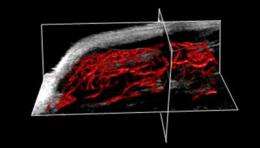
This is a dual-mode ultrasound image, showing traditional grayscale ultrasound of a subcutaneous tumor, simultaneously with acoustic angiography. The new technique of acoustic angiography enables visualization of the tissue microvasculature (red). Scientists have shown that this type of microvascular imaging can provide insight into the presence of cancer, based on examining the microvasculature alone. Scale bar = 1 cm. Credit: Image courtesy of the University of North Carolina at Chapel Hill
From the air, the twists and turns of rivers can easily be seen. In the body, however, tracing the twists and turns of blood vessels is difficult, but important. Vessel "bendiness" can indicate the presence and progression of cancer.
This principle led UNC scientists to a new method of using a high-resolution ultrasound to identify early tumors in preclinical studies. The method, based on vessel bendiness or "tortuosity," potentially offers an inexpensive, non-invasive and fast method to detect cancer that could someday help doctors identify cancers when tumors are less than a centimeter in size.
Their findings were published in the July 6, 2012 online issue of the journal Radiology.
Paul Dayton, PhD, associate professor of biomedical engineering explains, "The correlation between vessel tortuosity and cancer is well-established. What's new about our finding is that we can visualize these vessels in minutes with a very quick scan, using very inexpensive imaging methods." Dr. Dayton is a member of UNC Lineberger Comprehensive Cancer Center.
The UNC team used a new high-resolution ultrasound method, called "acoustic angiography," with an intravascular contrast agent that allowed them to acquire images of only the blood vessels. "Unlike current clinical 'grayscale' ultrasound, this method filters out all tissue signals, so we can see small blood vessels clearly." says Dayton.
"Our results showed a definitive difference between vessels within and surrounding tumors versus those associated with normal healthy vasculature. The limitation that we must now address is that our method works only for tumors at a shallow depth into tissue, such as melanomas or thyroid cancer. Our next studies will focus on this imaging-depth issue as well as evaluating the ability of this technology to determine a tumor's response to therapy.
"We know from several clinical and preclinical MRI studies at UNC by Elizabeth Bullitt, MD, and others, and at other institutions that vessels can unbend, or "normalize," in response to effective therapy. We need to see if our inexpensive ultrasound-based method of blood vessel visualization and tortuosity analysis can detect this normalization prior to conventional assessments of tumor response to therapy, such as measurements of tumor size.
Journal reference:
Radiology
Provided by
University of North Carolina Health Care
-
Noninvasive MR imaging of blood vessel growth in tumors using nanosized contrast agents
Jul 23, 2010 |
not rated yet |
0
-
Scientists identify growth factor as possible cancer drug target
Jun 09, 2009 |
not rated yet |
0
-
Catching cancer's spread by watching hemoglobin
Apr 30, 2007 |
not rated yet |
0
-
Neurotransmitter might improve cancer treatment: study
Dec 05, 2011 |
not rated yet |
0
-
Common transplant drug inhibits breast cancer growth, study shows
May 26, 2011 |
not rated yet |
0
-
Motion perception revisited: High Phi effect challenges established motion perception assumptions
Apr 23, 2013 |
3 / 5 (2) |
2
-
Anything you can do I can do better: Neuromolecular foundations of the superiority illusion (Update)
Apr 02, 2013 |
4.5 / 5 (11) |
5
-
The visual system as economist: Neural resource allocation in visual adaptation
Mar 30, 2013 |
5 / 5 (2) |
9
-
Separate lives: Neuronal and organismal lifespans decoupled
Mar 27, 2013 |
4.9 / 5 (8) |
0
-
Sizing things up: The evolutionary neurobiology of scale invariance
Feb 28, 2013 |
4.8 / 5 (10) |
14
-
How can there be villous adenoma in colon, if there are no villi there
11 hours ago
-
How can there be a term called "intestinal metaplasia" of stomach
May 21, 2013
-
Pressure-volume curve: Elastic Recoil Pressure don't make sense
May 18, 2013
-
If you became brain-dead, would you want them to pull the plug?
May 17, 2013
-
MRI bill question
May 15, 2013
-
Ratio of Hydrogen of Oxygen in Dessicated Animal Protein
May 13, 2013
- More from Physics Forums - Medical Sciences
More news stories
American cancer society celebrates 100 years of progress
(HealthDay)—The American Cancer Society, which is celebrating on Wednesday a century of fighting a disease once viewed as a death sentence, is making a pledge to put itself out of business.
Cancer
47 minutes ago |
not rated yet |
0
CT detects twice as many lung cancers as X-ray at initial screening exam
National Lung Screening Trial (NLST) investigators also conclude that the 20 percent reduction in lung cancer mortality with low-dose computed tomography (LDCT) versus chest X-ray (CXR) screening previously reported in the ...
Cancer
1 hour ago |
not rated yet |
0
Research offers promising new approach to treatment of lung cancer
Researchers have developed a new drug delivery system that allows inhalation of chemotherapeutic drugs to help treat lung cancer, and in laboratory and animal tests it appears to reduce the systemic damage ...
Cancer
4 hours ago |
not rated yet |
0
|
Study details genes that control whether tumors adapt or die when faced with p53 activating drugs
When turned on, the gene p53 turns off cancer. However, when existing drugs boost p53, only a few tumors die – the rest resist the challenge. A study published in the journal Cell Reports shows how: tumors that live even i ...
Cancer
4 hours ago |
not rated yet |
0
|
Small increase in cancer risk following CT scans in childhood and adolescence
Study leader, Professor John Mathews from the University of Melbourne said this small increase in cancer risk must be weighed against the undoubted benefits from CT scans in diagnosing and monitoring disease.
Cancer
8 hours ago |
not rated yet |
0
Systematic screening of med adherence will ID barriers
(HealthDay)—Implementation of systematic monitoring for medication adherence will allow for identification of barriers to adherence and tailoring of interventions, according to a viewpoint piece published ...
FDA panel backs experimental Merck insomnia drug
(AP)—A federal panel of medical experts says that an experimental insomnia drug from Merck & Co Inc. appears safe and effective, despite evidence from company trials that the pill can cause daytime sleepiness and difficulty ...
Having both migraines, depression may mean smaller brain
(HealthDay)—Migraines and depression can each cause a great deal of suffering, but new research indicates the combination of the two may be linked to something else entirely—a smaller brain.
Brain can be trained in compassion, study shows
Until now, little was scientifically known about the human potential to cultivate compassion—the emotional state of caring for people who are suffering in a way that motivates altruistic behavior.
Swine flu pandemic of 2009 more deadly for younger adults, study finds
As the world prepares for what may be the next pandemic strain of influenza virus, in the H7N9 bird flu, a new UC Irvine study reveals that the 2009 H1N1 swine flu pandemic was deadliest for people under the age of 65, while ...
'Boys will be boys' in US, but not in Asia
A new study shows there is a gender gap when it comes to behavior and self-control in American young children – one that does not appear to exist in children in Asia.