Brain imaging can predict how intelligent you are, study finds
August 1, 2012 By Gerry Everding in Neuroscience

Brain imaging can predict how intelligent you are, study finds

Enlarge

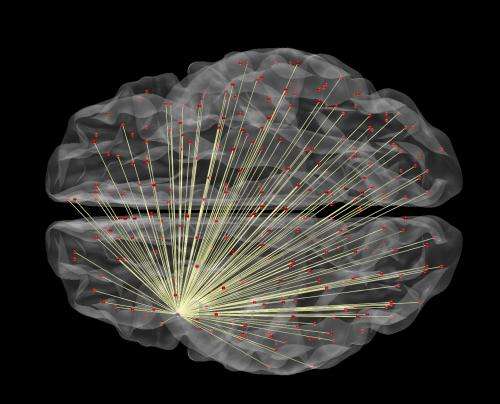
New research suggests as much as 10 percent of individual variances in human intelligence can be predicted based on the strength of neural connections between the left prefrontal cortex and other regions of the brain. WUSTL IMAGE / MICHAEL COLE

(Medical Xpress) -- When it comes to intelligence, what factors distinguish the brains of exceptionally smart humans from those of average humans?

As science has long suspected, overall matters somewhat, accounting for about 6.7 percent of individual variation in intelligence. More recent research has pinpointed the ’s prefrontal , a region just behind the forehead, as a critical hub for high-level mental processing, with activity levels there predicting another 5 percent of variation in individual intelligence.

Now, new research from Washington University in St. Louis suggests that another 10 percent of individual differences in intelligence can be explained by the strength of neural pathways connecting the left prefrontal cortex to the rest of the brain.

Published in the Journal of Neuroscience, the findings establish “global brain connectivity” as a new approach for understanding human intelligence.

“Our research shows that connectivity with a particular part of the prefrontal cortex can predict how intelligent someone is,” suggests lead author Michael W. Cole, PhD, a postdoctoral research fellow in cognitive neuroscience at Washington University. The study is the first to provide compelling evidence that neural connections between the left prefrontal cortex and the rest of the brain make a unique and powerful contribution to the cognitive processing underlying human intelligence, says Cole, whose research focuses on discovering the cognitive and neural mechanisms that make human behavior uniquely flexible and intelligent.

“This study suggests that part of what it means to be intelligent is having a prefrontal cortex that does its job well; and part of what that means is that it can effectively communicate with the rest of the brain,” says study co-author Todd Braver, PhD, professor of psychology in Arts & Sciences and of neuroscience and radiology in the School of Medicine. Braver is a co-director of the and Psychopathology Lab at Washington University, in which the research was conducted.

One possible explanation of the findings, the research team suggests, is that the prefrontal region is a “flexible hub” that uses its extensive brain-wide connectivity to monitor and influence other brain regions in a goal-directed manner.

“There is evidence that the left prefrontal cortex is the brain region that ‘remembers’ (maintains) the goals and instructions that help you keep doing what is needed when you’re working on a task,” Cole says. “So it makes sense that having this region communicating effectively with other regions (the ‘perceivers’ and ‘doers’ of the brain) would help you to accomplish tasks intelligently.”

While other regions of the brain make their own special contribution to cognitive processing, it is the left prefrontal cortex that helps coordinate these processes and maintain focus on the task at hand, in much the same way that the conductor of a symphony monitors and tweaks the real-time performance of an orchestra.

“We’re suggesting that the left prefrontal cortex functions like a feedback control system that is used often in engineering, that it helps implement cognitive control (which supports fluid intelligence), and that it doesn’t do this alone,” Cole says.

The findings are based on an analysis of functional magnetic resonance brain images captured as study participants rested passively and also when they were engaged in a series of mentally challenging tasks associated with fluid intelligence, such as indicating whether a currently displayed image was the same as one displayed three images ago.

Previous findings relating left prefrontal cortex activity to challenging task performance were supported. Connectivity was then assessed while participants rested, and their performance on additional tests of fluid intelligence and cognitive control collected outside the brain scanner was associated with the estimated connectivity.

Results indicate that levels of global brain connectivity with a part of left lateral prefrontal cortex serve as a strong predictor of both fluid intelligence and cognitive control abilities.

Although much remains to be learned about how these neural connections contribute to fluid intelligence, new models of brain function suggested by this research could have important implications for the future understanding — and perhaps augmentation — of human .

The findings also may offer new avenues for understanding how breakdowns in global brain connectivity contribute to the profound cognitive control deficits seen in schizophrenia and other mental illnesses, Cole suggests.

More information: Paper online: www.jneurosci.org/… 988.abstract

Journal reference: Journal of Neuroscience search and more info website

Provided by Washington University School of Medicine in St. Louis search and more info website

4.6 /5 (22 votes)  

Filter


Move the slider to adjust rank threshold, so that you can hide some of the comments.


Display comments: newest first

antialias_physorg
Aug 01, 2012

Rank: 4.2 / 5 (5)
So now al we need to do is figure out which gene (or epigenetic factor) puts the development of the left prefrontal cortex into overdrive and: voila.

OK...probably not quite that easy. But I'm willing to bet someone is going to try it on their children.
JVK
Aug 01, 2012

Rank: not rated yet
Of course we already know it is not which gene or which epigenetic factor that's involved. It is so clearly the epigenetic effects of nutrient chemicals and pheromones on intracellular signaling and stochastic gene expression (genetically predisposed, of course), that attempts to examine the molecular biology by looking at brain connectivity and correlate it with intelligence make it impossible to see our well-constructed socio-cognitive niche from the perspective of adaptive evolution, which is clearly first dependent on ecological, social, and neurogenic niche construction. So, please, don't try to tweak the ecological, social, and neurogenic niche construction of your children, just to see if you can increase their intelligence. That's not an intelligent thing to do, is it? Neither is writing rambling sentences that are likely to be read by the unintelligent, but therein lies yet another problem.
antonima
Aug 01, 2012

Rank: 5 / 5 (2)
I'm suspicious of studies that take into account remembering pictures to determine intelligence.
ngrailrei
Aug 01, 2012

Rank: 5 / 5 (3)
I'm with Antonima. This appears to have been a measure of memory, not of intelligence, and the activity reported seems very similar to that reported for savants:

Neurocase. 2007 Oct;13(5):311-9.
Savant memory for digits in a case of synaesthesia and Asperger syndrome is related to hyperactivity in the lateral prefrontal cortex.
Bor D, Billington J, Baron-Cohen S.
Source

Medical Research Council Cognition and Brain Sciences Unit, Cambridge, UK. daniel.bor@mrc-cbu.cam.ac.uk
Abstract

SINGLE CASE: DT is a savant with exceptional abilities in numerical memory and mathematical calculations. DT also has an elaborate form of synaesthesia for visually presented digits. Further more, DT also has Asperger syndrome (AS). We carried out two preliminary investigations to establish whether these conditions may contribute to his savant abilities. NEUROIMAGING: In an fMRI digit span study, DT showed hyperactivity in lateral prefrontal cortex when encoding digits, compared with controls....
Vendicar_Decarian
Aug 01, 2012

Rank: 5 / 5 (4)
"So now al we need to do is figure out which gene (or epigenetic factor) puts the development of the left prefrontal cortex into overdrive and: voila." - Antialias

No More Republicans....
ziphead
Aug 05, 2012

Rank: not rated yet
"So now al we need to do is figure out which gene (or epigenetic factor) puts the development of the left prefrontal cortex into overdrive and: voila." - Antialias

No More Republicans....


Yeah? And who would you bag then? Your superior cerebrum would have lost all sense of purpose.
Rank 4.6 /5 (22 votes)
Relevant PhysicsForums posts

More news stories

B vitamins could delay dementia

(Medical Xpress)—Despite spending billions of dollars on research and development, drug companies have been unable to come up with effective treatments for dementia and Alzheimer's Disease (AD). Now, A. ...

Neuroscience created 3 hours ago | popularity 4.7 / 5 (3) | comments 0 | with audio podcast report

Waiting for a sign? Researchers find potential brain 'switch' for new behavior

You're standing near an airport luggage carousel and your bag emerges on the conveyor belt, prompting you to spring into action. How does your brain make the shift from passively waiting to taking action when ...

Neuroscience created 3 hours ago | popularity not rated yet | comments 0 | with audio podcast

If you can remember it, you can remember it wrong

(Medical Xpress)—Native peoples in regions where cameras are uncommon sometimes react with caution when their picture is taken. The fear that something must have been stolen from them to create the photo ...

Neuroscience created 5 hours ago | popularity 4 / 5 (4) | comments 0 | with audio podcast report

Study shows where scene context happens in our brain

In a remote fishing community in Venezuela, a lone fisherman sits on a cliff overlooking the southern Caribbean Sea. This man –– the lookout –– is responsible for directing his comrades on the water, ...

Neuroscience created 7 hours ago | popularity 4 / 5 (1) | comments 0 | with audio podcast

Clouds in the head

Many brain researchers cannot see the forest for the trees. When they use electrodes to record the activity patterns of individual neurons, the patterns often appear chaotic and difficult to interpret.

Neuroscience created 8 hours ago | popularity not rated yet | comments 0


Antidepressant reduces stress-induced heart condition

A drug commonly used to treat depression and anxiety may improve a stress-related heart condition in people with stable coronary heart disease, according to researchers at Duke Medicine.

Americans still making unhealthy choices, CDC reports

(HealthDay)—The overall health of Americans isn't improving much, with about six in 10 people either overweight or obese and large numbers engaging in unhealthy behaviors like smoking, heavy drinking or ...

CDC presents recent trends in health behaviors of US adults

(HealthDay)—In 2008 to 2010, the prevalence of key health behaviors among U.S. adults varied, with about one in five adults current smokers and 62.1 percent overweight or obese, according to a report presented ...

Study examines outbreak of spinal infections in Michigan

(HealthDay)—Factors such as increased case finding may explain why Michigan had half of the total spinal infections associated with contaminated methylprednisolone acetate in the recent fungal meningitis ...

Early use of tracheostomy for mechanically ventilated patients not associated with improved survival

For critically ill patients receiving mechanical ventilation, early tracheostomy (within the first 4 days after admission) was not associated with an improvement in the risk of death within 30 days compared to patients who ...

CDC says high number of public pools contain microbes

(HealthDay)—Three-quarters of public schools in the metro Atlanta area contain microbes, including bacteria indicating the presence of fecal matter, according to research published in the May 17 issue of ...