A drug-screening platform for ALS
August 2, 2012 in Medical research

A drug-screening platform for ALS

Enlarge

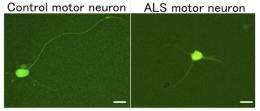
This shows a control iPSC-derived motor neuron (left) and a motor neuron derived from ALS patient-specific iPSC (right). Credit: Haruhisa Inoue's Laboratory, CiRA, Kyoto University

A research group at the Center for iPS Cell Research and Application (CiRA) at Japan's Kyoto University has successfully recapitulated amyotrophic lateral sclerosis (ALS)-associated abnormalities in motor neurons differentiated from induced pluripotent stem cells (iPSCs) obtained from patients with familial ALS, a late-onset, fatal disorder which is also known for Lou Gehrig's disease. In a drug screening assay using the disease model, the team further found that the chemical compound anacardic acid can rescue some ALS phenotypes in vitro.

In a study published online in Science Translational Medicine, Associate Professor Haruhisa Inoue and his team generated motor neurons from iPSCs derived from three ALS patients with mutations in Tar DNA-binding protein-43 (TDP-43). The motor neurons showed cellular phenotypes including vulnerability to stress, shorter neurites, and cytosolic aggregates similar to those seen in postmortem tissues from ALS patients. The team also found that TDP-43 mRNA was upregulated in the ALS motor neurons, which means that TDP-43 autoregulation was disturbed, and that TDP-43 protein in detergent-insoluble form aggregated with the splicing factor SNRPB2 in the nucleus, perturbing RNA metabolism. These findings shed light on the mechanism of disease onset.

Using the motor neurons as a , the researchers discovered that the anacardic acid can rescue the abnormal ALS motor neuron phenotypes. For example, when anacardic acid, a histone acetyltransferase inhibitor, was sprinkled on the motor neurons, TDP-43 was decreased, and the length of the increased.

''Our work represents an initial stage of drug screening for ALS using patient-specific iPSCs. TDP-43 is not only relevant to familial ALS but also to sporadic ALS, which represents the majority of ALS cases,'' said Inoue, a principal investigator at CiRA who is also one of research directors for the CREST research program funded by the Japan Science and Technology Agency. ''We will continue to work on ALS patient-specific iPSCs in order to help develop new drug seeds and candidates.''

More information: Egawa et al. "Drug Screening for ALS Using Patient-Specific Induced Pluripotent Stem Cells" Science Translational Medicine.

Journal reference: Science Translational Medicine search and more info website

Provided by Kyoto University search and more info website

not rated yet  

Rank not rated yet
Relevant PhysicsForums posts

More news stories

Computational tool translates complex data into simplified 2-dimensional images

In their quest to learn more about the variability of cells between and within tissues, biomedical scientists have devised tools capable of simultaneously measuring dozens of characteristics of individual ...

Medical research created 9 hours ago | popularity 5 / 5 (2) | comments 0 | with audio podcast

Now we know why old scizophrenia medicine works on antibiotics-resistant bacteria

In 2008 researchers from the University of Southern Denmark showed that the drug thioridazine, which has previously been used to treat schizophrenia, is also a powerful weapon against antibiotic-resistant bacteria such as ...

Medical research created May 17, 2013 | popularity 4 / 5 (4) | comments 0 | with audio podcast

SUMO wrestling cells reveal new protective mechanism target for stroke

Scientists investigating the interaction of a group of proteins in the brain responsible for protecting nerve cells from damage have identified a new target that could increase cell survival.

Medical research created May 17, 2013 | popularity 5 / 5 (1) | comments 0

How serotonin receptors can shape drug effects, from LSD to migraine medication

New findings by researchers carrying out experiments at the U.S. Department of Energy Office of Science's Advanced Photon Source (APS) help explain why some drugs that interact with two kinds of human serotonin ...

Medical research created May 17, 2013 | popularity 4 / 5 (1) | comments 0 | with audio podcast

Preventing blood poisoning

Peptide molecules derived from the body's natural immune system can help boost the body's defence against life-threatening blood poisoning, joint University research has uncovered.

Medical research created May 17, 2013 | popularity 4 / 5 (1) | comments 0 | with audio podcast


Researchers identify a potential new risk for sleep apnea: Asthma

Researchers at the University of Wisconsin have identified a potential new risk factor for obstructive sleep apnea: asthma. Using data from the National Institutes of Health (Heart, Lung, and Blood Institute)-funded Wisconsin ...

New theory on genesis of osteoarthritis comes with successful therapy in mice

Scientists at Johns Hopkins have turned their view of osteoarthritis (OA) inside out. Literally. Instead of seeing the painful degenerative disease as a problem primarily of the cartilage that cushions joints, ...

Study finds that sleep apnea and Alzheimer's are linked

A new study looking at sleep-disordered breathing (SDB) and markers for Alzheimer's disease (AD) risk in cerebrospinal fluid (CSF) and neuroimaging adds to the growing body of research linking the two.

'Gap' for HIV vaccine efforts after latest setback

The hunt for an HIV vaccine has gobbled up $8 billion in the past decade, and the failure of the most recent efficacy trial has delivered yet another setback to 26 years of efforts.

Ginger compounds may be effective in treating asthma symptoms

Gourmands and foodies everywhere have long recognized ginger as a great way to add a little peppery zing to both sweet and savory dishes; now, a study from researchers at Columbia University shows purified components of the ...

Ketamine shows significant therapeutic benefit in people with treatment-resistant depression

Patients with treatment-resistant major depression saw dramatic improvement in their illness after treatment with ketamine, an anesthetic, according to the largest ketamine clinical trial to-date led by researchers from the ...