Self-awareness in humans is more complex, diffuse than previously thought
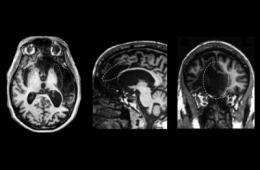
August 22, 2012 in Neuroscience
Researchers at the University of Iowa studied the brain of a patient with rare, severe damage to three regions long considered integral to self-awareness in humans (from left to right: the insular cortex, anterior cingulate cortex, and the medial prefrontal cortex). Based on the scans, the UI team believes self-awareness is a product of a diffuse patchwork of pathways in the brain rather than confined to specific areas. Credit: Department of Neurology, University of Iowa
Ancient Greek philosophers considered the ability to "know thyself" as the pinnacle of humanity. Now, thousands of years later, neuroscientists are trying to decipher precisely how the human brain constructs our sense of self.
Self-awareness is defined as being aware of oneself, including one's traits, feelings, and behaviors. Neuroscientists have believed that three brain regions are critical for self-awareness: the insular cortex, the anterior cingulate cortex, and the medial prefrontal cortex. However, a research team led by the University of Iowa has challenged this theory by showing that self-awareness is more a product of a diffuse patchwork of pathways in the brain – including other regions – rather than confined to specific areas.
The conclusions came from a rare opportunity to study a person with extensive brain damage to the three regions believed critical for self-awareness. The person, a 57-year-old, college-educated man known as "Patient R," passed all standard tests of self-awareness. He also displayed repeated self-recognition, both when looking in the mirror and when identifying himself in unaltered photographs taken during all periods of his life.
"What this research clearly shows is that self-awareness corresponds to a brain process that cannot be localized to a single region of the brain," said David Rudrauf, co-corresponding author of the paper, published online Aug. 22 in the journal PLOS ONE. "In all likelihood, self-awareness emerges from much more distributed interactions among networks of brain regions." The authors believe the brainstem, thalamus, and posteromedial cortices play roles in self-awareness, as has been theorized.
The researchers observed that Patient R's behaviors and communication often reflected depth and self-insight. First author Carissa Philippi, who earned her doctorate in neuroscience at the UI in 2011, conducted a detailed self-awareness interview with Patient R and said he had a deep capacity for introspection, one of humans' most evolved features of self-awareness.
"During the interview, I asked him how he would describe himself to somebody," said Philippi, now a postdoctoral research scholar at the University of Wisconsin-Madison. "He said, 'I am just a normal person with a bad memory.'"
Patient R also demonstrated self-agency, meaning the ability to perceive that an action is the consequence of one's own intention. When rating himself on personality measures collected over the course of a year, Patient R showed a stable ability to think about and perceive himself. However, his brain damage also affected his temporal lobes, causing severe amnesia that has disrupted his ability to update new memories into his "autobiographical self." Beyond this disruption, all other features of R's self-awareness remained fundamentally intact.
"Most people who meet R for the first time have no idea that anything is wrong with him," noted Rudrauf, a former assistant professor of neurology at the UI and now a research scientist at the INSERM Laboratory of Functional Imaging in France. "They see a normal-looking middle-aged man who walks, talks, listens, and acts no differently than the average person."
"According to previous research, this man should be a zombie," he added. "But as we have shown, he is certainly not one. Once you've had the chance to meet him, you immediately recognize that he is self-aware."
Patient R is a member of the UI's world-renowned Iowa Neurological Patient Registry, which was established in 1982 and has more than 500 active members with various forms of damage to one or more regions in the brain.
The researchers had begun questioning the insular cortex's role in self-awareness in a 2009 study that showed that Patient R was able to feel his own heartbeat, a process termed "interoceptive awareness."
The UI researchers estimate that Patient R has ten percent of tissue remaining in his insula and one percent of tissue remaining in his anterior cingulate cortex. Some had seized upon the presence of tissue to question whether those regions were in fact being used for self-awareness. But neuroimaging results presented in the current study reveal that Patient R's remaining tissue is highly abnormal and largely disconnected from the rest of the brain.
"Here, we have a patient who is missing all the areas in the brain that are typically thought to be needed for self-awareness yet he remains self-aware," added co-corresponding author Justin Feinstein, who earned his doctorate at the UI in February. "Clearly, neuroscience is only beginning to understand how the human brain can generate a phenomenon as complex as self-awareness."
Journal reference:
PLoS ONE
Provided by
University of Iowa
-
Study reveals second pathway to feeling your heartbeat
Nov 02, 2009 |
not rated yet |
0
-
Rare neurons discovered in monkey brains
May 21, 2012 |
not rated yet |
0
-
Conscious perception is a matter of global neural networks
Jun 13, 2012 |
not rated yet |
0
-
When the brain remembers but the patient doesn't
Jul 14, 2011 |
not rated yet |
0
-
Seeing color in 'blindsight'
Oct 27, 2008 |
not rated yet |
0
-
Motion perception revisited: High Phi effect challenges established motion perception assumptions
Apr 23, 2013 |
3 / 5 (2) |
2
-
Anything you can do I can do better: Neuromolecular foundations of the superiority illusion (Update)
Apr 02, 2013 |
4.5 / 5 (11) |
5
-
The visual system as economist: Neural resource allocation in visual adaptation
Mar 30, 2013 |
5 / 5 (2) |
9
-
Separate lives: Neuronal and organismal lifespans decoupled
Mar 27, 2013 |
4.9 / 5 (8) |
0
-
Sizing things up: The evolutionary neurobiology of scale invariance
Feb 28, 2013 |
4.8 / 5 (10) |
14
-
Pressure-volume curve: Elastic Recoil Pressure don't make sense
16 hours ago
-
If you became brain-dead, would you want them to pull the plug?
May 17, 2013
-
MRI bill question
May 15, 2013
-
Ratio of Hydrogen of Oxygen in Dessicated Animal Protein
May 13, 2013
-
Alcohol and acetaminophen
May 13, 2013
-
Marie Curie's leukemia
May 13, 2013
- More from Physics Forums - Medical Sciences
More news stories
For combat veterans suffering from post-traumatic stress disorder, 'fear circuitry' in the brain never rests
Chronic trauma can inflict lasting damage to brain regions associated with fear and anxiety. Previous imaging studies of people with post-traumatic stress disorder, or PTSD, have shown that these brain regions can over-or ...
Neuroscience
18 hours ago |
5 / 5 (1) |
0
|
Temporal processing in the olfactory system
The neural machinery underlying our olfactory sense continues to be an enigma for neuroscience. A recent review in Neuron seeks to expand traditional ideas about how neurons in the olfactory bulb might encode information about ...
Neuroscience
May 17, 2013 |
not rated yet |
0
|
Melon focus headband turns to Kickstarter for rollout plans
(Medical Xpress)—What if the quality of your work depends more on your focus on the piano keys or canvas or laptop than your musical or painting or computing skills? If target users can be convinced, they ...
Neuroscience
May 17, 2013 |
3.7 / 5 (3) |
0
|
Deep brain stimulation: A fix when the drugs don't work
Neurological disorders can have a devastating impact on the lives of sufferers and their families.
Neuroscience
May 17, 2013 |
5 / 5 (1) |
0
|
Brain makes call on which ear is used for cell phone
If you're a left-brain thinker, chances are you use your right hand to hold your cell phone up to your right ear, according to a newly published study from Henry Ford Hospital in Detroit.
Neuroscience
May 16, 2013 |
2 / 5 (2) |
0
|
New research identifies risks, interventions for children's GI health
An increasing number of U.S. children are experiencing gastrointestinal issues that require interventions to resolve, according to research presented at Digestive Disease Week (DDW).
US psychiatry gets makeover in new manual
The latest makeover to a massive psychiatric tome honored by some, reviled by others and even called the "Bible" of mental disorders is being released Saturday with a host of new changes.
New case of SARS-like virus in Saudi: ministry
A new case of the deadly coronavirus has been detected in Saudi Arabia where 15 people have already died after contracting it, the health ministry announced on Saturday on its Internet website.
AIDS science at 30: 'Cure' now part of lexicon
Big names in medicine are set to give an upbeat assessment of the war on AIDS on Tuesday, 30 years after French researchers identified the virus that causes the disease.
New colonoscope provides ground-breaking view of colon
A ground-breaking advance in colonoscopy technology signals the future of colorectal care, according to research presented today at Digestive Disease Week(DDW). Additional research focuses on optimizing the minimal withdrawal ...
Flesh-eating disease victim gets prosthetic hands
(AP)—A woman who lost both hands, her left leg and right foot after contracting a flesh-eating disease has been fitted with prosthetic hands.
Aug 22, 2012
Rank: 1.9 / 5 (9)
A: Animals thoughts are driven uniquely by need
B: Our brains are social machines which involves most of the brain
C: Existencial awareness is derived from the capability to sense pain
D: All other awareness beginning with identity are all derived from complete language (not just commands or queues like dolphins)
E: Awareness can also be derived from dreams
F: All humans are garanteed awareness, short of a brain.
G: The need for advanced language is what developed are human intellegence
H: Our imaginative capabilities are unparalleled since we are information processors (manipulate) advanced mech. behind that.
I should have a PHD, peace of cake.
Aug 22, 2012
Rank: 1.7 / 5 (6)
Aug 22, 2012
Rank: 2.5 / 5 (8)
Aug 22, 2012
Rank: 3.4 / 5 (9)
For self-awareness to be meaningful as a phenomenon, it must have consequences that are measurable, so it must be provable that someone is or isn't self-aware.
If there's no way of distinguishing between awareness and non-awareness, then we've framed the question wrong and are looking for ghosts.
Aug 22, 2012
Rank: 2.8 / 5 (9)
Aug 23, 2012
Rank: 3 / 5 (6)
yup, plus how its so obvious that this must be proof of a maker, no way it could evolve naturally......
I'm kind of surprised zephyer isnt here claiming this somehow proves his aether theories somehow. lol
Aug 23, 2012
Rank: 2.5 / 5 (4)
They can queue? Dolphins must be British.
But seriously, is it possible that awareness is in both parts and complete? That is, any part of the brain (or at least, any number of parts) may be capable of sustaining self-awareness, but it is more practical to be departmentalised and parts are prioritised, much how (at least a few species of) octopuses have completely flexible limbs but still choose to bend with artificial "joints"? If they injured where they might put a kink, they can put a kink further up the limb. Likewise, it's more practical to departmentalise for the sake of organisation. Self-awareness isn't restricted to the parts originally believed to be responsible, they're just the DNA's first choice.
Aug 23, 2012
Rank: 3 / 5 (5)
(Gurdjieff to Ouspensky)
Especially for 'framing' questions - see Eikka's insight.
The Achilles' heel exhibited in all the 'soft' sciences.
Aug 23, 2012
Rank: 3.7 / 5 (3)
Let me break it down further for you.
To simplify things, let's just say that awareness is existential awareness. The moment one can sense pain i.e., in a womb they are aware. Language on the hand is what allows for a greater sense of self (to distinguish from peers, physically and in mind).
I never said it was restricted to certain parts of the brain. I just said that the majority of it was involved, but that was for my broader definition of awareness. For the new one, it would put constraints (everything involved in processing pain). But language and what allows us to acquire it, play an important role in identity which one can construe as awareness.
Aug 23, 2012
Rank: 1 / 5 (1)
I was just playing with your typo regarding the dolphins.
I was just suggesting it as a possible hypothesis.
Aug 23, 2012
Rank: 1 / 5 (1)
Aug 24, 2012
Rank: not rated yet
Aug 25, 2012
Rank: 2.3 / 5 (3)
To put it simply, all of the nerves collect data points, sends them off to the brain, which turns them into the experience of experiencing via the internal representation of the world.
Or as wikipedia puts it, for vision: "An image is produced by the patterned excitation of the cones and rods in the retina. The excitation is processed by the neuronal system and various parts of the brain working in parallel to form a representation of the external environment in the brain"
What you see out of your eye is not actually outside.
As for eric96, all beasts feel pain, even some plants.. So that's pretty irrelevan
Aug 25, 2012
Rank: 3 / 5 (2)
Aug 25, 2012
Rank: not rated yet
Aug 25, 2012
Rank: 1 / 5 (2)
Sorry you just blundered a bunch of false statements.
1. Plants do not feel pain. They do not possess a nervous system which means necessarily that they cannot perceive pain so despite your obvious compassion for them this is incorrect.
Yes, all animals that have a nervous system and feel pain. Their self-awareness is limited to "I exist". Any greater sense of identity is manifested/enabled by complete language (large vocabulary, grammar and so on and so forth). No animal has this which is why are sense of self is that much more developed.
Aug 26, 2012
Rank: 1 / 5 (1)
Eikka has it pinned down.
@ eric96, Skepticus:
"Our imaginative capabilities are unparalleled since we are information processors (manipulate) advanced mech. behind that."
"Buddhism 101",
Trivial claims (as in all cells are information processors, and many animals have technologies) respectively non-testable claims are not informing.