New technology to transform blood processing
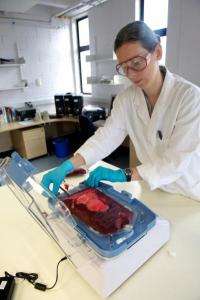
University of Strathclyde Bioengineer Laurie Shedden demonstrates the technology. Credit: University of Strathclyde
A pioneering surgical blood salvage technology developed at the University of Strathclyde, Glasgow, is set to transform the way major surgery is carried out by reducing blood loss in patients.
HemoSep is set to revolutionise the health care sector after gaining the CE mark and receiving Canadian national approval, following highly successful clinical trials in the world leading University of Kirikkale University Hospital in Ankara, Turkey.
The device is designed to recover blood spilled during open-heart and major trauma surgery and concentrate the blood cells for transfusion back to the patient. This process, known as autotransfusion, reduces the volume of donor blood required and the problems associated with transfusion reaction.
Professor Terry Gourlay, who led the development of the technology at the University's Department of Biomedical Engineering, said: "This is a fantastic example of real collaboration between the University of Strathclyde and the medical device industry to take this device from concept to clinical delivery.
"The introduction of HemoSep to the medical device field will make a significant difference to people's lives and greatly reduce the cost and risks associated with blood transfusions. The technology has distinct advantages over traditional techniques which are not only costly but technically challenging and involve the use of a complex centrifuge and pumping apparatus by specialist technicians.
"We expect further developments in the form of a derivative of this technology for use in children undergoing open-heart surgery where the challenges of blood conservation are even more critical."
In the clinical trials, carried out in over 100 open-heart surgery operations, the use of the HemoSep device significantly reduced the need for blood transfusions together with preservation of normal clotting mechanisms and a reduction in the inflammatory reaction often encountered after such surgical procedures.
The device consists of a blood bag which employs a chemical sponge technology and a mechanical agitator to concentrate blood sucked from the surgical site or drained from the heart-lung machine after the surgery. The separated cells are then returned to the patient by intravenous transfusion.
Professor Serdar Gunaydin, Head of Cardiac Surgery at the University of Kirikkale where the trials were conducted, said: "The technology is a real step forward in the field of autotransfusion for cardiac surgery, being highly effective, easy to use and associated with a reduction in the need for donor transfusion and blood loss in these patients.
"In the climate of national blood product shortages and concern for disease transmission and immunosuppression, every effort should be made to optimise blood recovery and reduce allogeneic blood usage.
"The HemoSep technology has produced impressive results, it is the easiest method we have ever used. There is no interference with the ongoing operation and product is ready to use following a very short processing time. It quickly and safely recovers substantial proteins, clotting factors and cell concentrates for all types of cardiac procedures.
"We believe this new technology will be one of the essential components of the routine heart surgery in the near future. We even think this technique may be useful for blood preservation during transplantation, orthopedics and neurosurgery."
Further clinical trials are planned, but the CE mark means that the device will now be sold to the healthcare sector. HemoSep has been licensed to Advancis Surgical Ltd. The company will market and sell the device in all European territories, other regions which recognise the CE mark and Canada.
Mr Stephen Cotton, Advancis Surgical Ltd director of research and development, said: "We are delighted to be able to make this announcement which comes after considerable shared effort to develop this exciting product. We hope that this success will be the first of many through our collaboration with the University of Strathclyde."
Professors Gourlay and Gunaydin will present the results of the recent clinical trials at the European Society for Artificial Organs congress in Rostock, Germany in September to correspond with Advancis' commercial launch of the device.
Provided by
University of Strathclyde, Glasgow
-
New treatment method in sight in cardiac surgery
May 10, 2010 |
not rated yet |
0
-
Antifibrinolytic drugs reduce blood loss during cardiac surgery
Oct 17, 2007 |
not rated yet |
0
-
Red blood cell transfusions under scrutiny
Nov 27, 2007 |
not rated yet |
0
-
Non-cardiac surgery: Safe for patients with heart device
Apr 15, 2011 |
not rated yet |
0
-
Study examines outcomes of patients who refuse transfusion following cardiac surgery
Jul 02, 2012 |
not rated yet |
0
-
Motion perception revisited: High Phi effect challenges established motion perception assumptions
Apr 23, 2013 |
3 / 5 (2) |
2
-
Anything you can do I can do better: Neuromolecular foundations of the superiority illusion (Update)
Apr 02, 2013 |
4.5 / 5 (11) |
5
-
The visual system as economist: Neural resource allocation in visual adaptation
Mar 30, 2013 |
5 / 5 (2) |
9
-
Separate lives: Neuronal and organismal lifespans decoupled
Mar 27, 2013 |
4.9 / 5 (8) |
0
-
Sizing things up: The evolutionary neurobiology of scale invariance
Feb 28, 2013 |
4.8 / 5 (10) |
14
-
Classical and Quantum Mechanics via Lie algebras
Apr 15, 2011
- More from Physics Forums - Independent Research
More news stories
Plastic realistic: Medical students to use plastinated human bodies for anatomy learning
Nanyang Technological University's (NTU) new medical school will be pioneering the use of plastinated bodies for medical education in Singapore.
Other
7 hours ago |
not rated yet |
0
Survey points out deficiencies in addictions training for medical residents
A 2012 survey of internal medicine residents at Massachusetts General Hospital (MGH) – one of the nation's leading teaching hospitals – found that more than half rated the training they had received in addiction and other ...
Other
May 22, 2013 |
5 / 5 (1) |
0
Early use of tracheostomy for mechanically ventilated patients not associated with improved survival
For critically ill patients receiving mechanical ventilation, early tracheostomy (within the first 4 days after admission) was not associated with an improvement in the risk of death within 30 days compared to patients who ...
Other
May 21, 2013 |
not rated yet |
0
Decisions to forgo life support may depend heavily on the ICU where patients are treated
The decision to limit life support in patients in the intensive care unit (ICU) appears to be significantly influenced by physician practices and/or the culture of the hospital, suggests new findings from researchers at the ...
Other
May 21, 2013 |
not rated yet |
0
People on higher incomes are happier with new knees
Knee replacement surgery is a very common procedure. However, it does not always resolve function or pain in all the recipients of new knees. A study by Robert Barrack, MD and his colleagues from the Washington University ...
Other
May 21, 2013 |
not rated yet |
0
Diabetes' genetic underpinnings can vary based on ethnic background, studies say
Ethnic background plays a surprisingly large role in how diabetes develops on a cellular level, according to two new studies led by researchers at the Stanford University School of Medicine.
Scientists discover cinnamon compounds' potential ability to prevent Alzheimer's
Cinnamon: Can the red-brown spice with the unmistakable fragrance and variety of uses offer an important benefit? The common baking spice might hold the key to delaying the onset of –– or warding off ...
Ferrets, pigs susceptible to H7N9 avian influenza virus
Chinese and U.S. scientists have used virus isolated from a person who died from H7N9 avian influenza infection to determine whether the virus could infect and be transmitted between ferrets. Ferrets are often used as a mammalian ...
Study reveals new mechanism for estrogen suppression of liver lipid synthesis
By discovering the new mechanism by which estrogen suppresses lipid synthesis in the liver, UC Irvine endocrinologists have revealed a potential new approach toward treating certain liver diseases.
Death rates decline for advanced heart failure patients, but outcomes are still not ideal
UCLA researchers examining outcomes for advanced heart-failure patients over the past two decades have found that, coinciding with the increased availability and use of new therapies, overall mortality has decreased and sudden ...
MRI-based measurement helps predict vascular disease in the brain
Aortic arch pulse wave velocity, a measure of arterial stiffness, is a strong independent predictor of disease of the vessels that supply blood to the brain, according to a new study published in the June issue the journal ...