How attention helps you remember
September 27, 2012 by Anne Trafton in Neuroscience
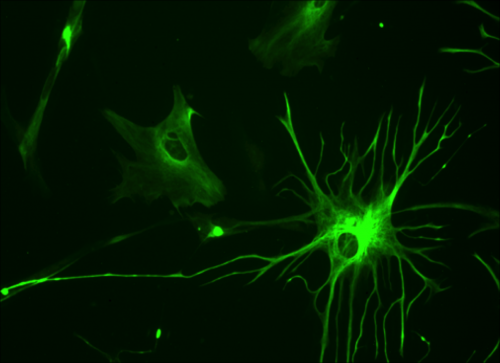
A human astrocyte cell. Credit: Wikipedia/Bruno Pascal
A new study from MIT neuroscientists sheds light on a neural circuit that makes us likelier to remember what we're seeing when our brains are in a more attentive state.
The team of neuroscientists found that this circuit depends on a type of brain cell long thought to play a supporting role, at most, in neural processing. When the brain is attentive, those cells, called astrocytes, relay messages alerting neurons of the visual cortex that they should respond strongly to whatever visual information they are receiving.
The findings, published this week in the online edition of the Proceedings of the National Academy of Sciences, are the latest in a growing body of evidence suggesting that astrocytes are critically important for processing sensory information, says Mriganka Sur, the Paul E. and Lilah Newton Professor of Neuroscience at MIT and senior author of the paper.
Sur's lab has been studying astrocytes for about five years, as part of a longstanding interest in revealing the functions of different cell types in the cortex. The star-shaped cells were first discovered and named 150 years ago, but since then, "it's been a mystery what they do," says Sur, who is a member of MIT's Picower Institute for Learning and Memory and director of the Simons Center for the Social Brain at MIT.
Lead authors of the paper are graduate student Naiyan Chen and research scientist Hiroki Sugihara. Other authors are research scientist Jitendra Sharma, postdocs Gertrudis Perea and Jeremy Petravicz, and technical assistant Chuong Le.
Attention strengthens response
In this study, the researchers focused on what astrocytes do when the brain is stimulated to pay attention to a specific visual stimulus. When someone is paying close attention to something, the nucleus basalis—a structure located deep within the brain, behind the eyes—floods the brain with a neurotransmitter called acetylcholine. Some of this acetylcholine targets astrocytes in the visual cortex.
To explore how astrocytes react to this stimulation, the researchers measured what happened in the visual cortex as they showed mice several visual patterns composed of parallel lines oriented in different directions. For one of the visual patterns, the researchers also provoked the nucleus basalis to release acetylcholine at the same time. This greatly boosted calcium levels in the astrocytes, indicating high activity.
When the mice were shown the same stimuli a few minutes later, the pattern that had been presented along with acetylcholine stimulation provoked a much stronger response in neurons of the visual cortex than the other patterns.
The researchers then did the same test in genetically engineered mice whose astrocytes were disabled. In those mice, the acetylcholine released by the nucleus basalis did not strengthen neurons' response to visual stimuli.
"If you are paying attention to something, which causes this release of acetylcholine, that leads to a long-lasting memory of that stimulus. If you remove the astrocytes, that doesn't happen," Sur says.
The strengthening effect lasts for tens of minutes, after which the neurons return to their original activity level in response to the selected stimulus.
"More directly than any other study to date, it illustrates the critical role of astrocytes in plasticity," says Michael Merzenich, a professor emeritus of neuroscience at the University of California at San Francisco, who was not part of the research team. "It's a crystal-clear demonstration."
'Major players in brain disorders'
It is already known that acetylcholine levels drop in the brains of patients with Alzheimer's disease. In fact, a commonly used treatment that can boost memory in Alzheimer's patients is a drug that blocks the degradation of acetylcholine. In a follow-up study, the researchers are planning to study how astrocytes are affected in mouse models of Alzheimer's.
Sur's lab is also studying the effects of nucleus basalis stimulation on inhibitory neurons. Those effects are thought to be shorter term, lasting seconds or fractions of seconds.
"You cannot understand brain disorders without understanding the basic mechanisms of cortical brain function," Sur says. "These cell types—astrocytes, inhibitory neurons—are emerging as major players in brain disorders, in unexpected ways."
Journal reference:
Proceedings of the National Academy of Sciences
Provided by
Massachusetts Institute of Technology
This story is republished courtesy of MIT News (web.mit.edu/newsoffice/), a popular site that covers news about MIT research, innovation and teaching.
-
Astrocytes found to bridge gap between global brain activity and localized circuits
May 11, 2012 |
not rated yet |
0
-
Astrocytes control the generation of new neurons from neural stem cells
Aug 24, 2012 |
not rated yet |
0
-
Study provides potential explanation for mechanisms of associative memory
Dec 13, 2011 |
not rated yet |
0
-
Researchers discover mechanism that determines when detailed memories are retained
Oct 13, 2006 |
not rated yet |
0
-
New brain cells implicated in machinery of cannabinoid signaling
Mar 26, 2008 |
not rated yet |
0
-
Motion perception revisited: High Phi effect challenges established motion perception assumptions
Apr 23, 2013 |
3 / 5 (2) |
2
-
Anything you can do I can do better: Neuromolecular foundations of the superiority illusion (Update)
Apr 02, 2013 |
4.5 / 5 (11) |
5
-
The visual system as economist: Neural resource allocation in visual adaptation
Mar 30, 2013 |
5 / 5 (2) |
9
-
Separate lives: Neuronal and organismal lifespans decoupled
Mar 27, 2013 |
4.9 / 5 (8) |
0
-
Sizing things up: The evolutionary neurobiology of scale invariance
Feb 28, 2013 |
4.8 / 5 (10) |
14
-
How can there be a term called "intestinal metaplasia" of stomach
1 hour ago
-
Pressure-volume curve: Elastic Recoil Pressure don't make sense
May 18, 2013
-
If you became brain-dead, would you want them to pull the plug?
May 17, 2013
-
MRI bill question
May 15, 2013
-
Ratio of Hydrogen of Oxygen in Dessicated Animal Protein
May 13, 2013
-
Alcohol and acetaminophen
May 13, 2013
- More from Physics Forums - Medical Sciences
More news stories
Clouds in the head
Many brain researchers cannot see the forest for the trees. When they use electrodes to record the activity patterns of individual neurons, the patterns often appear chaotic and difficult to interpret.
Neuroscience
2 minutes ago |
not rated yet |
0
New theory offers clues to vital 'repair and maintenance' role of sleep
(Medical Xpress)—We spend about a third of our life asleep, but why we need to do so remains a mystery. In a recent publication, researchers at University of Surrey and University College London suggest a new hypothesis, ...
Neuroscience
1 hour ago |
not rated yet |
0
Study puts Huntington's disease trials on TRACK
(Medical Xpress)—A three-year multinational study has tracked and detailed the progression of Huntington's disease (HD), predicting clinical decline in people carrying the HD gene more than 10 years before ...
Neuroscience
2 hours ago |
not rated yet |
0
Leading researchers report on the elusive search for biomarkers in Huntington's disease
While Huntington's disease (HD) is currently incurable, the HD research community anticipates that new disease-modifying therapies in development may slow or minimize disease progression. The success of HD research depends ...
Neuroscience
14 hours ago |
5 / 5 (1) |
0
Study shows premature birth interrupts vital brain development processes leading to reduced cognitive abilities
Researchers from King's College London have for the first time used a novel form of MRI to identify crucial developmental processes in the brain that are vulnerable to the effects of premature birth. This new study, published ...
Neuroscience
16 hours ago |
5 / 5 (1) |
0
|
Sugar injections for knee arthritis may ease pain
(HealthDay)—Injections of a sugar solution appear to help relieve knee pain and stiffness related to osteoarthritis, a new study suggests.
Anti-CD47 antibody may offer new route to successful cancer vaccination
(Medical Xpress)—Scientists at the School of Medicine have shown that their previously identified therapeutic approach to fight cancer via immune cells called macrophages also prompts the disease-fighting killer T cells ...
Evaluating a new way to open clogged arteries
Over the past few decades, scientists have developed many devices that can reopen clogged arteries, including angioplasty balloons and metallic stents. While generally effective, each of these treatments ...
Losing weight may ease chronic heartburn
(HealthDay)—Obese and overweight men and women who suffer from heartburn often report relief when they lose weight, a new study shows.
Primary care docs should play role in kids' dental health, experts say
(HealthDay)—When it comes to the care of your children's teeth, dentists aren't the only experts who can help.
ATS: Early prone positioning reduces mortality in ARDS
(HealthDay)—For patients with acute respiratory distress syndrome (ARDS), prolonged prone positioning during mechanical ventilation is associated with significantly reduced mortality at 28 and 90 days, ...