Gut bacteria increase fat absorption
September 12, 2012 in Medical research
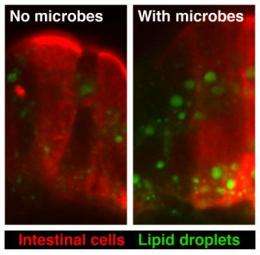
This confocal microscopy of intestinal epithelial cells (red) in zebrafish shows that the presence of microbes stimulates dietary fatty acid uptake and accumulation in epithelial lipid droplets (green). Credit: Ivana Semova, Ph.D.
You may think you have dinner all to yourself, but you're actually sharing it with a vast community of microbes waiting within your digestive tract. A new study from a team including Carnegie's Steve Farber and Juliana Carten reveals that some gut microbes increase the absorption of dietary fats, allowing the host organism to extract more calories from the same amount of food.
Previous studies showed gut microbes aid in the breakdown of complex carbohydrates, but their role in dietary fat metabolism remained a mystery, until now. The research is published September 13 by Cell Host & Microbe.
"This study is the first to demonstrate that microbes can promote the absorption of dietary fats in the intestine and their subsequent metabolism in the body," said senior study author John Rawls of the University of North Carolina. "The results underscore the complex relationship between microbes, diet and host physiology."
The study was carried out in zebrafish, which are optically transparent when young. By feeding the fish fatty acids tagged with fluorescent dyes, an approach originally developed in Farber's lab, the researchers were able to directly observe the absorption and transport of fats in live animals. The Rawl's lab pioneered methods to grow zebrafish larvae in the presence or absence of gut microbes.
By combining approaches, they determined that one type of bacteria, called Firmicutes, is instrumental in increasing fat absorption. They also found that the abundance of Firmicutes in the gut was influenced by diet. Fish fed normally had more Firmicutes than fish that were denied food for several days. Other studies have linked a higher relative abundance of Firmicutes in the gut with obesity in humans.
The findings indicate that bacteria in the gut can increase the host's ability to absorb fat and thereby harvest more calories from the diet. Another implication is that a high-fat diet promotes the growth of these fat-loving Firmicutes, resulting in more fat absorption.
Although the study involved only fish, not humans, it offers insights that could help inform new approaches to treating obesity and other disorders.
"The unique properties of zebrafish larvae are helping us develop a better understanding of how the intestine functions with the goal of contributing to ongoing efforts to reduce the impact of diseases associated with altered lipid metabolism, such as diabetes, obesity, and cardiovascular disease. Our collaboration with the Rawls lab is now focused on how specific gut bacteria are able to stimulate absorption of dietary fat. We hope to use that information to develop new ways to reduce fat absorption in the context of human diseases," Farber said.
The research team also included lead author Ivana Semova and co-author Lantz Mackey, both of UNC, as well as co-authors Jesse Stombaugh and Rob Knight of the University of Colorado at Boulder.
Journal reference:
Cell Host & Microbe
Provided by
Carnegie Institution for Science
-
Why do the different people's bodies react differently to a high-fat diet?
Apr 26, 2012 |
not rated yet |
0
-
Studying fish to learn about fat
Jun 28, 2012 |
not rated yet |
0
-
Zebrafish research shows how dietary fat regulates cholesterol absorption
Jun 22, 2012 |
not rated yet |
0
-
Transplanting human gut bugs into mice helps understanding of metabolic system
May 22, 2007 |
not rated yet |
0
-
Gastric bypass surgery alters gut microbiota profile along the intestine
Jul 10, 2012 |
not rated yet |
0
-
Motion perception revisited: High Phi effect challenges established motion perception assumptions
Apr 23, 2013 |
3 / 5 (2) |
2
-
Anything you can do I can do better: Neuromolecular foundations of the superiority illusion (Update)
Apr 02, 2013 |
4.5 / 5 (11) |
5
-
The visual system as economist: Neural resource allocation in visual adaptation
Mar 30, 2013 |
5 / 5 (2) |
9
-
Separate lives: Neuronal and organismal lifespans decoupled
Mar 27, 2013 |
4.9 / 5 (8) |
0
-
Sizing things up: The evolutionary neurobiology of scale invariance
Feb 28, 2013 |
4.8 / 5 (10) |
14
-
Pressure-volume curve: Elastic Recoil Pressure don't make sense
May 18, 2013
-
If you became brain-dead, would you want them to pull the plug?
May 17, 2013
-
MRI bill question
May 15, 2013
-
Ratio of Hydrogen of Oxygen in Dessicated Animal Protein
May 13, 2013
-
Alcohol and acetaminophen
May 13, 2013
-
Marie Curie's leukemia
May 13, 2013
- More from Physics Forums - Medical Sciences
More news stories
Study suggests new source of kidneys for transplant
Nearly 20 percent of kidneys that are recovered from deceased donors in the U.S. are refused for transplant due to factors ranging from scarring in small blood vessels of the kidney's filtering units to the organ going too ...
Medical research
1 hour ago |
not rated yet |
0
|
Discovery of circadian clock in mice hair reveals period of time when damage from radiotherapy can be quickly repaired
Discovering that mouse hair has a circadian clock - a 24-hour cycle of growth followed by restorative repair - researchers suspect that hair loss in humans from toxic cancer radiotherapy and chemotherapy ...
Medical research
2 hours ago |
5 / 5 (2) |
1
|
Do salamanders hold the solution to regeneration?
Salamanders' immune systems are key to their remarkable ability to regrow limbs, and could also underpin their ability to regenerate spinal cords, brain tissue and even parts of their hearts, scientists have ...
Medical research
3 hours ago |
not rated yet |
0
|
New study finds blind people have the potential to use their 'inner bat' to locate objects
New research from the University of Southampton has shown that blind and visually impaired people have the potential to use echolocation, similar to that used by bats and dolphins, to determine the location of an object.
Medical research
5 hours ago |
not rated yet |
1
|
Germ-fighting vaccine system makes great strides in delivery
A novel vaccine study from South Dakota State University (SDSU) will headline the groundbreaking research that will be unveiled at the American Association of Pharmaceutical Scientists' (AAPS) National Biotechnology Conference ...
Medical research
6 hours ago |
not rated yet |
0
Researchers develop model for better testing, targeting of malignant peripheral nerve sheath tumors
University of Minnesota Medical School researchers from the Masonic Cancer Center, University of Minnesota, in partnership with the University's Brain Tumor Program, have developed a new mouse model of malignant peripheral ...
Practice makes perfect? Not so much
Turns out, that old "practice makes perfect" adage may be overblown. New research led by Michigan State University's Zach Hambrick finds that a copious amount of practice is not enough to explain why people ...
Older prostate cancer patients should think twice before undergoing treatment
Older prostate cancer patients with other underlying health conditions should think twice before committing to surgery or radiation therapy for their cancer, according to a multicenter study led by researchers in the UCLA ...
New test better detects elephantiasis worm infection
A new diagnostic test for a worm infection that can lead to severe enlargement and deformities of the legs and genitals is far more sensitive than the currently used test, according to results of a field ...
Study shows that women who smoke during pregnancy increase the risk of both obesity and gestational diabetes in their da
Women who smoke during pregnancy increase the risk of both obesity and gestational diabetes, in their daughters, concludes research published in Diabetologia, the journal of the European Association for the Study of Diabet ...
Leading researchers report on the elusive search for biomarkers in Huntington's disease
While Huntington's disease (HD) is currently incurable, the HD research community anticipates that new disease-modifying therapies in development may slow or minimize disease progression. The success of HD research depends ...