Human brains share consistent genetic blueprint and possess enormous biochemical complexity
September 19, 2012 in Neuroscience
Credit: Allen Institute for Brain Science
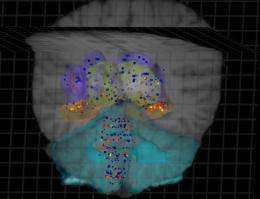
Scientists at the Allen Institute for Brain Science reported in the latest issue of the journal Nature that human brains share a consistent genetic blueprint and possess enormous biochemical complexity. The findings stem from the first deep and large-scale analysis of the vast data set publicly available in the Allen Human Brain Atlas.
The results of this study are based on extensive analysis of the Allen Human Brain Atlas, specifically the detailed all-genes, all-structures survey of genes at work throughout the human brain. This dataset profiles 400 to 500 distinct brain areas per hemisphere using microarray technology and comprises more than 100 million gene expression measurements covering three individual human brains to date. Among other findings, these data show that 84% of all genes are expressed somewhere in the human brain and in patterns that are substantially similar from one brain to the next.
"This study demonstrates the value of a global analysis of gene expression throughout the entire brain and has implications for understanding brain function, development, evolution and disease," said Ed Lein, Ph.D., Associate Investigator at the Allen Institute for Brain Science and co-lead author on the paper. "These results only scratch the surface of what can be learned from this immense data set. We look forward to seeing what others will discover."
Key Findings
The results of this study show that, despite the myriad personalities and cognitive talents seen across the human population, our brains are more similar to one another than different. Individual human brains share the same basic molecular blueprint, and deeper analysis of this shared architecture reveals several further findings:
- Neighboring regions of the brain's cortex—the wrinkly outer rind—are more biochemically similar to one another than to more distant brain regions, which has implications for understanding the development of the human brain, both during the lifespan and throughout evolution.
- The right and left hemispheres show no significant differences in molecular architecture. This suggests that functions such as language, which are generally handled by one side of the brain, likely result from more subtle differences between hemispheres or structural variation in size or circuitry, but not from a deeper molecular basis.
- Despite controlling a diversity of functions, ranging from visual perception to planning and problem-solving, the cortex is highly homogeneous relative to other brain regions. This suggests that the same basic functional elements are used throughout the cortex and that understanding how one area works in detail will uncover fundamentals that apply to the other areas, as well.
- In addition to such global findings, the study provides new insights into the detailed inner workings of the brain at the molecular level—the level at which diseases unfold and therapeutic drugs take action.
- 84% of all genes are expressed, or turned on, somewhere in the human brain.
- Many previously uncharacterized genes are turned on in specific brain regions and localize with known functional groups of genes, suggesting they play roles in particular brain functions.
- Synapse-associated genes—those related to cell-to-cell communication machinery in the brain—are deployed in complex combinations throughout the brain, revealing a great diversity of synapse types and remarkable regional variation that likely underlies functional distinctions between brain regions.
More information: Hawrylycz M.J., Lein E.S. et al., An anatomically comprehensive atlas of the adult human brain transcriptome, Nature, September 20, 2012.
Journal reference:
Nature
Provided by
Allen Institute for Brain Science
-
Fine-scale analysis of the human brain yields insight into its distinctive composition
Apr 12, 2012 |
not rated yet |
0
-
Gene activity in the brain depends on genetic background
Oct 19, 2010 |
not rated yet |
0
-
Found in the developing brain: Mental health risk genes and gender differences
Oct 26, 2011 |
not rated yet |
0
-
Autism blurs distinctions between brain regions
Jun 03, 2011 |
not rated yet |
0
-
Data release from the Allen Institute for Brain Science expands online atlas offerings
Jun 07, 2012 |
not rated yet |
0
-
Motion perception revisited: High Phi effect challenges established motion perception assumptions
Apr 23, 2013 |
3 / 5 (2) |
2
-
Anything you can do I can do better: Neuromolecular foundations of the superiority illusion (Update)
Apr 02, 2013 |
4.5 / 5 (11) |
5
-
The visual system as economist: Neural resource allocation in visual adaptation
Mar 30, 2013 |
5 / 5 (2) |
9
-
Separate lives: Neuronal and organismal lifespans decoupled
Mar 27, 2013 |
4.9 / 5 (8) |
0
-
Sizing things up: The evolutionary neurobiology of scale invariance
Feb 28, 2013 |
4.8 / 5 (10) |
14
-
How can there be villous adenoma in colon, if there are no villi there
13 hours ago
-
How can there be a term called "intestinal metaplasia" of stomach
May 21, 2013
-
Pressure-volume curve: Elastic Recoil Pressure don't make sense
May 18, 2013
-
If you became brain-dead, would you want them to pull the plug?
May 17, 2013
-
MRI bill question
May 15, 2013
-
Ratio of Hydrogen of Oxygen in Dessicated Animal Protein
May 13, 2013
- More from Physics Forums - Medical Sciences
More news stories
Having both migraines, depression may mean smaller brain
(HealthDay)—Migraines and depression can each cause a great deal of suffering, but new research indicates the combination of the two may be linked to something else entirely—a smaller brain.
Neuroscience
4 hours ago |
5 / 5 (1) |
0
|
Researchers analyse hunting behaviour of fish larvae in virtual reality
Moving objects attract greater attention – a fact exploited by video screens in public spaces and animated advertising banners on the Internet. For most animal species, moving objects also play a major ...
Neuroscience
7 hours ago |
not rated yet |
0
|
Signs of motor disorders can appear years before disease manifestation
It is known that signs of neurological disorders such as Alzheimer's and Huntington's disease can appear years before the disease becomes manifest; these signs take the form of subtle changes in the brain and behavior of ...
Neuroscience
7 hours ago |
not rated yet |
0
Taming suspect gene reverses schizophrenia-like abnormalities in mice
Scientists have reversed behavioral and brain abnormalities in adult mice that resemble some features of schizophrenia by restoring normal expression to a suspect gene that is over-expressed in humans with ...
Neuroscience
8 hours ago |
5 / 5 (1) |
0
|
Scientists uncover molecular roots of cocaine addiction in the brain
Researchers at Johns Hopkins have unraveled the molecular foundations of cocaine's effects on the brain, and identified a compound that blocks cravings for the drug in cocaine-addicted mice. The compound, already proven safe ...
Neuroscience
8 hours ago |
not rated yet |
0
|
Slowing the aging process—only with antibiotics
Swiss scientists reveal the mechanism responsible for aging hidden deep within mitochondria—and dramatically slow it down in worms by administering antibiotics to the young.
Brain can be trained in compassion, study shows
Until now, little was scientifically known about the human potential to cultivate compassion—the emotional state of caring for people who are suffering in a way that motivates altruistic behavior.
Researchers complete largest genetic sequencing study of human disease
Researchers from Queen Mary, University of London have led the largest sequencing study of human disease to date, investigating the genetic basis of six autoimmune diseases.
Novel approach for influenza vaccination shows promise in early animal testing
A new approach for immunizing against influenza elicited a more potent immune response and broader protection than the currently licensed seasonal influenza vaccines when tested in mice and ferrets. The vaccine ...
Calorie information in fast food restaurants used by 40 percent of 9-18 year olds when making food choices
A new study published online today (Thursday) in the Journal of Public Health has found that of young people who visited fast food or chain restaurants in the U.S. in 2010, girls and youth who were obese were more likely ...
Systematic screening of med adherence will ID barriers
(HealthDay)—Implementation of systematic monitoring for medication adherence will allow for identification of barriers to adherence and tailoring of interventions, according to a viewpoint piece published ...
Sep 20, 2012
Rank: not rated yet
http://phys.org/n...483.html
The key to all senses. Gene expression at work.
An additional 'discovery':
http://medicalxpr...ain.html
The power of gene expression.