Stemming the spread of cancer
September 21, 2012 in Cancer

Stemming the spread of cancer

Enlarge

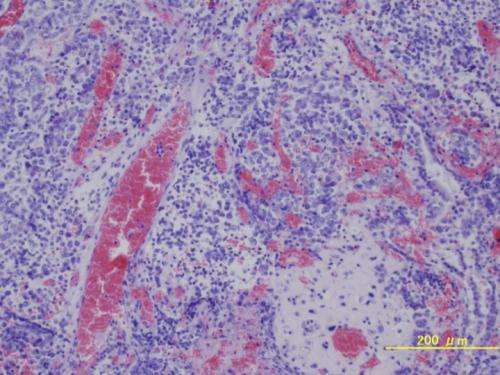
Angiogenesis.

Okayama University's Masaharu Seno and colleagues have demonstrated in vitro the development of cancer stem cells (CSCs) from a type of normal stem cell exposed to their hypothetical microenvironment of a tumor.

Cancer (CSCs) have been proposed as an explanation for the spread of cancer. These cells are tumorigenic and have the capacity of both self-renewal and differentiation into a range of various cell types. In this concept, provide heterogeneous aspects derived from CSCs as well as normal stem cells provide tissue specific phenotype in response to their microenvironment.
Stemming the spread of cancer
Enlarge

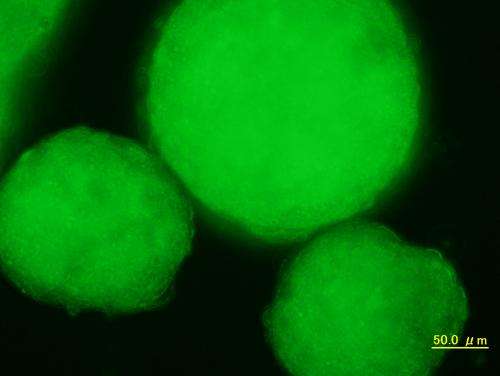
Spheroid GFP.

Researchers have now demonstrated in vitro the development of CSCs from a type of normal stem cell exposed to their hypothetical microenvironment of a tumor. The results are the work of a group of scientists led by Masaharu Seno, a professor of Okayama University, with his collaborators in China and the US.

The researchers cultured mouse induced pluripotent stem (miPS) cells in a conditioned medium obtained from a number of mouse cancer cell lines. Finally, a population of stem cells was kept undifferentiated and proliferating while other stem cells differentiated into specialized cells, which were incapable of proliferation any more.
Stemming the spread of cancer
Enlarge

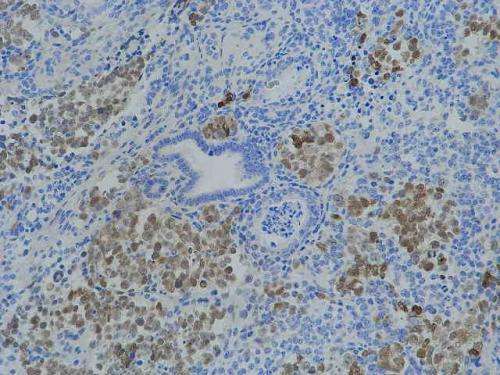
Immunostain.

Since the survived miPS cells treated with the conditioned medium were found malignantly tumorigenic in vivo, they concluded that the cells could be defined as CSCs . "The model of CSCs and the procedure of their establishment will help study the and the secreted factors in the which convert miPS cells to CSCs," explain the authors. The work should help breakthrough towards the development of new therapies to combat cancer.

More information: Ling Chen et al., A model of cancer stem cells derived from mouse induced pluripotent stem cells. PLoS One 7, e33544 (2012). DOI: 10.1371/journal.pone.0033544

Journal reference: PLoS ONE search and more info website

Provided by Okayama University

not rated yet  

Rank not rated yet
Relevant PhysicsForums posts

More news stories

American cancer society celebrates 100 years of progress

(HealthDay)—The American Cancer Society, which is celebrating on Wednesday a century of fighting a disease once viewed as a death sentence, is making a pledge to put itself out of business.

Cancer created 13 hours ago | popularity not rated yet | comments 0

CT detects twice as many lung cancers as X-ray at initial screening exam

National Lung Screening Trial (NLST) investigators also conclude that the 20 percent reduction in lung cancer mortality with low-dose computed tomography (LDCT) versus chest X-ray (CXR) screening previously reported in the ...

Cancer created 14 hours ago | popularity not rated yet | comments 0

Research offers promising new approach to treatment of lung cancer

Researchers have developed a new drug delivery system that allows inhalation of chemotherapeutic drugs to help treat lung cancer, and in laboratory and animal tests it appears to reduce the systemic damage ...

Cancer created 17 hours ago | popularity not rated yet | comments 0 | with audio podcast

Study details genes that control whether tumors adapt or die when faced with p53 activating drugs

When turned on, the gene p53 turns off cancer. However, when existing drugs boost p53, only a few tumors die – the rest resist the challenge. A study published in the journal Cell Reports shows how: tumors that live even i ...

Cancer created 17 hours ago | popularity not rated yet | comments 0 | with audio podcast

Small increase in cancer risk following CT scans in childhood and adolescence

Study leader, Professor John Mathews from the University of Melbourne said this small increase in cancer risk must be weighed against the undoubted benefits from CT scans in diagnosing and monitoring disease.

Cancer created 22 hours ago | popularity not rated yet | comments 0


US teen birth rate drops to record low

US teen births have dropped to a record low, but the country still has one of the highest rates among developed nations, the US Centers for Disease Control and Prevention said Thursday.

Slowing the aging process—only with antibiotics

Swiss scientists reveal the mechanism responsible for aging hidden deep within mitochondria—and dramatically slow it down in worms by administering antibiotics to the young.

Researchers complete largest genetic sequencing study of human disease

Researchers from Queen Mary, University of London have led the largest sequencing study of human disease to date, investigating the genetic basis of six autoimmune diseases.

Brain can be trained in compassion, study shows

Until now, little was scientifically known about the human potential to cultivate compassion—the emotional state of caring for people who are suffering in a way that motivates altruistic behavior.

Rate of bicycle-related fatalities significantly lower in states with helmet laws

Existing research shows that bicyclists who wear helmets have an 88 percent lower risk of brain injury, but researchers at Boston Children's Hospital found that simply having bicycle helmet laws in place showed a 20 percent ...

Having both migraines, depression may mean smaller brain

(HealthDay)—Migraines and depression can each cause a great deal of suffering, but new research indicates the combination of the two may be linked to something else entirely—a smaller brain.