Blocking tumor-induced inflammation impacts cancer development
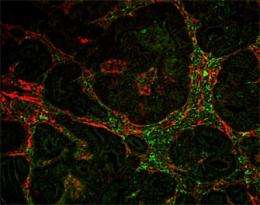
Researchers at the University of California, San Diego School of Medicine report the discovery of microbial–dependent mechanisms through which some cancers mount an inflammatory response that fuels their development and growth.
The findings are published in the October 3, 2012 Advanced Online Edition of Nature.
The association between chronic inflammation and tumor development has long been known from the early work of German pathologist Rudolph Virchow. Harvard University pathologist Harold Dvorak later compared tumors with "wounds that never heal," noting the similarities between normal inflammation processes that characterize wound- healing and tumorigenesis or tumor-formation.
Indeed, 15 to 20 percent of all cancers are preceded by chronic inflammation – a persistent immune response that can target both diseased and healthy tissues. Chronic hepatitis, for example, may result in hepatocellular carcinoma (liver cancer) and inflammatory bowel disease can eventually cause a form of colon cancer, known as colitis-associated cancer.
Still, most cancers are not preceded by chronic inflammation. On the other hand, they exploit ubiquitous, infiltrating immune cells to unduly provoke and hijack the host inflammatory reaction. Until now, the mechanism of so-called "tumor-elicited inflammation," which is detected in most solid malignancies, was poorly explained.
"The tumor-associated inflammatory reaction is an emerging and vibrant field for biomedical studies. It may hold the keys for future preventive and therapeutic measures," said first author Sergei Grivennikov, PhD, noting that studies of long-term users of non-steroidal anti-inflammatory drugs, such as aspirin, have revealed that general inhibition of inflammation reduces the risk of cancer death by up to 45 percent, depending on the type of cancer. "So inhibition of inflammation during cancer development may be beneficial."
Studying early colonic tumors in humans and in animal models, the researchers, led by principal investigator Michael Karin, PhD, Distinguished Professor of Pharmacology and head of the Laboratory of Gene Regulation and Signal Transduction at UC San Diego, found that developing tumors disrupt tissue homeostasis (the normal, healthy functioning of tissues), in part because they lack a particular protective protein coating and a tight seal between their epithelial cells – a basic cell type that covers most internal surfaces and organs. Without that coating and the cellular seal, ordinarily benign, commensal bacteria present in the colon can enter the tumor to be recognized by immune cells as invaders, launching an inflammatory reaction.
In addition, said Grivennikov, who is a scientist in Karin's lab, "cell-to-cell contacts are defective in tumors, further allowing entry of microbial products from the intestinal lumen into the tumor. These microbial products are recognized by tumor-associated macrophages and dendritic cells, which are normally isolated from commensal microflora by the intestinal barrier."
In response, the immune cells produce signaling proteins called cytokines that further spur the inflammatory process. Chief among these is a cytokine called Interleukin-23, which regulates tumor-elicited inflammation and triggers the production of other inflammatory cytokines that promote tumor development and progression.
Grivennikov said that when researchers reduced the presence of commensal microflora through a combination of broad spectrum antibiotics, tumor-elicited inflammation and tumor growth were dampened.
"This is a very nice demonstration of how tumor-elicited inflammation in cancers that arise in the absence of underlying chronic inflammatory disease can be induced," he said. "The next step is to look for the upregulation of Interleukin-23 and related cytokines in colon cancer patients, inhibit these cytokines and determine whether these impact cancer progression and response to therapy."
More information: DOI: 10.1038/nature11465


