Researchers discover new blood vessel-generating cell with therapeutic potential
October 16, 2012 in Medical research

Finnish researchers' discover new blood-vessel-generating cell with therapeutic potential

Enlarge

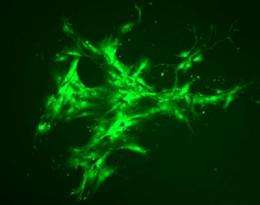
This shows an endothelial cell colony formed by one single adult vascular endothelial stem cell on a culture disk. Credit: Petri Salvén Laboratory

Researchers at the University of Helsinki believe they have discovered stem cells that play a decisive role in the growth of new blood vessels. If researchers learn to isolate and efficiently produce these stem cells found in blood vessel walls, the cells could offer new opportunities for developing therapeutics to treat diseases, such as cardiovascular disease and cancer. The study reporting the discovery of these stem cells is published in the open access journal PLOS Biology on October 16.

The growth of new blood vessels, known as neoangiogenesis, occurs during the repair of damaged tissue and organs in adults. However, malignant tumours also grow new blood vessels in order to receive oxygen and nutrients. As such, neoangiogenesis is both beneficial and detrimental to health, depending on the context, requiring that can either help to stimulate or prevent it. Therapeutics that aim to prevent the growth of new blood vessels are already in use, but the results are often more modest than predicted.
Finnish researchers' discover new blood-vessel-generating cell with therapeutic potential
Enlarge

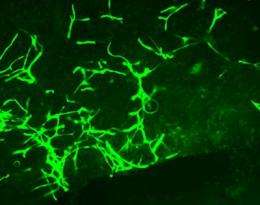
This shows functional blood vessels formed in vivo in mouse by transplanted daughter cells of one single adut vascular endothelial stem cell. The endothelial cells of the cell transplant are genetically tagged by green fluorescent protein to enable their recognition and tracking in the wild type recipient animal. Credit: Petri Salvén Laboratory

Adjunct Professor Petri Salvén and his team, from the University of Helsinki, now report that these can be found among the cells—so-called —that line the inside of blood vessel walls. He explains, "we succeeded in isolating endothelial cells with a high rate of division in the of mice. We found these same cells in human blood vessels and blood vessels growing in malignant tumours in humans. These cells are known as vascular endothelial stem cells, abbreviated as VESC. In a cell culture, one such cell is capable of producing tens of millions of new blood vessel wall cells".

From their studies in mice, the team are able to show that the growth of new blood vessels weakens, and the growth of malignant tumours slows, if the amount of these cells is below normal. Conversely, new blood vessels form where these stem cells are implanted.
Finnish researchers' discover new blood-vessel-generating cell with therapeutic potential
Enlarge

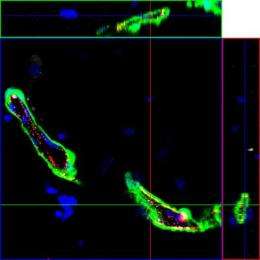
This shows functional blood vessels grown in vivo form a single transplanted adult vascular endothelial stem cell. High resolution confocal microscope scanning is used to visualize the cross sections of individual blood vessels. The blood vessel endtohelial cells are green (genetic GFP-tag) and the nuclei are blue. Credit: Petri Salvén Laboratory.

"The identification and isolation of an entirely new adult stem cell type is a significant discovery in stem cell biology." explains Salvén. "Endothelial stem cells in blood vessels are particularly interesting, because they offer great potential for applications in practical medicine and the treatment of patients."

If an efficient method of vascular endothelial stem cell production could be developed, it could offer new treatment opportunities in situations where damaged tissue or diseases call for new blood vessel growth, or where the constriction or dysfunction of blood vessels deprives tissues of oxygen, for example in cardiac disease. These cells also offer new opportunities for developing therapeutics that seek to prevent new blood vessel growth in malignant tumours.

More information: Fang S, Wei J, Pentinmikko N, Leinonen H, Salven P (2012) Generation of Functional Blood Vessels from a Single c-kit+ Adult Vascular Endothelial Stem Cell. PLoS Biol 10(10): e1001407. doi:10.1371/journal.pbio.1001407

Journal reference: PLoS Biology search and more info website

Provided by Public Library of Science search and more info website

5 /5 (1 vote)  

Rank 5 /5 (1 vote)
Relevant PhysicsForums posts

More news stories

Research shows how immune system peacefully co-exists with 'good' bacteria

The human gut is loaded with commensal bacteria – "good" microbes that, among other functions, help the body digest food. The gastrointestinal tract contains literally trillions of such cells, and yet the ...

Medical research created 1 hour ago | popularity not rated yet | comments 0 | with audio podcast

Slowing the aging process—only with antibiotics

Swiss scientists reveal the mechanism responsible for aging hidden deep within mitochondria—and dramatically slow it down in worms by administering antibiotics to the young.

Medical research created 1 hour ago | popularity 4 / 5 (1) | comments 0 | with audio podcast

How healthy are you for your age?

On May 22, JoVE will publish details of a technique to measure the health of human genetic material in relation to a patient's age. The method is demonstrated by the laboratory of Dr. Gil Atzmon at New York's Albert Einste ...

Medical research created 4 hours ago | popularity not rated yet | comments 0

A molecular explanation for age-related fertility decline in women

(Medical Xpress)—Scientists supported by the National Institutes of Health have a new theory as to why a woman's fertility declines after her mid-30s. They also suggest an approach that might help slow ...

Medical research created 5 hours ago | popularity not rated yet | comments 0 | with audio podcast

Medical researchers discover new ways to target, develop and design drugs to prevent and treat viral infection

Researchers at the University of Alberta have discovered a new drug target, developed a new drug and identified a new way to design drugs—all of which could be a winning combination in the battle against viruses.

Medical research created 6 hours ago | popularity 4 / 5 (1) | comments 0 | with audio podcast


Enzyme-activating antibodies revealed as marker for most severe form of rheumatoid arthritis

In a series of lab experiments designed to unravel the workings of a key enzyme widely considered a possible trigger of rheumatoid arthritis, researchers at Johns Hopkins have found that in the most severe ...

Research offers promising new approach to treatment of lung cancer

Researchers have developed a new drug delivery system that allows inhalation of chemotherapeutic drugs to help treat lung cancer, and in laboratory and animal tests it appears to reduce the systemic damage ...

Researchers analyse hunting behaviour of fish larvae in virtual reality

Moving objects attract greater attention – a fact exploited by video screens in public spaces and animated advertising banners on the Internet. For most animal species, moving objects also play a major ...

Overeating learned in infancy, study suggests

In the long run, encouraging a baby to finish the last ounce in their bottle might be doing more harm than good.

Study details genes that control whether tumors adapt or die when faced with p53 activating drugs

When turned on, the gene p53 turns off cancer. However, when existing drugs boost p53, only a few tumors die – the rest resist the challenge. A study published in the journal Cell Reports shows how: tumors that live even i ...

Children of married parents less likely to be obese

Children living in households where the parents are married are less likely to be obese, according to new research from Rice University and the University of Houston.