Study finds that closeness with either parent has behavioral, emotional benefits for a child
October 11, 2012 by Richard C. Lewis in Psychology & Psychiatry
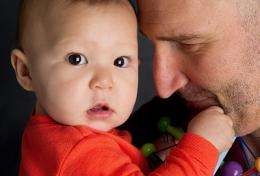
When infants develop a close bond with at least one parent, they experience fewer emotional and behavioral problems in childhood. Photo by Tim Schoon.
(Medical Xpress)—Parents: Want to help ensure your children turn out to be happy and socially well adjusted? Bond with them when they are infants.
That's the message from a study by the University of Iowa, which found that infants who have a close, intimate relationship with a parent are less likely to be troubled, aggressive or experience other emotional and behavioral problems when they reach school age. Surprisingly, the researchers found that a young child needs to feel particularly secure with only one parent to reap the benefits of stable emotions and behavior, and that being attached to dad is just as helpful as being close to mom.
The study bolsters the still-debated role of the influence that a parent can exercise at the earliest stages in a child's mental and emotional development, the authors contend in the paper, published in the journal Child Development.
"There is a really important period when a mother or a father should form a secure relationship with their child, and that is during the first two years of life. That period appears to be critical to the child's social and emotional development," says Sanghag Kim, a post-doctoral researcher in psychology at the UI who collaborated with UI psychology professor Grazyna Kochanska on the study. "At least one parent should make that investment."
The researchers assessed the relationship of 102 infants (15 months old) with a parent and then followed up with 86 of them when they reached age 8. Separate surveys of the parents and the child were taken at that time. The infants and parents were drawn from a broad spectrum of income, education, and race. All the couples were heterosexual.
The authors also solicited feedback from teachers about the children, which ranged from concerns about inner emotions, such as worry or sadness, to more outward displays, such as disobedience and aggression.
Interestingly, the children's reports and their teachers' impressions were similar; yet they differed, sometimes greatly, from the parents' evaluations.
"Parents and teachers have different perspectives," Kim explains. "They observe children in different contexts and circumstances. That is why we collected data from many informants who know the child."
The researchers were surprised to find out that infants who had felt attached to both parents did not enjoy additional mental and emotional advantages into childhood, compared to those who had been close to one parent. The UI psychologists' best explanation is that a warm, secure, and positive bond with at least one primary caregiver may be enough to meet the child's need for security and to provide a solid foundation for development. Other studies have contended that being secure with both parents can have additional advantages; this study, however, checked in with the children when they were older and their outcomes could be more fully measured than those surveyed in previous work, the Iowa researchers said.
The study appears to be good news for single mothers and stay-at-home dads, two marked parenting shifts that are defining this generation. Kim says the study shows that either parent can serve as a secure, attachment figure for the infant, thus providing the closeness and support to promote the child's healthy emotional growth.
"Some people think the father is not good enough to be the primary caregiver," says Kim, who earned his doctorate in sociology at the UI last year. "Our data show otherwise."
The study did not directly sample single mothers, as all families included two parents. Still, the finding that one parent can provide the tight bond and emotional dividends as two parents "is a good sign," Kim says, that should be studied further.
On the other end, the study showed that infants who had not felt secure with either parent were more likely to report worries, fears, and aggression when they reached school age. While the trend was clear, the Iowa researchers said, they cautioned that other reasons may explain those children's difficulties. Also, they note, that all children fell into what psychologists would consider a normal development range, largely without clinically significant problems.
Kochanska, the paper's corresponding author, says the study was inspired by the attachment theory, a key approach in the field of social and emotional development. She and colleagues have conducted several studies examining the long-term implications of a child's early relationship with the parents.
Some questions need further study. Among them is whether day-care providers can serve as effective care givers, providing emotional support for infants, or whether they interfere with an infant's ability to bond with the parents.
Journal reference:
Child Development
Provided by
University of Iowa
-
Parents' conflicts affect adopted infants' sleep
Aug 02, 2011 |
not rated yet |
0
-
Working mothers and the effects on children
Jul 22, 2011 |
not rated yet |
0
-
For infant sleep, receptiveness more important than routine
Aug 10, 2010 |
not rated yet |
0
-
Nearly one-third of US parents don't know what to expect of infants
May 04, 2008 |
not rated yet |
0
-
Empty nest syndrome may not be bad after all, study finds
Feb 21, 2008 |
not rated yet |
0
-
Motion perception revisited: High Phi effect challenges established motion perception assumptions
Apr 23, 2013 |
3 / 5 (2) |
2
-
Anything you can do I can do better: Neuromolecular foundations of the superiority illusion (Update)
Apr 02, 2013 |
4.5 / 5 (11) |
5
-
The visual system as economist: Neural resource allocation in visual adaptation
Mar 30, 2013 |
5 / 5 (2) |
9
-
Separate lives: Neuronal and organismal lifespans decoupled
Mar 27, 2013 |
4.9 / 5 (8) |
0
-
Sizing things up: The evolutionary neurobiology of scale invariance
Feb 28, 2013 |
4.8 / 5 (10) |
14
-
Why is zone 1 in liver more prone to ischemic injury?
11 hours ago
-
How can there be villous adenoma in colon, if there are no villi there
May 22, 2013
-
How can there be a term called "intestinal metaplasia" of stomach
May 21, 2013
-
Pressure-volume curve: Elastic Recoil Pressure don't make sense
May 18, 2013
-
If you became brain-dead, would you want them to pull the plug?
May 17, 2013
-
MRI bill question
May 15, 2013
- More from Physics Forums - Medical Sciences
More news stories
Motion quotient: IQ predicted by ability to filter motion (w/ video)
A brief visual task can predict IQ, according to a new study. This surprisingly simple exercise measures the brain's unconscious ability to filter out visual movement. The study shows that individuals whose ...
Psychology & Psychiatry
3 hours ago |
4.8 / 5 (5) |
0
|
Anxious men fare worse during job interviews, study finds
Nervous about that upcoming job interview? You might want to take steps to reduce your jitters, especially if you are a man.
Psychology & Psychiatry
4 hours ago |
5 / 5 (1) |
0
Are kids who take music lessons different from other kids?
(Medical Xpress)—Research by U of T Mississauga psychology professor Glenn Schellenberg reveals that two key personality traits – openness-to-experience and conscientiousness—predict better than IQ ...
Psychology & Psychiatry
6 hours ago |
3 / 5 (2) |
0
|
Parents can help preteens with abduction concerns
Parents naturally are concerned for their children's safety, particularly when there is news of a child abduction that happens close to home. Finding the balance between emotions and the "teachable moment" as parents talk ...
Psychology & Psychiatry
6 hours ago |
not rated yet |
0
Ireland needs real-time database for teen and young adult suicides
A new report on suicide in Ireland shows that suicide cases experienced a significant number (and intensity) of life events in the 6 months prior to their death.
Psychology & Psychiatry
6 hours ago |
not rated yet |
0
Ferrets, pigs susceptible to H7N9 avian influenza virus
Chinese and U.S. scientists have used virus isolated from a person who died from H7N9 avian influenza infection to determine whether the virus could infect and be transmitted between ferrets. Ferrets are often used as a mammalian ...
Scientists discover molecule triggers sensation of itch
Scientists at the National Institutes of Health report they have discovered in mouse studies that a small molecule released in the spinal cord triggers a process that is later experienced in the brain as the sensation of ...
Multiple research teams unable to confirm high-profile Alzheimer's study
Teams of highly respected Alzheimer's researchers failed to replicate what appeared to be breakthrough results for the treatment of this brain disease when they were published last year in the journal Science.
Researchers find common childhood asthma unconnected to allergens or inflammation
Little is known about why asthma develops, how it constricts the airway or why response to treatments varies between patients. Now, a team of researchers at Weill Cornell Medical College, Columbia University Medical Center ...
Drug reverses Alzheimer's disease deficits in mice, research confirms
An anti-cancer drug reverses memory deficits in an Alzheimer's disease mouse model, University of Pittsburgh Graduate School of Public Health researchers confirm in the journal Science.
Economic incentives increase blood donation without negative consequences
Can economic incentives such as gift cards, T-shirts, and time off from work motivate members of the public to increase their donations of blood?