Research discovers likely basis of birth defect causing premature skull closure in infants
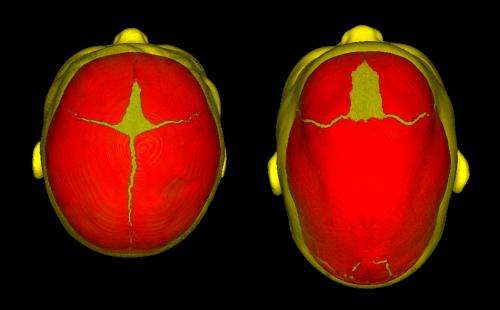
An international team of geneticists, pediatricians, surgeons and epidemiologists from 23 institutions across three continents has identified two areas of the human genome associated with the most common form of non-syndromic craniosynostosis ― premature closure of the bony plates of the skull.
"We have discovered two genetic factors that are strongly associated with the most common form of premature closure of the skull," said Simeon Boyadjiev, professor of pediatrics and genetics, principal investigator for the study and leader of the International Craniosynostosis Consortium.
"These findings may one day lead to prenatal screening and diagnostic tests for this condition or early interventions to prevent it," said Boyadjiev, who is a researcher affiliated with the UC Davis MIND Institute.
The study, "A genome-wide association study identifies susceptibility loci for non-syndromic sagittal craniosynostosis near BMP2 and within BBS9," is published online today in the journal, Nature Genetics.
During fetal and early child development, the skull is made of separate bony plates that allow for growth of the head. The borders between the plates do not normally fuse completely until a child is about 2 years old, leaving temporary "soft spots" at the intersection of the seams.
If the bones fuse too early ― the condition called craniosynostosis ― a child will develop an abnormally shaped head. Left untreated, the disorder causes complications due to brain compression, such as neurologic and visual problems and learning disabilities. Typically, craniosynostosis requires extensive neurosurgical correction.
About 20 percent of cases of craniosynostosis have previously been linked to a number of different genetic syndromes, but the vast majority of cases (not associated with a syndrome involving other birth defects) arise without any known family history or cause. The most common form of non-syndromic craniosynostosis ― affecting about 1 in 5,000 newborns ― involves the sagittal suture, the main seam that runs down the center of the top of the skull. These cases were the subject of the investigation.
Although the condition has long been thought to be partially determined by genes ― it is three times more common in boys than in girls, and identical twins are much more likely to both be affected than non-identical twins ― the exact basis was unclear.
To help determine the cause, the investigators conducted the first genome-wide association study for the disorder, which involves scanning the entire genome of a group of people with craniosynostosis and comparing it to a control group of people without the condition. The study searched for single nucleotide polymorphisms (abbreviated as SNPs and called "snips") that are associated with craniosynostosis. SNPs are DNA changes in which a single nucleotide differs from the usual one at that position. There are some three billion nucleotides, the basic building blocks of DNA, in the human genome.
The study first evaluated the DNA ― extracted from whole blood or oral samples ― of 214 children and both of their parents, who did not have the condition, and restricted their final analysis to a group of 130 non-Hispanic white child-parent trios. This approach reduces the genetic variability inherent to individuals from different ethnicities. Their results identified very strong associations to SNPs in two areas of the genome, coding for bone morphogenetic protein 2 (BMP2) and Bardet-Biedl syndrome 9 protein (BBS9). Both proteins are known to play a role in skeletal development.
The findings were replicated in another population of 172 cases of children with the condition and 548 unrelated controls. The extensive international collaboration came about because of the desire to include as many cases as possible worldwide to strengthen the findings.
"No matter how we analyzed the data ― whether we included familial cases, cases with other minor anomalies, or mixed children of different ethnic groups together, these two genetic factors were highly significant," said Boyadjiev. "This provides strong evidence that non-syndromic sagittal craniosynostosis has a major genetic component and identifies where the problem is likely to originate."
Boyadjiev added that the genetic differences do not fully explain the development of the condition and that other genes and environmental factors are also likely important. He likened the condition to spina bifida: Infants who develop this defect in their spine are known to have a genetic propensity, but vitamin supplementation with folic acid of pregnant women can prevent many cases. He plans to extend the research to find the exact disease-causing genetic variants and to study other types of craniosynostosis in various ethnic groups. Boyadjiev also will search for a marker in the blood of expectant mothers to identify fetuses at risk for craniosynostosis, which one day may lead to an intervention during pregnancy to prevent craniosynostosis.
"The identification of two biologically plausible candidate genes affecting susceptibility to non-syndromic sagittal craniosynostosis provides promising leads in the search for understanding how these conditions develop," said Emily Harris, chief of the translational genomics research branch at the National Institutes of Health's Institute of Dental and Craniofacial Research.


