Doctors communicate with man assumed to be in vegetative state using fMRI
November 14, 2012 by Bob Yirka in Neuroscience weblog

fMRI

Enlarge

Credit: National Institute of Mental Health

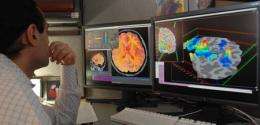
(Medical Xpress)—Doctors in Canada claim they have opened a communication channel, using fMRI, with a man assumed to be in a vegetative state for over twelve years. By asking the patient to envision two different types of mental exercises and assigning a value of yes or no respectively to each, while undergoing a brain scan, they believe car accident patient Scott Routley has informed them that he is not experiencing any pain.

Routley was severely injured in a car accident in 2000. Subsequent tests indicated that his brain was in a vegetative state, which is described as one where the patient is incapable of displaying any signs of consciousness and shows no signs of responsiveness to . The brain of such a patient is not considered to be dead however, as EEGs continue to show activity.

To try to communicate with Routley, doctors asked him to try to visualize himself playing tennis and recorded the way his brain responded using fMRI. They then asked him next to try to visualize himself walking around in his house and recorded the way his brain responded to that exercise as well. Then, they asked Routley to use the visualizations as a means of responding to questions – to visualize the tennis match as a means of answering yes to a question, for example. The doctors note that different are used to conjure up the two different types of thought processes making them easy to tell apart on fMIR scans. In interviews with the BBC, which is making a documentary about using fMRI to communicate with those thought to be in a , team lead Prof Adrian Owen, said tests were run multiple times using the same question and answer process and he reports that the results indicate that Routley was definitely communicating with him and his team.

Not everyone agrees with the results of course as reading results is still part art as well as science. Also, such research raises the possibility that science will discover that some people have been left to lie immobile for years under the assumption that they are unaware of the reality of their situation – a situation that would have to be addressed if it's determined that they are and have been, capable of conscious thought.

More information: via BBC

© 2012 Medical Xpress

4.7 /5 (17 votes)  

Filter


Move the slider to adjust rank threshold, so that you can hide some of the comments.


Display comments: newest first

verkle
Nov 14, 2012

Rank: 3.7 / 5 (6)
Wow! Really incredible. This will cause people to rethink their relationships and attitudes towards loved ones who are in such a state.

mrlewish
Nov 14, 2012

Rank: 4.6 / 5 (5)
Wow! Really incredible. This will cause people to rethink their relationships and attitudes towards loved ones who are in such a state.


Yes. They will probably ask to die.
ziphead
Nov 14, 2012

Rank: 1 / 5 (2)
Organ vampires would want this research to go away.
bhiestand
Nov 15, 2012

Rank: not rated yet
Yeah, remind me to update my advance directive to account for this... I'd love to see a long list of questions asked, his responses, and a repeat of this on others.
Tausch
Nov 19, 2012

Rank: not rated yet
Any research attempts under these circumstances for communication is commendable.
Motivations behind a 'documentary' of such attempts must be questioned.
geraldkeister
Nov 19, 2012

Rank: not rated yet
This story is several years old.
Tausch
Nov 19, 2012

Rank: not rated yet
Then a 'documentary' is premature unless the research has reach a stage in time for effective universal application and recognition.
Rank 4.7 /5 (17 votes)
Relevant PhysicsForums posts

More news stories

For combat veterans suffering from post-traumatic stress disorder, 'fear circuitry' in the brain never rests

Chronic trauma can inflict lasting damage to brain regions associated with fear and anxiety. Previous imaging studies of people with post-traumatic stress disorder, or PTSD, have shown that these brain regions can over-or ...

Neuroscience created 4 hours ago | popularity not rated yet | comments 0 | with audio podcast

Temporal processing in the olfactory system

The neural machinery underlying our olfactory sense continues to be an enigma for neuroscience. A recent review in Neuron seeks to expand traditional ideas about how neurons in the olfactory bulb might encode information about ...

Neuroscience created 15 hours ago | popularity not rated yet | comments 0 | with audio podcast report

Melon focus headband turns to Kickstarter for rollout plans

(Medical Xpress)—What if the quality of your work depends more on your focus on the piano keys or canvas or laptop than your musical or painting or computing skills? If target users can be convinced, they ...

Neuroscience created 15 hours ago | popularity 3.7 / 5 (3) | comments 0 | with audio podcast weblog

Deep brain stimulation: A fix when the drugs don't work

Neurological disorders can have a devastating impact on the lives of sufferers and their families.

Neuroscience created 20 hours ago | popularity 5 / 5 (1) | comments 0 | with audio podcast

Brain makes call on which ear is used for cell phone

If you're a left-brain thinker, chances are you use your right hand to hold your cell phone up to your right ear, according to a newly published study from Henry Ford Hospital in Detroit.

Neuroscience created May 16, 2013 | popularity 2 / 5 (2) | comments 0 | with audio podcast


AIDS science at 30: 'Cure' now part of lexicon

Big names in medicine are set to give an upbeat assessment of the war on AIDS on Tuesday, 30 years after French researchers identified the virus that causes the disease.

Now we know why old scizophrenia medicine works on antibiotics-resistant bacteria

In 2008 researchers from the University of Southern Denmark showed that the drug thioridazine, which has previously been used to treat schizophrenia, is also a powerful weapon against antibiotic-resistant bacteria such as ...

Study identifies new approach to improving treatment for MS and other conditions

(Medical Xpress)—Working with lab mice models of multiple sclerosis (MS), UC Davis scientists have detected a novel molecular target for the design of drugs that could be safer and more effective than current FDA-approved ...

College women exceed NIAAA drinking guidelines more frequently than college men

In order to avoid harms associated with alcohol consumption, in 2009 the National Institute on Alcohol Abuse and Alcoholism issued guidelines that define low-risk drinking. These guidelines differ for men and women: no more ...

Individuals who drink heavily and smoke may show 'early aging' of the brain

Treatment for alcohol use disorders works best if the patient actively understands and incorporates the interventions provided in the clinic. Multiple factors can influence both the type and degree of neurocognitive abnormalities ...

Skydiving is never plane sailing

Skydivers show the same level of physical stress before every jump whether a first-timer or experienced jumper, say Northumbria researchers.