Where does it hurt? Pain map discovered in the human brain
November 29, 2012 in Neuroscience

Where does it hurt? Pain map discovered in the human brain

(Phys.org)—Scientists have revealed the minutely detailed pain map of the hand that is contained within our brains, shedding light on how the brain makes us feel discomfort and potentially increasing our understanding of the processes involved in chronic pain. 

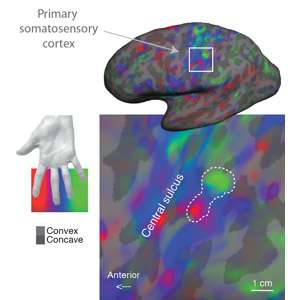
The map, uncovered by scientists at UCL, is the first to reveal how finely-tuned the is to pain. Published today in the , the study uses fMRI techniques in conjunction with laser stimuli to the fingers to plot the exact response to pain across areas of the brain.

"The results reveal that pain can be finely mapped in the brain," said lead author Dr Flavia Mancini (UCL Institute of ). "While many studies have examined the to pain before, our study is the first to map pain responses for the individual digits of the human hand."

Using an fMRI brain imaging technique originally created to map the visual field, the researchers were able to distinguish the brain's responses to painful laser heat on each finger in seven healthy participants, and to study their organisation in the brain. 

This enabled the team to produce a fine-grained map showing how pain in the right hand results in certain being activated in the primary somatosensory cortex, an area in the left hemisphere of the brain which is involved in processing bodily information. 

When comparing this pain map to ones generated by non-painful touch to the right hand, the researchers found that the two were very similar, with each map aligning with one another in each of the seven volunteers tested.

"The cells in the skin that respond to pain and the cells that respond to touch have very different structures and distributions, so we were surprised to find that the maps of pain and of touch were so similar in the brain," said Dr Mancini. "The striking alignment of pain and touch maps suggests powerful interactions between the two systems."

The pain maps could be used to provide markers for the location of pain in the human brain, enabling clinicians to see how patients' brains reorganise following

"We know that the organisation of other sensory maps in the brain is altered in patients with chronic pain," said Professor Patrick Haggard (UCL Institute of Cognitive Neuroscience). "Our method could next be used to track the reorganisation of brain maps that occurs in chronic pain, providing new insights into how the brain makes us feel pain. Therefore, measuring the map for pain itself is highly important."

Journal reference: Journal of Neuroscience search and more info website

Provided by University College London search and more info website

5 /5 (6 votes)  

Filter


Move the slider to adjust rank threshold, so that you can hide some of the comments.


Display comments: newest first

Tausch
Nov 29, 2012

Rank: not rated yet
The use of the word 'map' to label 'interactions' of 'systems' is a good analogy.
A dynamic map where what remains static are the exceptions.
Rank 5 /5 (6 votes)
Relevant PhysicsForums posts

More news stories

New neuron formation could increase capacity for new learning, at the expense of old memories

New research presented today shows that formation of new neurons in the hippocampus - a brain region known for its importance in learning and remembering - could cause forgetting of old memories by causing a reorganization ...

Neuroscience created 7 hours ago | popularity 3.7 / 5 (3) | comments 0

Help at hand for people with schizophrenia

How can healthy people who hear voices help schizophrenics? Finding the answer for this is at the centre of research conducted at the University of Bergen.

Neuroscience created 8 hours ago | popularity 4 / 5 (2) | comments 2

Japanese research organizations contribute to Human Brain Project

One of the major frontiers of modern science is a comprehensive understanding of the human brain and its functions to guide the development of new technologies in information and communication. In a major announcement for ...

Neuroscience created 8 hours ago | popularity 1 / 5 (1) | comments 0

Controlling mood through the motions of mitochondria

(Medical Xpress)—Regulating the distribution of power in neurons is done by a system that makes the national electric grid look simple by comparison. Each neuron has several thousand mitochondria confined ...

Neuroscience created 23 hours ago | popularity 4.9 / 5 (9) | comments 0 | with audio podcast report

Brain uses internal 'average voice' prototype to identify who is talking

(Medical Xpress)—The human brain is able to identify individuals' voices by comparing them against an internal 'average voice' prototype, according to neuroscientists.

Neuroscience created May 23, 2013 | popularity 3 / 5 (2) | comments 3 | with audio podcast


Engineered cytomegalovirus protects monkeys from HIV equivalent

(Medical Xpress)—A new study by researchers in the US has shown that an ancient virus can be modified to help in the fight against the simian immunodeficiency virus SIV, which is the equivalent in monkeys ...

Researchers identify first drug targets in childhood genetic tumor disorder

Two mutations central to the development of infantile myofibromatosis (IM)—a disorder characterized by multiple tumors involving the skin, bone, and soft tissue—may provide new therapeutic targets, according to researchers ...

Hormone levels may provide key to understanding psychological disorders in women

Women at a particular stage in their monthly menstrual cycle may be more vulnerable to some of the psychological side-effects associated with stressful experiences, according to a study from UCL.

Going live: Immune cell activation in multiple sclerosis

Biological processes are generally based on events at the molecular and cellular level. To understand what happens in the course of infections, diseases or normal bodily functions, scientists would need to ...

Driving and hands-free talking lead to spike in errors, study shows

Talking on a hands-free device while behind the wheel can lead to a sharp increase in errors that could imperil other drivers on the road, according to new research from the University of Alberta.

Depression raises diabetics' risk of severe low blood sugar episodes

(Medical Xpress)—Patients with diabetes who are depressed are much more likely to develop episodes of dangerously low blood sugars, or hypoglycemia, than are those who are not depressed, a new study has ...