Targeting protein could prevent metastasis of cancer cells
November 14, 2012 in Cancer

Targeting protein could prevent spread of cancer cells

(Medical Xpress)—Researchers at King's College London have uncovered a protein required by cancer cells to spread to other parts of the body, highlighting it as a potential target for future treatments to prevent secondary cancers (metastases).

Funded by Cancer Research UK, and published in the , the study looked at how cancer cells form new tumours in other parts of the body. Most cancer deaths are due to cancer metastasis which develops most commonly in the lungs, bones or liver, yet there are very few treatments designed to prevent this from happening.

The team have shown for the first time that a protein found inside cancer cells, called Cdc42, plays a role in enabling cells to physically attach themselves to so they can spread to other parts of the body through the blood.

This video is not supported by your browser at this time.

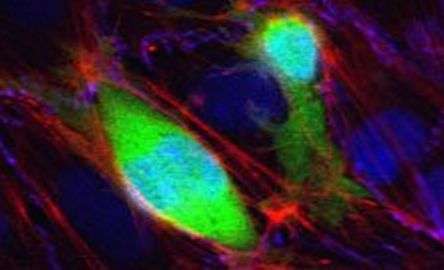
The video shows prostate cancer cells where Cdc42 levels have been reduced (green), preventing them from attaching to endothelial cells (which line blood vessel walls). The normal prostate cancer cells (blue) are still able to attach.

Looking at human prostate and , as well as cancer cells in mice, the team found that Cdc42 affects the amount of another protein on the surface of cancer cells called β1 integrin. By inhibiting Cdc42 or β1 integrin, the cells could not attach themselves to , which line blood vessels.

Professor Anne Ridley from King's College London, who led the study, said: 'This finding adds to our understanding of how cancer spreads from one part of the body to another.

'Now we have identified a key protein involved in how cells attach themselves to blood vessels, it could lead to the design of new treatments in the future to reduce (secondary cancers). It's a long way off, but in theory it could one day be possible to deliver an inhibitor directly into the blood to block cancer cells from attaching to cell walls, or to help detach those already attached, reducing the chance of tumours developing elsewhere.

'Most people who die of cancer die from metastases, as unfortunately they can be treated but not cured. This could be a very significant development in the fight against cancer.'

Dr Julie Sharp, Cancer Research UK's senior science information manager, said: 'Cancer spread is one of the biggest challenges our scientists are trying to tackle – understanding more about the molecules that allow cancer to move around the body will help researchers to find new ways to tackle this problem with the aim of saving many more lives in the future.'

Journal reference: Journal of Cell Biology search and more info website

Provided by King's College London search and more info website

5 /5 (1 vote)  

Rank 5 /5 (1 vote)
Relevant PhysicsForums posts

More news stories

American cancer society celebrates 100 years of progress

(HealthDay)—The American Cancer Society, which is celebrating on Wednesday a century of fighting a disease once viewed as a death sentence, is making a pledge to put itself out of business.

Cancer created 47 minutes ago | popularity not rated yet | comments 0

CT detects twice as many lung cancers as X-ray at initial screening exam

National Lung Screening Trial (NLST) investigators also conclude that the 20 percent reduction in lung cancer mortality with low-dose computed tomography (LDCT) versus chest X-ray (CXR) screening previously reported in the ...

Cancer created 1 hour ago | popularity not rated yet | comments 0

Research offers promising new approach to treatment of lung cancer

Researchers have developed a new drug delivery system that allows inhalation of chemotherapeutic drugs to help treat lung cancer, and in laboratory and animal tests it appears to reduce the systemic damage ...

Cancer created 4 hours ago | popularity not rated yet | comments 0 | with audio podcast

Study details genes that control whether tumors adapt or die when faced with p53 activating drugs

When turned on, the gene p53 turns off cancer. However, when existing drugs boost p53, only a few tumors die – the rest resist the challenge. A study published in the journal Cell Reports shows how: tumors that live even i ...

Cancer created 4 hours ago | popularity not rated yet | comments 0 | with audio podcast

Small increase in cancer risk following CT scans in childhood and adolescence

Study leader, Professor John Mathews from the University of Melbourne said this small increase in cancer risk must be weighed against the undoubted benefits from CT scans in diagnosing and monitoring disease.

Cancer created 8 hours ago | popularity not rated yet | comments 0


Systematic screening of med adherence will ID barriers

(HealthDay)—Implementation of systematic monitoring for medication adherence will allow for identification of barriers to adherence and tailoring of interventions, according to a viewpoint piece published ...

FDA panel backs experimental Merck insomnia drug

(AP)—A federal panel of medical experts says that an experimental insomnia drug from Merck & Co Inc. appears safe and effective, despite evidence from company trials that the pill can cause daytime sleepiness and difficulty ...

Having both migraines, depression may mean smaller brain

(HealthDay)—Migraines and depression can each cause a great deal of suffering, but new research indicates the combination of the two may be linked to something else entirely—a smaller brain.

Brain can be trained in compassion, study shows

Until now, little was scientifically known about the human potential to cultivate compassion—the emotional state of caring for people who are suffering in a way that motivates altruistic behavior.

Swine flu pandemic of 2009 more deadly for younger adults, study finds

As the world prepares for what may be the next pandemic strain of influenza virus, in the H7N9 bird flu, a new UC Irvine study reveals that the 2009 H1N1 swine flu pandemic was deadliest for people under the age of 65, while ...

'Boys will be boys' in US, but not in Asia

A new study shows there is a gender gap when it comes to behavior and self-control in American young children – one that does not appear to exist in children in Asia.