New study brings long-sought vaccines for deadly parasite closer to reality
December 13, 2012 in Immunology

New study brings long-sought vaccines for deadly parasite closer to reality

Enlarge

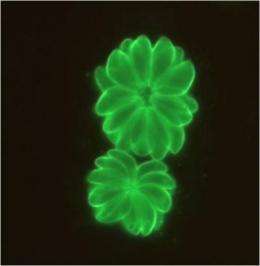
This is an image of T. gondii. Credit: Sankar Ghosh

One major cause of illness from food-borne diseases is the parasite Toxoplasma gondii (T. gondii). New insights into how the immune system combats T. gondii are provided in a study published by Cell Press December 13th in the journal Immunity. The findings could lead to the development of long-sought vaccines to protect against T. gondii and related parasites.

To fight off pathogens, the immune system relies on Toll-like receptors (TLRs)—a class of proteins that recognize and activate immune responses. The important role of TLR11 in recognizing the T. gondii infection was previously demonstrated by a team led by Sankar Ghosh of Columbia University and Alan Sher of the National Institute of Allergy and . But scientists had not yet identified any TLRs—including TLR11—that could promote survival in infected animals.

In the new study, Ghosh, Sher, and their collaborators focused on the previously uncharacterized TLR12 because it is closely related to TLR11 and physically interacts with that receptor, suggesting that the two might work together to mount immune responses. When they genetically engineered mice to lack TLR12, they found that could not recognize or protect against T. gondii, and these mice quickly succumbed to infection. Although both TLR11 and TLR12 activate overlapping immune responses to T. gondii in certain types of cells, TLR12 also triggers responses in a distinct set of immune cells to promote survival.

This video is not supported by your browser at this time.

This shows Toxoplasma gondii tachyzoites egressing from an infected fibroblast and invading new cells. Credit: Dr. Gustavo Arrizabalaga

"Prior to this study, TLR12 had no known function in the immune system, and it was not known what pathogen this receptor recognized," Ghosh says. "We have demonstrated that TLR12 is essential for resistance to T. gondii in mice."

Because TLR12 also recognized another related parasite, the findings could have broad . "By investigating how immune cells expressing TLR12 organize the against T. gondii infection, we hope to identify new means of promoting protective immune responses against T. gondii and potentially other important parasite pathogens," Ghosh says.

More information: Koblansky et al.: "Recognition of profilin by toll-like receptor 12 is critical for host resistance to Toxoplasma gondii." DOI: 10.1016/j.immuni.2012.09.016

Journal reference: Immunity search and more info website

Provided by Cell Press search and more info website

5 /5 (3 votes)  

Rank 5 /5 (3 votes)
Related Stories
Relevant PhysicsForums posts

More news stories

Stem-cell-based strategy boosts immune system in mice

Raising hopes for cell-based therapies, UC San Francisco researchers have created the first functioning human thymus tissue from embryonic stem cells in the laboratory. The researchers showed that, in mice, ...

Immunology created May 16, 2013 | popularity 4.8 / 5 (5) | comments 0 | with audio podcast

Resistance to visceral leishmaniasis: New mechanisms involved

Researchers from CNRS, Université Toulouse III - Paul Sabatier and IRD have elucidated new molecular mechanisms involved in resistance to visceral leishmaniasis, a serious parasitic infection. They have shown that dectin-1 ...

Immunology created May 16, 2013 | popularity not rated yet | comments 0

Women's immune systems remain younger for longer

Women's immune systems age more slowly than men's, suggests research in BioMed Central's open access journal Immunity & Ageing. The slower decline in a woman's immune system may contribute to women living longer than men. ...

Immunology created May 14, 2013 | popularity not rated yet | comments 0

Newly described type of immune cell and T cells share similar path to maturity, according to new study

(Medical Xpress)—Labs around the world, and a core group at Penn, have been studying recently described populations of immune cells called innate lymphoid cells (ILCs). Some researchers liken them to foot soldiers that ...

Immunology created May 14, 2013 | popularity 5 / 5 (3) | comments 0 | with audio podcast

Not all cytokine-producing cells start out the same way, study finds

(Medical Xpress)—Cytokines are molecules produced by immune cells that induce the migration of other cells to sites of infection or injury, promote the production of anti-microbial agents, and signal the production of inflammatory ...

Immunology created May 13, 2013 | popularity 5 / 5 (1) | comments 0 | with audio podcast


AIDS science at 30: 'Cure' now part of lexicon

Big names in medicine are set to give an upbeat assessment of the war on AIDS on Tuesday, 30 years after French researchers identified the virus that causes the disease.

Temporal processing in the olfactory system

The neural machinery underlying our olfactory sense continues to be an enigma for neuroscience. A recent review in Neuron seeks to expand traditional ideas about how neurons in the olfactory bulb might encode information about ...

Melon focus headband turns to Kickstarter for rollout plans

(Medical Xpress)—What if the quality of your work depends more on your focus on the piano keys or canvas or laptop than your musical or painting or computing skills? If target users can be convinced, they ...

For combat veterans suffering from post-traumatic stress disorder, 'fear circuitry' in the brain never rests

Chronic trauma can inflict lasting damage to brain regions associated with fear and anxiety. Previous imaging studies of people with post-traumatic stress disorder, or PTSD, have shown that these brain regions can over-or ...

Now we know why old scizophrenia medicine works on antibiotics-resistant bacteria

In 2008 researchers from the University of Southern Denmark showed that the drug thioridazine, which has previously been used to treat schizophrenia, is also a powerful weapon against antibiotic-resistant bacteria such as ...

Study identifies new approach to improving treatment for MS and other conditions

(Medical Xpress)—Working with lab mice models of multiple sclerosis (MS), UC Davis scientists have detected a novel molecular target for the design of drugs that could be safer and more effective than current FDA-approved ...