Protein creates paths for growing nerve cells
December 19, 2012 in Neuroscience
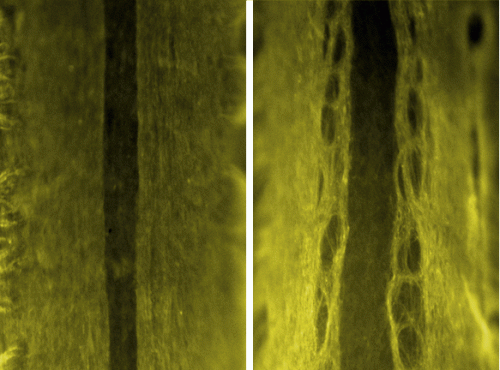
This shows neatly organized axons traveling up and down the spinal cord of a healthy, embryonic mouse (left). Axons in mice without dystroglycan (right) are tangled and disorganized. Credit: Kevin Wright
Working with mice, Johns Hopkins scientists have discovered that a particular protein helps nerve cells extend themselves along the spinal cord during mammalian development. Their results shed light on the subset of muscular dystrophies that result from mutations in the gene that holds the code for the protein, called dystroglycan, and also show how the nerve and muscle failings of the degenerative diseases are related.
As mammals like mice and humans develop, nerve cells in the brain and spinal cord must form connections with themselves and with muscles to assure proper control of movement. Nerve cells sometimes extend the whole length of the spinal cord to connect sensory nerves bearing information, for example, from the legs to the brain. To do so, nerve cells anchor their "headquarters," or cell bodies, in one location, and then extend a long, thin projection all the way to their target locations. These projections, or axons, can be 10,000 times longer than the cell body.
In a report published in the journal Neuron on Dec. 6, the authors suggest that, during fetal development, axons extend themselves along specific pathways created by dystroglycan.
"Dystroglycan creates a path and then binds other molecules that act as traffic signs, providing directional cues for axons en route to their targets," says David Ginty, Ph.D., a Howard Hughes investigator and professor of neuroscience in the Institute for Basic Biomedical Sciences at the Johns Hopkins University School of Medicine."
To find new genes associated with axon migration, Kevin Wright, Ph.D., a postdoctoral fellow in Ginty's laboratory, chemically provoked random genetic changes throughout the genomes of mice and then examined their axons for defective organization. What stood out were mutations in two genes that resulted in axon growth patterns similar to those in mice lacking the protein Slit, which is known to provide directional cues for nerve axons.
Digging deeper, Wright found that the mutated genes encode for the proteins B3gnt1 and ISPD, both of which had recently been implicated in adding sugar molecules to dystroglycan. Sugars bound to proteins often control their activity, so B3gnt1 and ISPD led the team to focus on dystroglycan as the key to the axon flaws they saw.
Through a series of genetic and biochemical experiments, the scientists learned that B3gnt1 and ISPD are indeed required for dystroglycan to work properly. Dystroglycan is made and released by specific cells within the spinal cord. It acts as a hub for tethering instructional molecules, like Slit, that guide nerve axons as they grow. But before dystroglycan can bind the instructional molecules, B3gnt1 and ISPD must attach sugars to it.
As expected, mice with defective dystroglycan usually have symptoms similar to mice with defective B3gnt1, ISPD or Slit. Moreover, the development of their muscles and nerves is severely disturbed, and the animals die soon after birth. Mouse fetuses completely missing any of the four proteins usually die before they are born.
Without dystroglycan or its helpers, the axons don't know where to go and the connection between nerve cells is lost, Ginty says. "Dystroglycan creates the road, B3gnt1 and ISPD add tar on top, and directional molecules like Slit stick to the tar and point the axons in the right direction," he explains. "If any part of the collaboration is missing, the axons overshoot their targets or don't turn where they should."
"Many muscular dystrophies are caused by a defect specific to muscles," says Ginty. "Children with defects in dystroglycan suffer from muscle weakening and bad nerve connections. Now we have mice with similar symptoms that we can study further."
More information: www.cell.com/neuro… 3(12)00899-9
Journal reference:
Neuron
Provided by
Johns Hopkins University School of Medicine
-
Researchers identify new form of muscular dystrophy
Mar 09, 2011 |
not rated yet |
0
-
Biologists discover genes that repair nerves after injury
Sep 21, 2011 |
not rated yet |
0
-
Rare muscular dystrophy gene mutations discovered
Apr 24, 2012 |
not rated yet |
0
-
Study reveals enzyme function, could help find muscular dystrophy therapies
Jan 09, 2012 |
not rated yet |
0
-
Unusual protein modification involved in muscular dystrophy, cancer
Dec 31, 2009 |
not rated yet |
0
-
Motion perception revisited: High Phi effect challenges established motion perception assumptions
Apr 23, 2013 |
3 / 5 (2) |
2
-
Anything you can do I can do better: Neuromolecular foundations of the superiority illusion (Update)
Apr 02, 2013 |
4.5 / 5 (11) |
5
-
The visual system as economist: Neural resource allocation in visual adaptation
Mar 30, 2013 |
5 / 5 (2) |
9
-
Separate lives: Neuronal and organismal lifespans decoupled
Mar 27, 2013 |
4.9 / 5 (8) |
0
-
Sizing things up: The evolutionary neurobiology of scale invariance
Feb 28, 2013 |
4.8 / 5 (10) |
14
-
Pressure-volume curve: Elastic Recoil Pressure don't make sense
16 hours ago
-
If you became brain-dead, would you want them to pull the plug?
May 17, 2013
-
MRI bill question
May 15, 2013
-
Ratio of Hydrogen of Oxygen in Dessicated Animal Protein
May 13, 2013
-
Alcohol and acetaminophen
May 13, 2013
-
Marie Curie's leukemia
May 13, 2013
- More from Physics Forums - Medical Sciences
More news stories
For combat veterans suffering from post-traumatic stress disorder, 'fear circuitry' in the brain never rests
Chronic trauma can inflict lasting damage to brain regions associated with fear and anxiety. Previous imaging studies of people with post-traumatic stress disorder, or PTSD, have shown that these brain regions can over-or ...
Neuroscience
19 hours ago |
5 / 5 (1) |
0
|
Temporal processing in the olfactory system
The neural machinery underlying our olfactory sense continues to be an enigma for neuroscience. A recent review in Neuron seeks to expand traditional ideas about how neurons in the olfactory bulb might encode information about ...
Neuroscience
May 17, 2013 |
not rated yet |
0
|
Melon focus headband turns to Kickstarter for rollout plans
(Medical Xpress)—What if the quality of your work depends more on your focus on the piano keys or canvas or laptop than your musical or painting or computing skills? If target users can be convinced, they ...
Neuroscience
May 17, 2013 |
3.7 / 5 (3) |
0
|
Deep brain stimulation: A fix when the drugs don't work
Neurological disorders can have a devastating impact on the lives of sufferers and their families.
Neuroscience
May 17, 2013 |
5 / 5 (1) |
0
|
Brain makes call on which ear is used for cell phone
If you're a left-brain thinker, chances are you use your right hand to hold your cell phone up to your right ear, according to a newly published study from Henry Ford Hospital in Detroit.
Neuroscience
May 16, 2013 |
2 / 5 (2) |
0
|
New research identifies risks, interventions for children's GI health
An increasing number of U.S. children are experiencing gastrointestinal issues that require interventions to resolve, according to research presented at Digestive Disease Week (DDW).
US psychiatry gets makeover in new manual
The latest makeover to a massive psychiatric tome honored by some, reviled by others and even called the "Bible" of mental disorders is being released Saturday with a host of new changes.
New case of SARS-like virus in Saudi: ministry
A new case of the deadly coronavirus has been detected in Saudi Arabia where 15 people have already died after contracting it, the health ministry announced on Saturday on its Internet website.
AIDS science at 30: 'Cure' now part of lexicon
Big names in medicine are set to give an upbeat assessment of the war on AIDS on Tuesday, 30 years after French researchers identified the virus that causes the disease.
New colonoscope provides ground-breaking view of colon
A ground-breaking advance in colonoscopy technology signals the future of colorectal care, according to research presented today at Digestive Disease Week(DDW). Additional research focuses on optimizing the minimal withdrawal ...
Flesh-eating disease victim gets prosthetic hands
(AP)—A woman who lost both hands, her left leg and right foot after contracting a flesh-eating disease has been fitted with prosthetic hands.