Strength training improves vascular function in young black men
December 21, 2012 in Cardiology
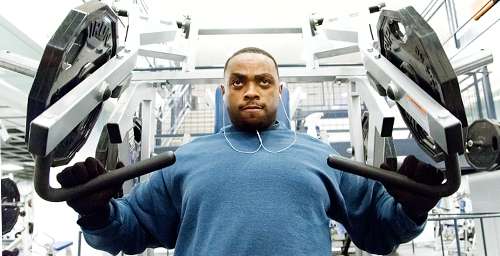
University of Illinois graduate student Marc Cook and his colleagues found that young African American men experienced some cardiovascular benefits from weight training that Caucasian men of the same age did not. Credit: L. Brian Stauffer
Six weeks of weight training can significantly improve blood markers of cardiovascular health in young African-American men, researchers report in the Journal of Human Hypertension.
The researchers measured blood markers associated with inflammation, immune response or the remodeling of arteries that normally occur after tissue damage, infection or other types of stress. They found that levels of two of these markers dropped significantly in African-American men but not in Caucasian men after six weeks of resistance training.
"This suggests that resistance exercise training is more beneficial in young African-American men than in Caucasian men of the same age," said Bo Fernhall, the dean of the College of Applied Health Sciences at the University of Illinois at Chicago. Fernhall led the study as a professor in the department of kinesiology and community health at the Urbana-Champaign campus. The 14 African-American and 18 Caucasian study subjects were matched for body mass index, cardiovascular fitness and age. None had previously been trained in endurance or resistance exercise.
African-Americans are known to have higher rates of cardiovascular disease than Caucasians, Fernhall said. In particular, "hypertension, stroke and kidney disease are much, much higher in the African-American population," he said.
Some of these problems start young.
"Higher blood pressures in African-American children have been shown as young as 8 to 10 years of age," Fernhall said. "So there's obviously something going on that predisposes the African-American population to end stage disease, hypertension and stroke and the more debilitating diseases later on in life."
A previous study led by Fernhall and his doctoral student Kevin Heffernan (an author on the new paper as well) found that resistance training reduced levels of C-reactive protein (CRP) in the blood of African-American, but not Caucasian, men. This protein is a reliable marker of systemic inflammation. Levels of CRP rise after injury or infection, and chronically elevated levels are sometimes associated with heart disease and cancer.
The new study looked at other markers that could signal trouble in the arteries: MMPs, which help remodel blood vessels after injury or infection; and 8-isoprostane, a marker of oxidative stress involving chemically charged ions or molecules called reactive oxygen species. Both markers went down in the African-Americans, but not the Caucasians, after resistance training.
The researchers were surprised to see that initial levels of MMP-9 were lower in African-Americans before the weight training.
"It may be that MMP-9 has a different effect on the vasculature of African-Americans than it does on Caucasians," said Illinois doctoral student Marc Cook, who conducted the new analysis. "We don't know."
The decrease in MMP-9 was significantly correlated with the increase in muscle strength in the African-American men, Cook said. He sees the reduction in MMP-9s and 8-isoprostane as a positive outcome in the African-American men.
Previous studies showed that "aerobic exercise actually reduces oxidative stress, and reduces iosprostane," Cook said. "But nobody had a clue about resistance training."
Cook said he now knows what to say to African-American men who ask him why they should exercise.
"If you don't like cardiovascular exercise, if you don't like running on a treadmill, if you can't play basketball or you're not good at it, you can lift weights and improve your health, especially when it comes to high blood pressure, which happens to run in our family," he said. "If you just want to lift weights and you do it on a regular basis, you could improve your function."
"The overall goal of our departmental research here at the U. of I. is to explore the use of exercise as adjunct therapy for disease, while providing a public health message and evidence about how exercise is beneficial, even at an early age," said Illinois kinesiology and community health professor Jeffrey Woods, a co-author on the study.
More information: The paper, "Effect of Resistance Training on Biomarkers of Vascular Function and Oxidative Stress in Young African American and Caucasian Men," is available online: www.nature.com/jhh… 201248a.html
Provided by
University of Illinois at Urbana-Champaign
-
Hypertension develops early, silently, in African-American men
Nov 17, 2008 |
not rated yet |
0
-
Differences in cell response could explain higher rates of hypertension in African-Americans
Aug 29, 2011 |
not rated yet |
0
-
PSA levels accurately predict prostate cancer risk in African-American men
Feb 24, 2009 |
not rated yet |
0
-
Genetic risk factors may tailor prostate cancer screening approaches
Nov 17, 2008 |
not rated yet |
0
-
African-Americans more likely to donate kidney to family member
Oct 18, 2011 |
not rated yet |
0
-
Motion perception revisited: High Phi effect challenges established motion perception assumptions
Apr 23, 2013 |
3 / 5 (2) |
2
-
Anything you can do I can do better: Neuromolecular foundations of the superiority illusion (Update)
Apr 02, 2013 |
4.5 / 5 (11) |
5
-
The visual system as economist: Neural resource allocation in visual adaptation
Mar 30, 2013 |
5 / 5 (2) |
9
-
Separate lives: Neuronal and organismal lifespans decoupled
Mar 27, 2013 |
4.9 / 5 (8) |
0
-
Sizing things up: The evolutionary neurobiology of scale invariance
Feb 28, 2013 |
4.8 / 5 (10) |
14
-
Image of a Convex Lens Cut in Half Horizontally
2 hours ago
-
Ray tracing throught optical system of thick lenses
2 hours ago
-
Faraday's law on circular wire
3 hours ago
-
Specific Exergy vs Specific Flow Exergy
4 hours ago
-
The Durability of Bone: Long Falls
13 hours ago
-
Is energy convertible to matter?
14 hours ago
- More from Physics Forums - Classical Physics
More news stories
New blood-thinner measures may cut medication errors
Blood thinners are the preferred treatment option to prevent heart attacks, blood clots and stroke, but they are not without risk, and not just because of their side effects. These high-risk drugs, known as anticoagulants, ...
Cardiology
1 hour ago |
not rated yet |
0
Registry questions superiority of bivalirudin over heparin
Results from a large observational study reported at EuroPCR 2013 today question whether bivalirudin is superior to heparin in the absence of GPIIb/IIIa blockade, showing similar 30-day mortality in patients with non-ST segment ...
Cardiology
1 hour ago |
not rated yet |
0
Study shows low rate of late lumen loss with bioresorbable DESolve device
The DESolve bioresorbable coronary scaffold system achieves good efficacy and safety with low rates of late lumen loss and major coronary adverse events at six months, show first results from the pivotal DESolve Nx trial ...
Cardiology
1 hour ago |
not rated yet |
0
Biodegradable stent proves non-inferior to drug-eluting stent
The Orsiro stent, which is a novel stent platform eluting sirolimus from a biodegradable polymer, demonstrated non-inferiority to the Xience Prime everolimus-eluting stent for the primary angiographic endpoint of in-stent ...
Cardiology
17 hours ago |
5 / 5 (1) |
0
Post-approval TAVI registry shows high rates of device success at one year
One-year results from SOURCE XT – one of the largest, post-approval transcatheter aortic valve implantation (TAVI) registries to-date – reported today at EuroPCR 2013 show good clinical outcomes in routine clinical practice, ...
Cardiology
17 hours ago |
not rated yet |
0
Study finds new pneumococcal vaccine appears to be as safe as previously used vaccine
The new 13-valent pneumococcal conjugate vaccine (PCV13) appears to be as safe as the previous version used prior to 2010, the 7-valent pneumococcal conjugate vaccine (PCV7), according to a Kaiser Permanente study published ...
Addiction to unhealthy foods could help explain the global obesity epidemic
Research presented today shows that high-fructose corn syrup can cause behavioural reactions in rats similar to those produced by drugs of abuse such as cocaine. These results, presented by addiction expert Francesco Leri, ...
Study says empathy plays a key role in moral judgments
Is it permissible to harm one to save many? Those who tend to say "yes" when faced with this classic dilemma are likely to be deficient in a specific kind of empathy, according to a report published in the scientific journal ...
A molecular explanation for age-related fertility decline in women
(Medical Xpress)—Scientists supported by the National Institutes of Health have a new theory as to why a woman's fertility declines after her mid-30s. They also suggest an approach that might help slow ...
If you can remember it, you can remember it wrong
(Medical Xpress)—Native peoples in regions where cameras are uncommon sometimes react with caution when their picture is taken. The fear that something must have been stolen from them to create the photo ...
Phthalates: Study links chemicals widely found in plastics, processed food to elevated blood pressure in children, teens
Plastic additives known as phthalates (pronounced THAL-ates) are odorless, colorless and just about everywhere: They turn up in flooring, plastic cups, beach balls, plastic wrap, intravenous tubing and—according to the ...