Cerebral malaria: Pinpointing a potential therapeutic target
January 16, 2013 in Immunology
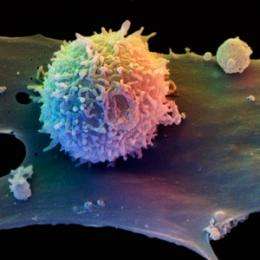
Dendritic cells from human blood are integral parts of the immune system. Credit: David Scharf/Science Faction/Corbis
An excessive response of the immune system to malarial infection can lead to serious complications, such as cerebral malaria. While the mechanism causing the onset of cerebral malaria is unclear, immunologists think that contributing factors include cells of the immune system and the inflammation that they cause. Laurent Renia and co-workers at the A*STAR Singapore Immunology Network and collaborators from Nanyang Technological University, Singapore, have now singled out one subtype of immune cells that is key to the onset of this often fatal disease.
The researchers used an established mouse model of the disease, called experimental cerebral malaria (ECM). Accumulation of CD8+ T cells, immune cells that destroy infected or damaged cells, is one known contributing factor in this model. Dendritic cells (see image), another type of immune cell, are important in activating certain types of T cells and are also known to be involved in experimental cerebral malaria.
"Dendritic cells are essential for the development of the immune response in particular T cells," explains Renia. "These cells express different markers and are present in many tissues like the spleen. It was previously shown that splenic dendritic cells are important for ECM to develop."
In the earlier work, dendritic cells were modified so that they could be selectively destroyed. A marker that all dendritic cells express, called CD11c, was targeted with a diphtheria toxin receptor, allowing them to be killed using this toxin. The targeted destruction of dendritic cells prevented experimental cerebral malaria. However, this method did not discriminate between the several subtypes of dendritic cells that express CD11c, so the exact dendritic cell type responsible remained elusive.
Renia and his co-workers used a similar approach in this study, but targeted a marker called Clec9A with the diphtheria toxin receptor. Clec9A is expressed by one subtype of dendritic cells only. The subtype, called CD11chighCD8+, is a candidate in experimental cerebral malaria because its cells are involved in activating CD8+ T cells.
Destroying the CD11chighCD8+ cells provided mice with complete protection from experimental cerebral malaria. Renia and co-workers also showed that without these cells, fewer CD8+ T cells were activated in the spleen and fewer were found in the brain. "Our findings show that these dendritic cells are essential to CD8+ T cell development and thus to experimental cerebral malaria," says Renia.
Although this work was done in an artificial model of the disease in mice, Renia notes that it provides a starting point in overcoming the disease in people.
More information: Piva, L., et al. Clec9A+ dendritic cells mediate the development of experimental cerebral malaria. The Journal of Immunology 189, 1128–1132 (2012). www.jimmunol.org/c… unol.1201171
Journal reference:
Journal of Immunology
Provided by
Agency for Science, Technology and Research (A*STAR), Singapore
-
Discovery of immune cells that protect against multiple sclerosis offers hope for new treatment
Aug 16, 2012 |
not rated yet |
0
-
How excess alcohol depresses immune function
Aug 16, 2011 |
not rated yet |
0
-
Dendritic cells as a new player in arteries and heart valves
Feb 17, 2009 |
not rated yet |
0
-
Breakthrough in malaria research looks to body's immune cells
Nov 25, 2011 |
not rated yet |
0
-
Skin sentry cells promote distinct immune responses
Jul 21, 2011 |
not rated yet |
0
-
Motion perception revisited: High Phi effect challenges established motion perception assumptions
Apr 23, 2013 |
3 / 5 (2) |
2
-
Anything you can do I can do better: Neuromolecular foundations of the superiority illusion (Update)
Apr 02, 2013 |
4.5 / 5 (11) |
5
-
The visual system as economist: Neural resource allocation in visual adaptation
Mar 30, 2013 |
5 / 5 (2) |
9
-
Separate lives: Neuronal and organismal lifespans decoupled
Mar 27, 2013 |
4.9 / 5 (8) |
0
-
Sizing things up: The evolutionary neurobiology of scale invariance
Feb 28, 2013 |
4.8 / 5 (10) |
14
-
Bubbles in a Pre-Boiling/Boiling pot of water
1 hour ago
-
Assumptions of Griffith's fracture theory
11 hours ago
-
Current leading voltage or vice versa concept
13 hours ago
-
Angular Frequency of AC voltage
16 hours ago
-
Modeling Rigid Body - Unsure about Euler angles and angular velocity
16 hours ago
-
Function for a bullet's path
18 hours ago
- More from Physics Forums - Classical Physics
More news stories
New immune system discovered
(Medical Xpress)—A research team, led by Jeremy Barr, a biology post-doctoral fellow, unveils a new immune system that protects humans and animals from infection.
Immunology
19 hours ago |
4.7 / 5 (18) |
8
|
Vitamin D could provide new and effective treatments for asthma
(Medical Xpress)—Scientists at King's College London have discovered that Vitamin D has the potential to significantly reduce the symptoms of asthma. The study, led by Professor Catherine Hawrylowicz from ...
Immunology
May 20, 2013 |
5 / 5 (1) |
0
|
Immune protein could stop diabetes in its tracks
Melbourne researchers have identified an immune protein that has the potential to stop or reverse the development of type 1 diabetes in its early stages, before insulin-producing cells have been destroyed.
Immunology
May 20, 2013 |
5 / 5 (5) |
0
|
Stem-cell-based strategy boosts immune system in mice
Raising hopes for cell-based therapies, UC San Francisco researchers have created the first functioning human thymus tissue from embryonic stem cells in the laboratory. The researchers showed that, in mice, ...
Immunology
May 16, 2013 |
4.8 / 5 (5) |
0
|
Resistance to visceral leishmaniasis: New mechanisms involved
Researchers from CNRS, Université Toulouse III - Paul Sabatier and IRD have elucidated new molecular mechanisms involved in resistance to visceral leishmaniasis, a serious parasitic infection. They have shown that dectin-1 ...
Immunology
May 16, 2013 |
not rated yet |
0
B vitamins could delay dementia
(Medical Xpress)—Despite spending billions of dollars on research and development, drug companies have been unable to come up with effective treatments for dementia and Alzheimer's Disease (AD). Now, A. ...
Enrichment therapy effective among children with autism, study finds
Children with autism showed significant improvement after six months of simple sensory exercises at home using everyday items such as scents, spoons and sponges, according to UC Irvine neurobiologists.
Poliovirus vaccine trial shows early promise for recurrent glioblastoma
An attack on glioblastoma brain tumor cells that uses a modified poliovirus is showing encouraging results in an early study to establish the proper dose level, researchers at Duke Cancer Institute report.
'Doctor shopping' by obese patients negatively affects health
Overweight and obese patients are significantly more likely than their normal-weight counterparts to repeatedly switch primary care doctors, a practice that disrupts continuity of care and leads to more emergency room visits, ...
Decisions to forgo life support may depend heavily on the ICU where patients are treated
The decision to limit life support in patients in the intensive care unit (ICU) appears to be significantly influenced by physician practices and/or the culture of the hospital, suggests new findings from researchers at the ...
Better behavior after tonsil/adenoid surgery for kids with sleep breathing trouble?
Children with obstructive sleep apnea who had a common surgery to remove their tonsils and adenoids showed notable improvements in behavior, quality of life and other symptoms compared to those treated with "watchful waiting" ...