Placental blood flow can influence malaria during pregnancy
Malaria in pregnancy causes a range of adverse effects, including abortions, stillbirths, premature delivery and low infant birth weight. Many of these effects are thought to derive from a placental inflammatory response resulting from interaction of infected red blood cells with the placental tissue.
In a study published in the latest issue of the journal PLOS Pathogen, a researchers' team led by Carlos Penha-Gonçalves at the Instituto Gulbenkian de Ciência (IGC), Portugal, observed, for the first time, the mouse placental circulation and showed how it can influence the malaria parasite behavior and infection. Their results indicate a higher accumulation of parasites in placental regions with low blood flow, being these areas more prone to an inflammatory response.
In humans, red blood cells infected with the malaria parasite, Plasmodium falciparum, accumulate in the placenta via interaction with a molecule expressed on the placental tissue – a process called sequestration. In response to this event, placental cells secrete substances that recruit inflammatory cells leading to placental damage and negatively impacting fetal growth. Until now placental circulation has not been linked to the infected red blood cell sequestration. In fact, it is not trivial to investigate this hypothesis in human placenta, due to technical constraints
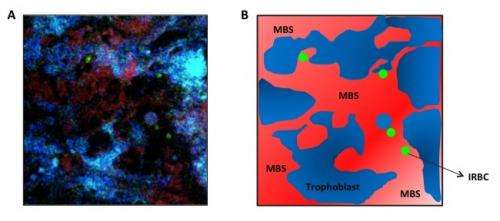
Luciana Moraes, an investigator of Carlos Penha-Gonçalves laboratory, has provided new insights to this issue by developing an experimental system that allowed the live observation of the blood flow in the mouse placenta. Mating two strains of mice, one of them with cells stained with a colorful marker, Luciana was able to identify the placental tissue (fetus origin). In collaboration with Carlos Tadokoro's laboratory at the IGC, the investigators developed a microscopy technique that allowed the observation of the placenta in a living mouse. Immediately before exposure to the microscope the mouse was injected with a fluorescent substance that labels the blood. With this set-up it was possible to distinguish maternal blood and placental tissue. The results showed for the first time how the circulation occurs in the placenta, and that the blood flows with different speeds in different regions of the placenta.
Next, the investigators infected red blood cells with the malaria parasite Plasmodium berghei, stained with a different color, and observed – live – the behavior of the parasite inside the placenta. They observed that in the areas with higher blood flow, the parasite never stops moving and does not interact with the placental tissue. The accumulation of parasite just occurs in areas of low or absence of flow. In these regions, placental macrophages engulf the infected red blood cells to attempt parasite clearance. Their observations also suggest that movements of the placental tissue may control the blood flow.
Luciana Moraes says: "Our results indicate that binding of infected red blood cells to a molecule expressed in the placenta may not be the only mechanism of parasite sequestration. The dynamics of placental circulation may also play an important role, and should be considered when designing therapeutics."
Carlos Penha-Gonçalves adds: "This is the first study done that shows live how placental blood circulation impacts on the local infection by the malaria parasite. It would be interesting and worthwhile to explore if a similar process occurs in the placenta of humans, taking in consideration that microcirculation in human placenta is quite different."
More information: de Moraes LV, Tadokoro CE, Gómez-Conde I, Olivieri DN, Penha-Gonçalves C (2013) Intravital Placenta Imaging Reveals Microcirculatory Dynamics Impact on Sequestration and Phagocytosis of Plasmodium-Infected Erythrocytes. PLoS Pathog 9(1): e1003154. doi:10.1371/journal.ppat.1003154


