Sensory hair cells regenerated, hearing restored in mammal ear
January 9, 2013 in Neuroscience

Regeneration of sound sensing cells recovers hearing in mice with noise-induced deafness

Enlarge

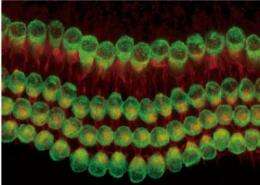
These are normal inner and outer hair cells. Credit: Neuron, Mizutari et al.

Hearing loss is a significant public health problem affecting close to 50 million people in the United States alone. Sensorineural hearing loss is the most common form and is caused by the loss of sensory hair cells in the cochlea. Hair cell loss results from a variety of factors including noise exposure, aging, toxins, infections, and certain antibiotics and anti-cancer drugs. Although hearing aids and cochlear implants can ameliorate the symptoms somewhat, there are no known treatments to restore hearing, because auditory hair cells in mammals, unlike those in birds or fish, do not regenerate once lost. Auditory hair cell replacement holds great promise as a treatment that could restore hearing after loss of hair cells.

In the Jan. 10 issue of Neuron, Massachusetts Eye and Ear and Harvard Medical School researchers demonstrate for the first time that hair cells can be regenerated in an adult mammalian ear by using a drug to stimulate resident cells to become new hair cells, resulting in partial recovery of hearing in mouse ears damaged by noise trauma. This finding holds great potential for future that may someday reverse deafness in humans.

"Hair cells are the primary for sound and are responsible for the sense of hearing," explains senior author, Dr. Albert Edge, of Harvard Medical School and Mass. Eye and Ear. "We show that hair cells can be generated in a damaged cochlea and that hair cell replacement leads to an improvement in hearing."

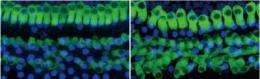
In the experiment, the researchers applied a drug to the cochlea of deaf mice. The drug had been selected for its ability to generate hair cells when added to stem cells isolated from the ear. It acted by inhibiting an enzyme called gamma-secretase that activates a number of . The drug applied to the cochlea inhibited a signal generated by a protein called Notch on the surface of cells that surround hair cells. These supporting cells turned into new hair cells upon treatment with the drug. Replacing hair cells improved hearing in the mice, and the improved hearing could be traced to the areas in which supporting cells had become new hair cells. "The missing hair cells had been replaced by new hair cells after the drug treatment, and analysis of their location allowed us to correlate the improvement in hearing to the areas where the hair cells were replaced," Dr. Edge said.
Regeneration of sound sensing cells recovers hearing in mice with noise-induced deafness
Enlarge

This image shows cochlea after damage only and after damage and replacement of hair cells. Credit: Neuron, Mizutari et al.

This is the first demonstration of hair cell regeneration in an adult mammal. "We're excited about these results because they are a step forward in the biology of regeneration and prove that mammalian hair cells have the capacity to regenerate," Dr. Edge said. "With more research, we think that regeneration of opens the door to potential therapeutic applications in deafness."

More information: "Notch Inhibition Induces Cochlear Hair Cell Regeneration and Recovery of Hearing after Acoustic Trauma." Neuron, 2013. dx.doi.org/10.1016… .2012.10.032

Journal reference: Neuron search and more info website

Provided by Massachusetts Eye and Ear Infirmary search and more info website

4.7 /5 (39 votes)  

Filter


Move the slider to adjust rank threshold, so that you can hide some of the comments.


Display comments: newest first

VendicarD
Jan 09, 2013

Rank: 3 / 5 (2)
Thank God for Government funded research.
snivvy
Jan 09, 2013

Rank: 4 / 5 (1)
Why do you think the government had anything to do with this?
nathj72
Jan 09, 2013

Rank: not rated yet
There appears to be many sources of funding. Here is the acknowledgment section from the paper.
We thank M.C. Liberman for critical comments on the manuscript. We thank
Yukiko Watada and Yumi Matsuzaki for assistance. This work was supported
by grants RO1 DC007174, R21 DC010440, and P30 DC05209 from the
National Institute on Deafness and other Communicative Disorders (NIDCD);
by the Tillotson Corporation, the Shulsky Foundation, and Robert Boucai; by
the Mochida Memorial Foundation for Medical and Pharmaceutical Research;
and by grants for International Activities in Life Sciences and Medicine, Keio
University Medical Science Fund.
Whydening Gyre
Jan 09, 2013

Rank: 1 / 5 (1)
These previous three statements define change -
1. Definitive. (from Vendicar)
2. "Yeah - but"... (from snivvy)
3. Refined definitive. (from Nathj72)

A plus (A plus Y) = (E)verything. Repeat.

MY T.O.E. I love it.
Tausch
Jan 09, 2013

Rank: 5 / 5 (3)
...analysis of their location allowed... - authors


Translates to: the resonance frequencies spatially designated by tonographic mappings of which the distributions on the basilar membrane are known.

Passive tonotopy doesn't stop there. The kino/stereo-celia's dimensions contribute to a separation of frequencies too.

It appears as if all information send to the brain is a form of spatial projection representing all the information senses provide to be processed in the brain.

Kudos to the research and researchers.
Jo01
Jan 09, 2013

Rank: 2 / 5 (4)
I wonder what kind of torture the mouse was subjected to.
Knowledge at any price?

J.
GaryB
Jan 09, 2013

Rank: 3.7 / 5 (3)
Why do you think the government had anything to do with this?


The guy who runs the group, Albert Edge has been looking into regeneration for years all supported by your coerced tax dollars! Many NIH grants to support his group. I agree that in ~10 years, some "free market" Entrepreneur will take the 50K human years of gov. supported work in this area and turn it into a product to save me and maybe you from my inherited slowly declining hearing. Go Gov!

I never even knew I had this problem and so would never have even found let alone supported his research. But here it is just waiting for me from our collective communal efforts. High fives all around and especially to Dr. Edge who keeps on pursuing this stuff (with our, now thankful, help).

Long term research, such as is now (within another 10) going to spawn a private space industry, is never worth it in a market economy. It takes a gov. Deal with it.
Jaeherys
Jan 09, 2013

Rank: 5 / 5 (3)
From the article, "Four-week-old mice were exposed free field, awake and unrestrained, in a small reverberant chamber (Wang et al., 2002). Acoustic trauma was produced by a 2 hr exposure to an 8–16 kHz octave band noise presented at 116 dB SPL."

I'm no sound expert but I imagine that would be quite painful. I glanced over the article of the team that developed the sound exposure technique as to why they were not anaesthetized but didn't really see much. I was thinking maybe it was to prevent damage to just one side of the ear (only the right ear is tested) but anyone else wager a guess?

Here's the link to that article: http://www.ncbi.n...e_28.pdf
Herbert43
Jan 09, 2013

Rank: 5 / 5 (3)
In the hearing lab I worked at the standard practice was to place essentially earbuds into the guineapigs' ears before subjecting them to 90 minutes of 110 dB sound at a variety of frequencies.

Many labs going for deafness caused by hair cell destruction treat the ears with neomycin which kills the hair cells and causes utter deafness.
Jaeherys
Jan 10, 2013

Rank: 5 / 5 (1)
@Herbert43
What is the purpose of the earbuds? I'm assuming it doesn't stop the deafness but does it help with pain? Since neomycin kills the hair cells causing deafness, what are the reasons to choose exposure to sound versus chemical treatment?
DeafScribe
Jan 10, 2013

Rank: 5 / 5 (1)
Cochlear hair cell regeneration isn't new. What I'd like to know - will hairs grown with this technique be permanent, or dependent on continued drug use to remain viable? I'm wary of being forced into a lifetime of indentured servitude to pharmaceutical firms to maintain restored hearing.
hb_
Jan 10, 2013

Rank: 5 / 5 (3)
Fantastic! Most people have deteriorating hearing with age, even if they are not technically deaf, and now there seems to be a treatment for this..! Kudos to the researchers!
TransmissionDump
Jan 13, 2013

Rank: 5 / 5 (1)
Bloody Brilliant!!

I hope this technology one day can restore my partial hearing loss. In social situations I'm retarded as I can't distinguish the sound of someone speaking to me from the buzz of background noise.
Tausch
Jan 13, 2013

Rank: 5 / 5 (1)
Ask someone who has learned lip reading if this hard to learn.
This is motion associated with sound if deafness was gradual.

More interesting this is motion associated with static symbols (numbers, letters, words, etc.) when deafness is encountered since birth.
Cave_Man
Jan 14, 2013

Rank: 5 / 5 (1)
I've got a progressive degenerative hearing loss, I'm 24 years old and have the hearing of an 80 year old. By the time I am 50 years old I will be deaf as a bat without hearing aides. I would really like to see some kind of one time treatment to make me and my whole family (it's a genetic disorder) hear again!
Whydening Gyre
Jan 15, 2013

Rank: 1 / 5 (1)
Cochlear hair cell regeneration isn't new. What I'd like to know - will hairs grown with this technique be permanent, or dependent on continued drug use to remain viable? I'm wary of being forced into a lifetime of indentured servitude to pharmaceutical firms to maintain restored hearing.

I'm certain it is subject to it's own ratio of degeneration. It is also certain there will be a point of diminishing return for each successive regeneration. Or not....
Rank 4.7 /5 (39 votes)
Relevant PhysicsForums posts

More news stories

Controlling mood through the motions of mitochondria

(Medical Xpress)—Regulating the distribution of power in neurons is done by a system that makes the national electric grid look simple by comparison. Each neuron has several thousand mitochondria confined ...

Neuroscience created 7 hours ago | popularity 4.8 / 5 (5) | comments 0 | with audio podcast report

Brain uses internal 'average voice' prototype to identify who is talking

(Medical Xpress)—The human brain is able to identify individuals' voices by comparing them against an internal 'average voice' prototype, according to neuroscientists.

Neuroscience created 11 hours ago | popularity 1 / 5 (1) | comments 0 | with audio podcast

Depression common among children with temporal lobe epilepsy

A new study determined that children and adolescents with seizures involving the temporal lobe are likely to have clinically significant behavioral problems and psychiatric illness, especially depression. Findings published ...

Neuroscience created 11 hours ago | popularity not rated yet | comments 0

The secret lives, and deaths, of neurons

As the human body fine-tunes its neurological wiring, nerve cells often must fix a faulty connection by amputating an axon—the "business end" of the neuron that sends electrical impulses to tissues or other ...

Neuroscience created 13 hours ago | popularity 5 / 5 (2) | comments 0 | with audio podcast

Regenerating spinal cord fibers may be treatment for stroke-related disabilities

A study by researchers at Henry Ford Hospital found "substantial evidence" that a regenerative process involving damaged nerve fibers in the spinal cord could hold the key to better functional recovery by most stroke victims.

Neuroscience created 13 hours ago | popularity not rated yet | comments 0 | with audio podcast


ACP issues recommendations for management of high blood glucose in hospitalized patients

High blood glucose is associated with poor outcomes in hospitalized patients, and use of intensive insulin therapy (IIT) to control hyperglycemia is a common practice in hospitals. But the recent evidence does not show a ...

Motion quotient: IQ predicted by ability to filter motion (w/ video)

A brief visual task can predict IQ, according to a new study. This surprisingly simple exercise measures the brain's unconscious ability to filter out visual movement. The study shows that individuals whose ...

Multiple research teams unable to confirm high-profile Alzheimer's study

Teams of highly respected Alzheimer's researchers failed to replicate what appeared to be breakthrough results for the treatment of this brain disease when they were published last year in the journal Science.

Scientists discover molecule triggers sensation of itch

Scientists at the National Institutes of Health report they have discovered in mouse studies that a small molecule released in the spinal cord triggers a process that is later experienced in the brain as ...

Researchers find common childhood asthma unconnected to allergens or inflammation

Little is known about why asthma develops, how it constricts the airway or why response to treatments varies between patients. Now, a team of researchers at Weill Cornell Medical College, Columbia University Medical Center ...

Diabetes' genetic underpinnings can vary based on ethnic background, studies say

Ethnic background plays a surprisingly large role in how diabetes develops on a cellular level, according to two new studies led by researchers at the Stanford University School of Medicine.